Celltrion maps long-term shift toward antibody-based drug platform
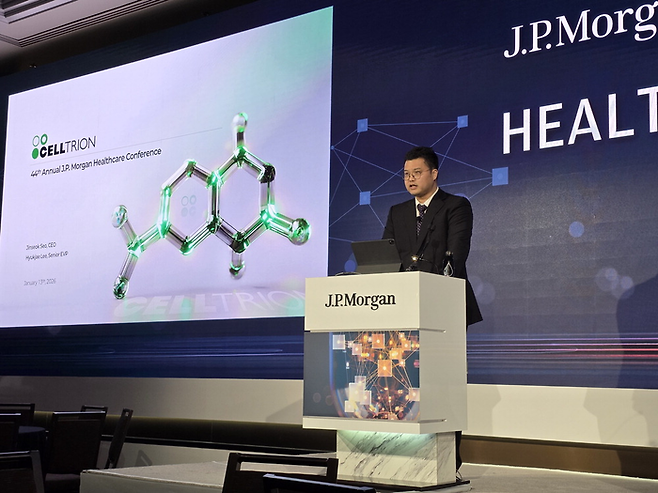
Speaking on Tuesday, local time, on the main track of the 44th J.P. Morgan Healthcare Conference in San Francisco, Celltrion Chief Executive Officer Seo Jin-seok said the company “has entered a new growth phase of building a true innovative drug platform beyond biosimilars” and aims to establish a robust innovation pipeline by submitting four to five clinical trial applications annually through 2028.
Seo outlined development roadmaps for 16 novel drug candidates, including antibody-drug conjugates, multispecific antibodies, Fc receptor (FcRn) inhibitors, and obesity treatments.
He also detailed plans for next-generation obesity treatment CT-G32, which Celltrion is developing as a quad-agonist, with a clinical trial application targeted for submission in the second half of next year.
Seo said the company is accelerating new drug development through in-house research and development and collaborations with global biotech companies, noting that it achieved 10 open innovation milestones in a single year to strengthen its global partnership network.
Senior Executive Vice President Lee Hyuk-jae presented plans to expand investment in the Branchburg manufacturing facility in New Jersey, which Celltrion acquired last year.
In December, the company purchased the antibody biologics manufacturing facility from Eli Lilly and Co. for $330 million and plans to invest more than $18 billion over the next 10 years to expand the site.
By 2030, Celltrion aims to boost total capacity at the facility to 132,000 liters and add drug product manufacturing lines, completing an end-to-end manufacturing system in the United States.
“The facility is being positioned as a global strategic production hub for biosimilars, innovative therapies, and some contract manufacturing volumes,” Lee said. “It will enhance speed, scale, and resilience across the global supply chain.”
Copyright © 매일경제 & mk.co.kr. 무단 전재, 재배포 및 AI학습 이용 금지
- [단독] 무한리필인데 1만2천원밖에 안 한다고?…‘초가성비’ 승부수 띄운 이랜드이츠 - 매일경
- “하루도 같이 산 적 없어”…‘2번 이혼’ 이지현, 의사 남편과 재혼 생활 폭로 - 매일경제
- “아빠라 불러라” 16세 9차례 성폭행한 공무원, 징역형 집행유예 - 매일경제
- 트럼프 “반도체에 25% 관세…AI 데이터센터용은 제외” - 매일경제
- 오늘의 운세 2026년 1월 15일 木(음력 11월 27일) - 매일경제
- 올해 들어올 ‘13월의 월급’ 얼마나 될까?…15일 ‘연말정산 서비스’ 개통 - 매일경제
- [단독] ‘달러 유출’ 서학개미 탓했는데…국내상장 美ETF가 진짜 주범 - 매일경제
- [속보] 올해 첫 금통위…‘환율·물가’ 걱정에 기준금리 5연속 동결 - 매일경제
- “오천피, 그만 얘기하세요”…환율 발목잡힌 소비재株엔 딴나라 이야기 - 매일경제
- ‘밀라노 가자!’ 김민재 향한 AC밀란 러브콜, 현실적인 시나리오 되나?…“잔류 원하는 KIM, 뮌헨