Hanwha spinoff sharpens succession lines
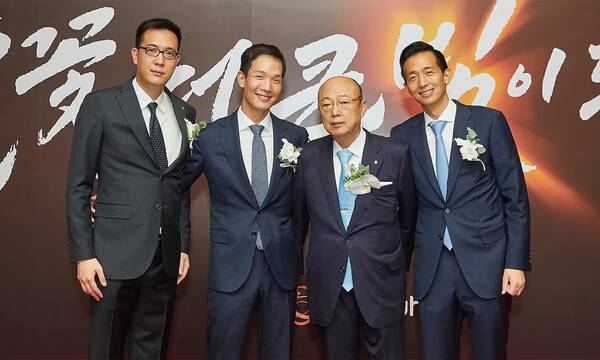
Hanwha Corp., the holding company of Korea’s seventh-largest conglomerate Hanwha Group, decided Wednesday to split into two holding entities.
Many believe the move seeks to clarify the management domains of three heirs and boost shareholder value by reducing the "conglomerate discount."
Hanwha’s board approved the physical spinoff earlier in the day, creating the new holding company Hanwha Machinery & Services Holdings, which will oversee the group's technology and lifestyle affiliates.
The restructuring is subject to shareholder approval at an extraordinary meeting in June and is expected to be completed in July.
Under the plan, the existing Hanwha Corp. will retain businesses spanning defense, shipbuilding, energy and finance, including Hanwha Aerospace, Hanwha Ocean, Hanwha Solutions and Hanwha Life Insurance, the company said.
The new holding company will manage affiliates such as Hanwha Vision, Hanwha Hotel & Resort, Hanwha Galleria, Hanwha Momentum, Hanwha Robotics and food service operator Ourhome. These businesses are led by Kim Dong-seon, the youngest son of Hanwha Group Chair Kim Seung-youn.
This means shipbuilding and defense businesses overseen by Kim Dong-kwan, the group's vice chair and eldest son, as well as financial operations led by second son Kim Dong-won, will remain under the existing Hanwha Corp.
When asked whether Hanwha is considering spinning off its financial unit, the company said "there has been no review" of any further split during a conference call for investors.
Industry analysts say the move signals that efforts to separate affiliates among Hanwha Group’s third generation have accelerated, while further cementing Dong-kwan’s position as heir apparent.
Because the restructuring is a physical division, existing Hanwha Corp. shareholders will receive shares in the new holding company. The split ratio has been set at 76.3 percent for the remaining Hanwha Corp. and 23.7 percent for the new entity, based on net asset book value.
This means Chair Kim and his three sons will initially hold the stakes in both companies.
The eldest Kim holds an 11.33 percent stake in Hanwha Corp, while Dong-kwan owns 9.76 percent. Dong-won and Dong-seon each hold 5.38 percent.
If Hanwha eventually pursues a full affiliate separation among the brothers, the family would likely need to carry out share swaps or other stake adjustments to realign ownership control, observers say.
Hanwha said the restructuring will allow each company to establish strategies tailored to its respective business environments, enabling swift decision-making in order to enhance corporate and shareholder value.
The company explained that the reorganization reflects the growing difficulty of managing businesses with sharply contrasting characteristics under a single corporate umbrella. Long-term, capital-intensive businesses such as defense, energy and shipbuilding have been grouped with more agile machinery and service businesses, leading to mismatches in strategic pace, direction, portfolio management and capital deployment.
“The spinoff is expected to significantly ease the ‘conglomerate discount’ that has weighed on corporate value,” the company said in a statement.
Alongside the spinoff, Hanwha on Wednesday announced measures to boost shareholder returns. It announced the cancellation of 4.45 million common shares, representing 5.9 percent of total common stock and valued at around 456.2 billion won ($310,000).
The company also announced it will raise its minimum annual dividend per common share to 1,000 won, up 25 percent from the 800 won last year.
Copyright © 코리아헤럴드. 무단전재 및 재배포 금지.