Kim Yo-jong’s rare back-to-back statements signal Pyongyang’s external unease: experts
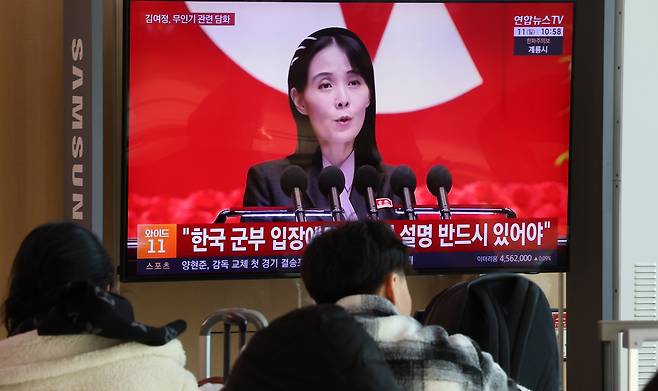
North Korea’s recent release of two unusually rapid-fire statements by Kim Yo-jong, the powerful sister of leader Kim Jong-un, underscores Pyongyang’s heightened sensitivity to external diplomatic pressure and security threats, analysts said Wednesday, as the regime moves to further entrench its hardline posture ahead of key political events.
Late Tuesday, Kim Yo-jong dismissed prospects for improving inter-Korean relations, rejecting Seoul’s assessment that her earlier remarks on an alleged drone infiltration incident left room for dialogue. Calling such expectations a “daydream,” she said in an English-language statement carried by the Korean Central News Agency that “the present address of the DPRK-ROK relations can never change.” DPRK refers to the Democratic People’s Republic of Korea, North Korea’s official name, while ROK stands for the Republic of Korea, South Korea’s official designation.
Her remarks were widely interpreted as reaffirming Kim Jong-un’s doctrine of “two hostile states,” which frames the two Koreas as separate and adversarial countries rather than counterparts in a divided nation.
The statement came days after an earlier statement on Sunday in which Kim Yo-jong demanded a “detailed explanation” from Seoul regarding alleged drone incursions into North Korean airspace. While acknowledging South Korea’s Defense Ministry statement denying military involvement, Kim nonetheless insisted that clarification was required and expressed “personal appreciation” that Seoul had chosen not to provoke Pyongyang.
Experts say the dual statements reflect a calculated political maneuver rather than emotional inconsistency.
“Regarding the recent drone incident, Kim Yo-jong issued two separate statements directed at South Korea,” said Yang Moo-jin, a professor at the University of North Korean Studies in Seoul. “The first statement contained both Pyongyang’s subjective interpretation and what it presented as its ‘objective’ position, while the second was a reaction to South Korea’s interpretation, marked by spontaneous emotional involvement.”
Yang said the remarks should be viewed in the context of the upcoming 9th Party Congress, where Pyongyang is expected to further institutionalize its hostile posture toward Seoul.
“North Korea is seeking to use the drone incident as justification to entrench the ‘hostile two-state’ relationship and to strengthen internal cohesion by stoking anti-South sentiment,” he said.
Yang added that the timing was also significant, noting that the second statement was released immediately after the South Korea–Japan summit.
“By releasing the statement immediately after the summit, North Korea indirectly signaled its opposition to the denuclearization and peace-building efforts outlined in the joint statement issued by Seoul and Tokyo,” he said.
Lim Eul-chul, a professor at Kyungnam University’s Institute for Far Eastern Studies, said Kim Yo-jong’s second statement was deliberately harsher in tone, aimed at shutting down Seoul’s optimism.
“This is a sophisticated political maneuver aimed at demonstrating that any so-called ‘dialogue phase’ anticipated by the Lee Jae Myung administration remains firmly under Pyongyang’s control,” Lim said.
Lim also pointed to Pyongyang’s irritation with President Lee’s recent summit diplomacy, including outreach to China and Japan.
“A particularly notable objective is to undermine President Lee’s achievements in summit diplomacy,” Lim said. “Kim Yo-jong’s remark that Seoul is ‘running around abroad making solicitations’ reflects strong dissatisfaction with South Korea’s approach of pressuring North Korea or seeking mediation through neighboring countries.”
He added that Pyongyang could feel a “heightened sense of betrayal” over the South Korea–Japan summit’s renewed use of the phrase “complete denuclearization.”
“At this stage, North Korea needs to demonstrate that the ‘hostile two-state’ relationship is being implemented in practice and use it as a basis to further reinforce internal unity,” Lim said, citing the approach of the 9th Party Congress.
North Korea’s sensitivity to external variables is also reflected in recent changes to Kim Jong-un’s security apparatus, analysts say.
According to South Korea’s Unification Ministry on Tuesday, commanders of three out of four units responsible for Kim’s personal security and regime protection were replaced between late 2023 and early 2024 — a rare and sweeping reshuffle.
Hong Min, a senior research fellow at the Korea Institute for National Unification, said the changes likely stem from external threats and evolving security challenges.
“The personnel changes suggest the need to introduce new operational concepts and technical adjustments in Kim Jong-un’s personal security and Pyongyang’s defense,” Hong said, pointing to drone threats and electronic warfare.
Hong noted that visible changes in Kim’s security posture have been observed since April 2023, including bodyguards carrying black briefcase-like equipment, widely believed to be counter-explosive or electronic defense tools.
He also linked the upgrades to the attempted bombing attack on Japanese Prime Minister Fumio Kishida in April 2023 and North Korea’s deployment of troops to Russia in late 2024, which heightened concerns over drone and electronic warfare threats.
Hong added that Kim Jong-un’s daughter, Ju-ae — who has appeared in state media since late 2022 — may also have factored into security planning.
“When the father and daughter’s movement routes overlap or are separated, new protocols may have been required to manage them smoothly,” Hong said, stressing that the measures fall within the scope of “family security,” not successor-level protection.
Taken together, Kim Yo-jong’s dual statements and the overhaul of Kim Jong-un’s security structure point to a regime increasingly alert to external diplomatic pressure and security risks, analysts say.
Copyright © 코리아헤럴드. 무단전재 및 재배포 금지.