Kospi hits fresh record above 4,700 despite signs of fatigue
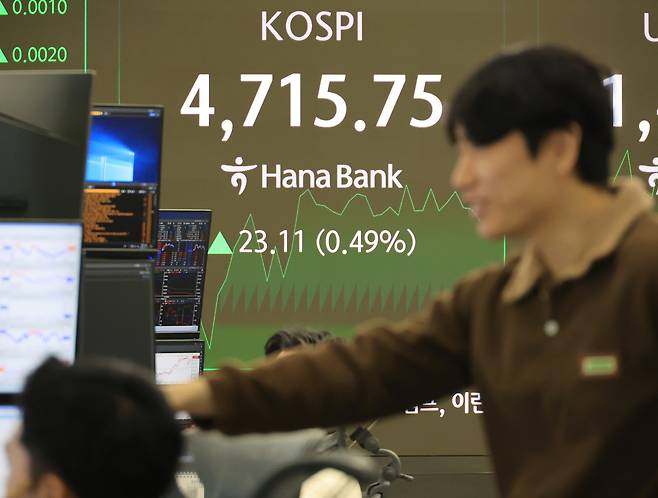
Korea’s benchmark Kospi climbed to another record high on Wednesday, breaching the 4,700 level for the first time, as a powerful New Year rally powered ahead even as early signs of stabilization began to emerge.
The index crossed 4,700 shortly after opening at 4,685.11, surging to an intraday high of 4,715 in morning trade. Volatility picked up soon after, with the benchmark retreating to as low as 4,670 before regaining momentum in the final hour and closing at a fresh record.
The advance ran counter to expectations. US equities weakened overnight — a notable headwind given their influence on Korean stocks — while retail investors, who had underpinned much of the recent rally, turned net sellers early in the session, eventually offloading about 430 billion won ($291 million).
Even so, the benchmark showed little sign of strain, extending a rally that has carried uninterrupted into 2026. As of Wednesday’s close, the Kospi had set record highs for nine consecutive sessions, with intraday peaks also reset on most days, a run capped by Wednesday’s milestone.
From its end-2025 close of 4,214, the index has climbed nearly 12 percent at its intraday peak.
However, caution is beginning to creep in after the sharp ascent. The rally has been heavily concentrated in a handful of market heavyweights, including Samsung Electronics, SK hynix and Hyundai Motor. Gains in those three stocks alone account for about 40 percent of the Kospi’s roughly 400 trillion won increase in market capitalization so far this year.
Market watchers say that leaves room for sector rotation and profit-taking that could temper further short-term gains.
“While it’s positive that other key sectors such as shipbuilding, defense and nuclear power are benefiting from rotation even as semiconductors go through a period of consolidation, fatigue is building after the extended rally, and a short-term pullback driven by unwinding in recently surging stocks could emerge," said Han Ji-young, an analyst at Kiwoom Securities.
Selling pressure from retail investors has already picked up. Individuals snapped a five-day buying streak on Tuesday, unloading about 600 billion won of shares, and continued to add to net sales through Wednesday’s session.
Foreign investors also maintained heavy selling, unloading more than 360 billion won worth of Kospi shares on Wednesday, marking the fifth straight session of net outflows.
On Wednesday, institutional investors stood out as the sole buying bloc, posting net purchases of about 600 billion won.
Currency moves are adding another layer of uncertainty. The won, which has continued to weaken into the New Year, slid to its weakest intraday rate of 1,479 per US dollar on Wednesday.
Still, most strategists see the rally pausing rather than reversing. Several brokerages have raised the upper end of their Kospi targets beyond 5,200 following the New Year surge. SK Securities forecasts the index climbing as high as 5,250 this year on the back of valuation rerating, while Hana Securities has projected a peak near 5,600, citing strength in the semiconductor cycle.
Meanwhile, a separate report from Korea CXO Institute showed the Kospi’s market capitalization expanded by about 1,700 trillion won, or 76 percent, over the past year, rising from 2,254 trillion won to 3,972 trillion won.
The largest contributor was Samsung Electronics, whose market value more than doubled to about 760 trillion won. SK hynix followed, nearly tripling to around 492 trillion won. Other notable gainers included SK Square, Doosan Enerbility and Hanwha Aerospace, each adding more than 20 trillion won in market value over the period.
Copyright © 코리아헤럴드. 무단전재 및 재배포 금지.