Main opposition's troubles grow as factions clash over Han's expulsion
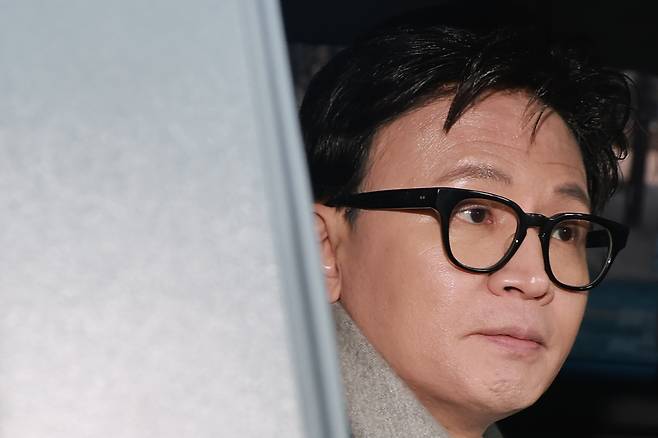
The main opposition People Power Party is on the brink of yet another rupture after its ethics committee decided on Wednesday to expel former party leader Han Dong-hoon, a move that immediately triggered a backlash from a bloc of lawmakers supportive of Han.
While the expulsion still requires approval from the party’s supreme council, the decision has already exposed widening fault lines within the conservative bloc, pitting the current leadership — backed by hard-liners — against a group of mostly first- and second-term lawmakers who have rallied behind Han.
Early Wednesday, the party’s ethics committee voted to strip Han of party membership over alleged misconduct on internal online party forums, including posts critical of former President Yoon Suk Yeol and the party leadership, as well as actions the committee said caused confusion over the party’s bylaws.
The ethics committee’s ruling came hours after a special counsel requested the death penalty for Yoon on charges of insurrection related to his December 2024 declaration of martial law.
The announcement on Han's membership was the party’s only noticeable response, while left-leaning parties — including the ruling Democratic Party and the Rebuilding Korea Party — issued statements backing the death penalty.
Despite the backlash from lawmakers with ties to Han, party Chair Rep. Jang Dong-hyeok reaffirmed that the party would not revisit the committee’s ruling, which now awaits final approval from the supreme council.
Han strongly rejected the decision.
In a Facebook post earlier in the day, he said he would “stand with the people and party members to defend democracy.”
At a press conference later Wednesday at the National Assembly, Han went further, likening the party’s move to a renewed assault on constitutional order and drawing parallels with Yoon’s martial law attempt.
“After stopping martial law and trying to protect the party, I have been expelled through fabricated allegations,” Han said. “At a time when we should be overcoming the martial law crisis and pursuing unity, another form of martial law has been declared — one that destroys the Constitution and democracy.”
Asked whether he would seek a court injunction to block the expulsion, Han did not give a direct answer. However, he said he would “do everything possible, together with the people and party members,” leaving open the possibility of legal action.
Han was accompanied at the press conference by around 70 People Power Party members, many of them first- or second-term lawmakers, including Reps. Sung Sung-kuk, Park Jung-hoon, Koh Dong-jin, Yoo Yong-won, Kim Hyung-dong and Bae Hyun-jin.
For years, Han had been widely viewed as one of Yoon’s closest allies.
A former prosecutor who rose through the ranks alongside Yoon, Han entered politics following Yoon’s ascent and quickly emerged as a central figure in the conservative camp.
Their ties initially appeared ironclad. After winning the 2022 presidential election, Yoon — who had also entered politics as an outsider — moved to build his own power base within the party and the government, forming a close-knit inner circle largely drawn from his prosecutorial background, a process in which Han played a central role. Han went on to serve as justice minister and later became leader of the People Power Party in July 2024.
Their relationship, however, deteriorated as Yoon’s presidency entered its later stages amid growing differences over governance style and political strategy. The rift became unmistakable after Yoon’s surprise declaration of martial law on Dec. 3, 2024, which prompted Han to step down as party leader.
Subsequent reports underscored the depth of the divide. Han’s name was reported to have appeared on a list of lawmakers whom Yoon had instructed military units to detain during the martial law operation — a revelation that suggested he had shifted from being part of Yoon’s inner circle to a figure viewed with suspicion by the very system he had helped build.
Since then, Han has held no official post — neither a National Assembly seat nor within the party — though he remains a member. During this period, he has taken an increasingly critical stance toward Yoon, while also openly rebuking party lawmakers who continue to support the former president.
Choi Chang-ryeol, a political commentator and professor of political science at Yongin University, said Han’s expulsion reflected the cumulative consequences of the political course he had taken within the party.
“As Yoon’s presidency entered its later stages, Han increasingly sought to carve out a more independent political profile,” Choi said. “While that raised expectations that he could broaden the party’s appeal beyond its traditional base, it also left him without a firm foothold among the party’s pro-Yoon establishment.”
Choi pointed in particular to figures such as Jang, who has emerged as a central figure in the party’s current leadership with backing from Yoon’s supporters, who are largely conservative hard-liners.
“By the time the ethics committee moved to expel him, Han remained formally within the party but had long been politically isolated from its power center,” Choi added. “For many first- and second-term lawmakers, standing with Han can be seen as a strategic bet that aligning with a figure outside the party’s current power structure may offer greater political space — and future returns — than remaining within it.”
Another political commentator, Park Sang-byeong, said the party’s move should also be viewed in the context of preparations for the June 3 local elections.
“The People Power Party is seeking to clarify its ideological direction while weighing potential realignments within the conservative bloc, including possible cooperation with forces aligned with Rep. Lee Jun-seok, chair of the minor opposition Reform Party and a former leader of the People Power Party,” Park said.
“For Han, the decision marks a dramatic reversal for a figure who once embodied the conservative establishment’s future,” Park added. “For the People Power Party, it underscores how the aftershocks of the 2024 martial law crisis continue to reshape South Korea’s political landscape well into 2026.”
Copyright © 코리아헤럴드. 무단전재 및 재배포 금지.