Takaichi first to propose joint probe into wartime Chosei mine remains: Seoul
전체 맥락을 이해하기 위해서는 본문 보기를 권장합니다.
"This was the first issue Prime Minister Takaichi raised among the major agenda items during the one-on-one meeting," Wi told reporters. "She mentioned it first."
"This marks a first step toward fulfilling the long-held wishes of the bereaved families, and could also serve as a starting point for South Korea and Japan to address historical issues together, grounded in the universal values of human rights and humanitarianism that the two countries share."
이 글자크기로 변경됩니다.
(예시) 가장 빠른 뉴스가 있고 다양한 정보, 쌍방향 소통이 숨쉬는 다음뉴스를 만나보세요. 다음뉴스는 국내외 주요이슈와 실시간 속보, 문화생활 및 다양한 분야의 뉴스를 입체적으로 전달하고 있습니다.
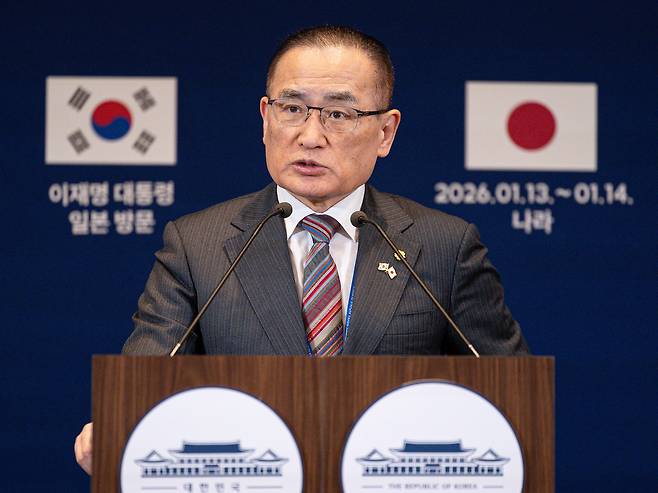
NARA, Japan — Plans for South Korea and Japan to jointly investigate remains believed to be those of Koreans who died during Japan's 1910-45 colonial rule were initially suggested by Japanese Prime Minister Sanae Takaichi, Cheong Wa Dae said Wednesday.
South Korean national security adviser Wi Sung-lac underscored that Seoul and Tokyo "agreed to strengthen humanitarian cooperation on historical issues" as a key outcome of President Lee Jae Myung's summit with Takaichi on Tuesday in Nara prefecture.
Specifically, the two sides agreed to pursue DNA testing to identify the remains — believed to be linked to the Chosei coal mine disaster — and to hold working-level consultations between relevant authorities on the details, according to Cheong Wa Dae.
The Chosei coal mine disaster occurred on Feb. 3, 1942, when an undersea tunnel off Ube in Japan's Yamaguchi prefecture was flooded, killing 183 workers, including 136 Koreans who were forcibly mobilized. The Japanese government never recovered the victims' remains or conducted a full investigation.
"This was the first issue Prime Minister Takaichi raised among the major agenda items during the one-on-one meeting," Wi told reporters. "She mentioned it first."
"This marks a first step toward fulfilling the long-held wishes of the bereaved families, and could also serve as a starting point for South Korea and Japan to address historical issues together, grounded in the universal values of human rights and humanitarianism that the two countries share."
Wi underscored a two-track approach — addressing historical issues stemming from Japan's forced occupation of the Korean Peninsula from 1910 to 1945, while separately advancing cooperation on other matters aimed at a more future-oriented relationship.
"South Korea and Japan can truly grow closer and raise the quality of their cooperation by working to resolve historical issues as they stand, while separately advancing cooperation aimed at the future," Wi said.
Cheong Wa Dae has repeatedly underlined that Seoul aims to use the Lee-Takaichi summit as an opportunity for the two countries to pursue humanitarian cooperation on historical issues, including those related to the Chosei coal mine.
The summit also covered South Korea's bid to join the Comprehensive and Progressive Agreement for Trans-Pacific Partnership, Wi said, noting both countries exchanged basic positions "in a positive atmosphere."
Led by Japan, the CPTPP brings together 12 economies across the Indo-Pacific region, but any new entrant requires unanimous approval from existing members.
"There was discussion on the CPTPP, during which we explained our basic approach, and the Japanese side also laid out its basic position," Wi said. "It was not discussed in detail. The talks took place in a positive atmosphere."
Wi further explained that for both sides the "discussion concluded with the understanding that additional working-level consultations would be required to flesh out the specifics."
That unanimity requirement puts renewed focus on the terms Tokyo may seek to attach, most notably South Korea's ban on seafood imports from eight Japanese prefectures, including Fukushima. Introduced in 2013 after the Fukushima nuclear disaster, the restrictions remain in place, with Seoul insisting they will not be lifted until public safety concerns are fully addressed.
Asked whether Seoul's ban on Japanese seafood imports had been discussed, Wi said Japan provided an explanation on food safety and that South Korea "listened to the explanation," offering no further details.
Wi further explained that a significant outcome of the summit was an agreement between the two leaders to "expand cooperation across the board — in the overall relationship, the economy, advanced technologies and various supply chains — so as to open a new chapter" in bilateral ties.
On supply chains, Wi said the leaders also expressed their commitment to cooperate, adding that Seoul and Tokyo are "preparing various frameworks at the working level to promote that cooperation."
"It will take a bit more time, but there will be results," Wi said.
Tensions between Beijing and Tokyo over Taiwan have been spilling into areas beyond traditional security issues into economic security and supply chains.
On Jan. 6, China's Commerce Ministry said it would bar exports of certain dual-use items to Japanese military end users and for uses deemed to bolster Japan's military capabilities. Seoul has been bracing for direct and indirect fallout from China's export controls.
Asked whether the supply-chain cooperation was aimed at China against that backdrop, Wi dismissed the proposition, explaining that "supply chains are an important issue for us, and we cooperate with many countries."
"We have also discussed cooperation with China on supply chains," Wi added.
Wi said Tuesday's summit addressed closer Korea-Japan cooperation, stronger coordination among South Korea, the US and Japan, as well as efforts to reinforce trilateral cooperation among South Korea, Japan and China.
"It was not discussed with any specific country in mind," Wi said. "In yesterday's discussions, we said everyone needs to make efforts to maintain stability in Northeast Asia and to increase cooperation. We also expressed that position."
Wi noted that South Korea hosts the secretariat of the trilateral cooperation framework with Japan and China.
"From that standpoint, we believe efforts to expand cooperation and shared prosperity in the region should be further strengthened," Wi underscored.
Copyright © 코리아헤럴드. 무단전재 및 재배포 금지.