Creator, copyright groups oppose 'use first, pay later' stance in government AI plan
South Korean creator and copyright groups issued a joint statement rejecting the “Korea AI Action Plan” released by the Presidential Council on National Artificial Intelligence Strategy, warning it could allow AI companies to use copyrighted works “without legal uncertainty” and, in practice, without paying.
The groups — spanning literature, broadcasting, screenwriting, music, choreography and visual arts — said Tuesday they cannot accept what they described as a “use first, pay later” policy direction. They argued it would weaken creators’ control over their own works and undermine the long-term sustainability of Korea’s cultural industries.
“This is a declaration that the government is abandoning the sustainability of Korea’s cultural industry,” they said, calling for a fundamental policy review.
At the center of the backlash is Action Plan No. 32, which promotes “activating the ecosystem for the use and distribution of copyrighted works for AI training and evaluation.” The statement points to language recommending that the Culture Ministry, working with other ministries, prepare by the second quarter either amendments to the AI Basic Act or a separate “AI Special Act” that would allow companies to use copyrighted works for training purposes, “without legal uncertainty.”
Creator and copyright groups say the plan stretches the concept of fair use too far in favor of private commercial interests, misrepresents global trends as moving toward broader exemptions, and risks shifting the burden of enforcement onto creators. They also criticized the plan’s mention of “opt-out” protections, warning that requiring machine-readable technical measures would leave most individual creators unable to realistically defend their rights.
The groups added that they plan to continue taking strong action until the government revises its policy direction toward a sustainable AI development strategy that protects creators’ rights and upholds fair compensation as a core principle.
The statement follows similar criticism from the Korea Newspaper Association, which has argued that the foundation of copyright lies in the right holder’s ability to decide whether a work can be used in advance. The creator groups urged the government to rethink its approach and reaffirm a framework built on prior permission and fair compensation, warning that once unpaid or low-cost use becomes normalized, meaningful compensation may become impossible to restore.
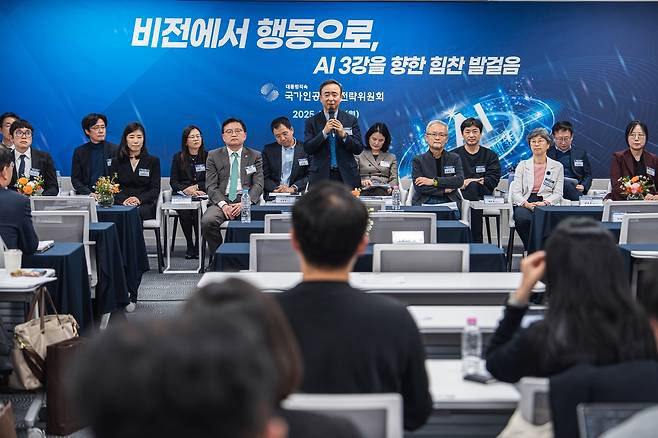
Promoting the AI industry is a key priority for the Lee Jae Myung administration, which launched the Presidential Council on National Artificial Intelligence Strategy on Sept. 8, tasked with coordinating Korea’s national AI agenda.
The council brings together government, industry and expert stakeholders under one framework, as Seoul accelerates efforts to scale AI infrastructure, expand AI adoption across the economy, and strengthen global competitiveness.
A draft of the Korea AI Action Plan unveiled on Dec. 15 was open for public feedback through Jan. 4. The execution-focused national strategy is built around 98 action items ranging from expanded computing infrastructure and AI semiconductor development to industrial AI transformation and institutional reforms governing the use of copyrighted works for AI training and evaluation.
The joint statement was signed by 16 organizations, including groups representing independent producers, digital content creators, writers, screenwriters, performers, choreographers, music copyright holders and the broader broadcasting industry.
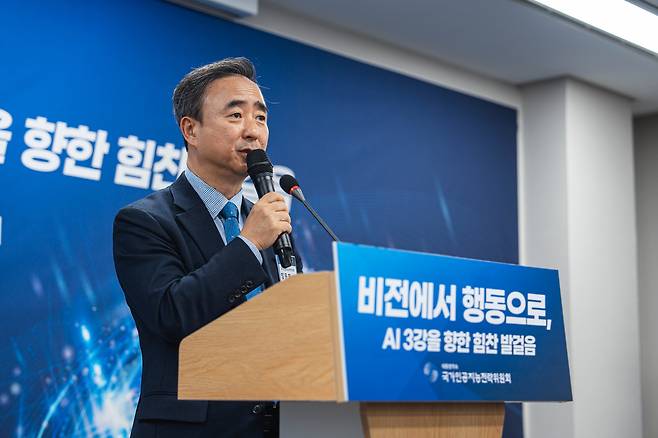
An official at the council told The Korea Herald Wednesday that it plans to hold a discussion session on the matter.
Copyright © 코리아헤럴드. 무단전재 및 재배포 금지.