Korean food industry turns to AI to cut costs, boost margins
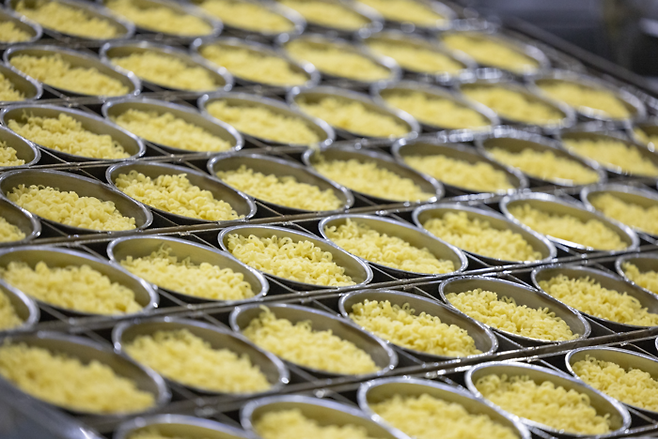
According to industry sources on Tuesday, Nongshim Co., the country’s leading instant noodle maker, plans to expand its AI product inspection system this year to overseas production lines in the United States, China, and other markets.
The system combines AI and computer vision software installed on factory cameras to automatically assess noodle quality, including thickness, as well as weight and packaging conditions.
Cameras installed along production lines analyze hundreds of thousands of product images using AI neural networks to precisely identity defects.
Pulmuone Corp. also plans to introduce AI-powered smart process systems this year at tofu factories in Korea, the U.S., China, and Japan.
Since 2023, Pulmuone has collected tofu production data from 12 domestic plants, two U.S. plants, and nine partner companies. The company aims to use AI trained on three years of accumulated data to improve product quality and productivity.
“AI will detect early signs of equipment abnormalities, predict quality fluctuations in real time, and recommend optimal operating conditions based on process and raw material characteristics,” said a company official.
Paris Croissant, an affiliate of bakery giant SPC Group, has used an AI dough portioning solution at its Seongnam bakery since last year. Because fermentation changes dough volume and weight, workers previously had to manually adjust equipment to maintain consistency.
After adopting AI, the company improved portioning accuracy and production efficiency. SPC Group is reviewing plans to expand the system to other plants this year.
SPC Group is also preparing to break ground this year on a smart safety factory in Eumseong, North Chungcheong Province.
The group plans to invest 300 billion won ($203 million) to build a bakery equipped with AI, automated robots, and Internet of Things sensors.
Construction is expected to begin this year, with completion targeted for 2028, the company said.
Otoki Corp. is also stepping up AI adoption.
Since November last year, the company has used AI during pilot production runs before launching new products, cutting development lead times by 38 percent.
AI automatically checks hygiene issues, product consistency, and expiration date labeling on packaging, reducing the workload for workers.
“AI is also used to monitor electricity and fuel use and minimize waste,” said an Otoki official.
Dongwon F&B Co. has used AI-based X-ray inspection at its Changwon plant in South Gyeongsang Province since last year to detect tiny fish bones in canned tuna that even experienced workers might miss.
The company said consumer complaints have fallen by more than 20 percent.
CJ CheilJedang Corp. plans to expand its AI quality inspection solution this year to additional plants, including its Busan facility, after introducing the system in 2024 at its Incheon frozen food plant and Yeongdeungpo plant. The system uses AI-powered X-ray equipment installed above conveyor belts to quickly detect and remove foreign substances.
Industry observers expect adoption of AI technologies across the food sector to continue rising as related technologies advance.
Copyright © 매일경제 & mk.co.kr. 무단 전재, 재배포 및 AI학습 이용 금지
- “1890만원 신문지로 감쌌다가 맙소사”…제대로 써보지 못한 돈 ‘2조8400억’ - 매일경제
- “14일, 휴가낸 사람이 진짜 승자”…‘영하15도’ 미친듯이 춥다는데 - 매일경제
- 특검 "전두환보다 엄정히 단죄"… 尹 '사형' 구형 순간 헛웃음 - 매일경제
- 삼성 뛰쳐나와 빚더미 침대 공장 출근…1100억 잭팟 만들어낸 남자 - 매일경제
- 전세보증금, 집주인 대신 보증기관에 맡긴다 - 매일경제
- “몸테크 10년 했더니 분담금 10억 내라고?”…강남 재건축 ‘가시방석’ - 매일경제
- “집에 빨리 가려다”…얼어붙은 저수지 건너다 물에 빠진 50대, 극적 구조 - 매일경제
- 최강록, ‘흑백요리사2’ 최종 우승…백종원·안성재 만장일치 - 매일경제
- 한국인 암 6%가 ‘식습관’ 영향…기여도 1위는 의외로 ‘이 음식’ - 매일경제
- ‘최강 중국에 무관 선물’ 韓 탁구 희망 장우진, WTT 챔피언스 준우승…역대 최고 성적 타이 + AG