Audit scandal rocks NongHyup leadership
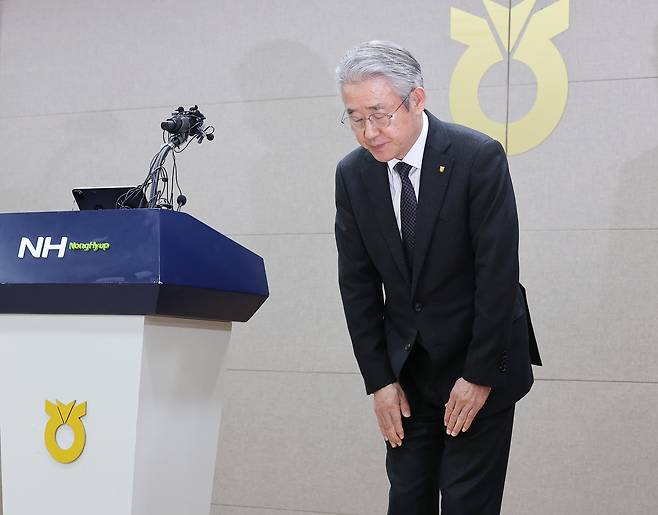
Kang Ho-dong, head of South Korea’s National Agricultural Cooperative Federation, known as NongHyup, said Tuesday he would step down from key senior posts after a government audit found major management lapses.
In a public statement released Tuesday, Kang said he took the ongoing public criticism seriously.
“I deeply regret failing to meet the expectations of the public and of farmers, and I sincerely apologize for the concern I have caused," Kang said, announcing he would step down as chair of the Farmers Newspaper and of the NongHyup Foundation.
Kang stated he would pull back from day-to-day management and leave personnel and business decisions to a professional chief executive. Other senior executives, including the federation’s vice chair, the chief executive of its mutual finance arm and the president of the Farmer Newspaper, also said they would step down.
“This must become not just crisis management, but mark the beginning of restoring NongHyup’s original purpose and role,” Kang remarked.
The apology followed the release last Thursday of interim findings from a special audit by the Ministry of Agriculture, Food and Rural Affairs.
The audit found that although the chair’s post is legally defined as a non-executive, honorary and unpaid position, the federation paid Kang about 400 million won ($270,000) a year in allowances and a salary of more than 300 million won for his role as newspaper chief, with the prospect of a large severance also seen as inconsistent with that status.
The investigation also found that Kang overspent on overseas travel, exceeding the daily hotel cap of $250 on all five trips he took after assuming office in March 2024. In total, excess spending reached about 40 million won.
According to the ministry, while exceptions to the cap are allowed in special circumstances, Kang failed to document any such justification. Kang said he would personally reimburse all amounts that exceeded the lodging limits.
Kang is also under police investigation on suspicion of taking a 100 million won bribe during the federation’s leadership race in late 2023.
If further issues surface in follow-up audits, the ministry said it would examine allegations of bribery, anti-graft violations, improper personnel interference and bad loans.
The controversy carries added weight given the farmer-owned cooperative’s central role in the nation’s rural economy, spanning finance, retail, insurance and support services.
NongHyup has about 2.04 million farmer members and 1,110 local farm and livestock cooperatives. Under the central federation sit four education-support affiliates, along with NongHyup Agribusiness Group and NH Financial Group, which control 17 and 12 subsidiaries respectively. Total assets across the group reached about 711 trillion won in 2024, with the financial arm accounting for 532 trillion won.
Agriculture Minister Song Mi-ryung said Monday that NongHyup suffers from a governance system that fails to reflect the democratic voice of its members.
“The direction of reform is to fix institutional shortcomings that undermine the spirit of the cooperative,” she said, adding that the ministry would move ahead with the changes needed to restore NongHyup to its intended role.
Echoing that call, NongHyup said Tuesday it would set up an independent reform panel, led by outside experts, to review its election system, governance and internal practices, aiming to improve transparency in cooperative management and rebuild trust.
“For 65 years, NongHyup has worked for farmers and rural communities,” Kang said. “We will do everything possible to return it to its original mission and restore public trust.”
Copyright © 코리아헤럴드. 무단전재 및 재배포 금지.