POSCO Future M eyes mass production of solid-state battery materials in 2030
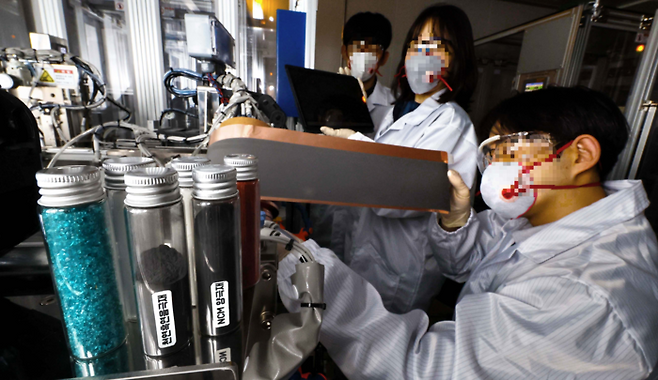
During a recent visit to the company’s technology research center in Sejong City by Maeil Business, researchers were seen examining whether particles were evenly distributed within electrodes, a key step in increasing battery density during the development of cathode materials for all-solid-state batteries.
Unlike conventional batteries, all-solid-state batteries use solid materials instead of liquid electrolytes, making them high value-added products.
While conventional batteries carry fire risks due to electrolyte leakage, all-solid-state batteries significantly reduce such risks and are lighter, earning them the nickname “dream batteries” for their potential to reshape future industries.
The industry outlook remains positive.
According to Markets and Markets and other solid-state battery market data sources, the global all-solid-state battery market is expected to grow nearly sevenfold over five years, reaching $963 million by 2030 from $148 million in 2025.
Cost, however, remains a major hurdle.
Manufacturing all-solid-state batteries costs three to five times more than conventional products, which is why electric vehicles equipped with all-solid-state batteries have yet to enter the market.
Reducing production costs through technological advances and economies of scale is therefore the key challenge. POSCO Future M is widely regarded as having world-leading technology in this field.
“POSCO Future M is the company closest to mass-producing high value-added cathode materials for all-solid-state batteries and the only company within the group capable of sourcing solid electrolytes internally,” said a POSCO official, highlighting the firm’s strengths in designing and coating cathode raw materials.
To extend battery life and increase capacity, cathode particles must be efficiently arranged and carefully coated to prevent direct contact with electrolytes. POSCO Future M has secured precision technology that uniformly coats cathode materials to a thickness one ten-thousandth that of a human hair.
“If even a small portion of the cathode material is left uncoated, it reacts directly with the solid battery and degrades performance,” said Nam Sang-cheol, head of the company’s cathode research center. “The key is technology that wraps the cathode materials without gaps at an atomically thin level, and we have secured all of those capabilities.”
The company has also laid the groundwork to achieve economies of scale.
At the group level, POSCO has built a fully integrated value chain spanning raw materials such as lithium, nickel, and graphite through to finished battery materials. The group plans to enter mass production in line with growth in the all-solid-state battery market, and expects solid electrolyte prices to fall sharply once economies of scale are realized.
Industry sources expect POSCO Future M to begin full-scale mass production of all-solid-state battery materials by 2030.
The company is also broadening its growth strategy to offset a temporary slowdown in battery demand.
Rather than relying solely on electric vehicle batteries or energy storage systems, POSCO Future M is expanding into higher value-added applications such as humanoid robots.
“Our materials can also be supplied for batteries used in humanoid and industrial robots,” Nam said, adding that research and development and testing are currently under way.
To counter China’s low-price offensive, POSCO Future M is focusing on securing technologies that Chinese competitors cannot easily replicate.
A representative example is lithium manganese-rich (LMR) batteries.
LMR batteries are priced similarly to lithium iron phosphate (LFP) batteries, which are widely produced by Chinese companies, but offer 30 percent higher energy density. China has yet to enter this segment, and POSCO Future M has already secured foundational mass-production technology.
The company is also accelerating development of advanced silicon-based anode materials.
These materials offer five to 10 times higher energy storage capacity and enable ultra-fast charging compared with graphite-based anodes, although high costs remain a challenge. POSCO Future M is developing technologies to enable large-scale use of silicon anodes and is operating a demonstration plant capable of producing 50 tons of silicon anode materials annually.
China is rapidly intensifying its push not only in battery cells but also in materials.
According to market research firm SNE Research, the total volume of cathode materials loaded into electric vehicles worldwide reached 2.32 million tons from January to November last year, up 36.7 percent from a year earlier.
The increase was driven by Chinese companies sharply expanding shipments despite the temporary demand slowdown.
“Competitiveness in the cathode materials market this year will be reshaped to encompass not only performance and cost but also how transparently companies manage supply chains and respond to risks,” SNE Research said.
Copyright © 매일경제 & mk.co.kr. 무단 전재, 재배포 및 AI학습 이용 금지
- 서울 강남 뺨치는 경기 이 동네…집값 급등에 전세가율 50% 아래 ‘뚝’ - 매일경제
- “한국인 머리카락을 훔치고 싶다”…해외에서 반응 오는 K헤어 - 매일경제
- “이란 가만두면 안될 거 같다”...트럼프 으름장에 하메네이 대답은 - 매일경제
- 재정폭탄 코앞인데 “선거부터”…기초연금·정년연장 개혁도 밀렸다 - 매일경제
- 미사일 대신 관세폭탄 먼저 쏜 트럼프…“이란과 거래하는 나라에 관세 25% 부과” - 매일경제
- “교실이 텅 비어간다”…올해 초등학교 입학생 30만명 붕괴 - 매일경제
- “7년 전부터 엔비디아 보유”…수익률 ‘800%’ 고백한 여가수 - 매일경제
- “이젠 사람이 귀하지 않습니다”…은행, 신규채용 ‘찔끔’ 희망퇴직 ‘북적’ - 매일경제
- [단독] 부모님의 주택연금, 목돈 없이 자녀가 이어받을 길 열린다 - 매일경제
- 적수가 없다!…‘세계 최강’ 안세영, 中 왕즈이 꺾고 말레이시아 오픈 3연패 달성 - MK스포츠