Korea maps investigative, prosecutorial powers after breakup
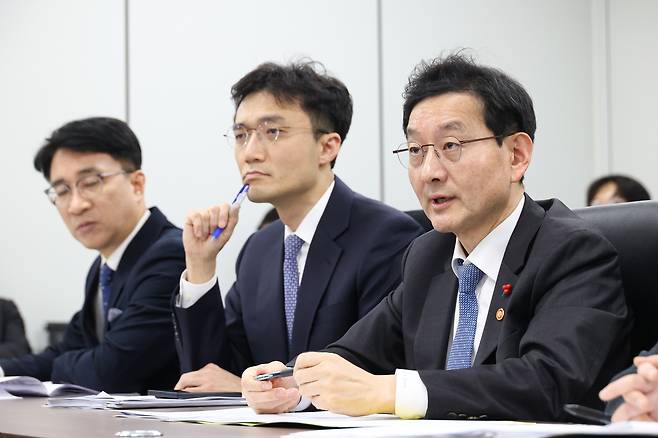
The South Korean government on Monday gave more details of the two new agencies that will replace the Prosecutors' Office, following legislative approval last year to dismantle the country's 78-year-old prosecutorial system.
The ruling Democratic Party of Korea led revisions to the Government Organization Act last year to abolish the Prosecutors' Office in September 2026, following a one-year grace period, redistributing its concentrated powers of investigation and indictment between two separate institutions.
The legislative notice, announced Monday by the Prosecutorial Reform Task Force under the Prime Minister’s Office, sets out legislation to establish the two entities, tentatively named the Indictment Agency and the Serious Crimes Investigation Agency, respectively.
Under the proposal, the Serious Crimes Investigation Agency, to be placed under the Ministry of the Interior and Safety, would investigate serious crimes. The Indictment Agency, under the Ministry of Justice, would decide whether to indict suspects referred by police and other investigative bodies.
Interior Minister Yun Ho-jung said the restructuring is intended to disperse investigative and prosecutorial authority long centralized within the Prosecutors’ Office.
"The bill was crafted to emphasize protecting citizens’ fundamental rights by ensuring that investigation and indictment operate under mutual checks and balances, and to restore public trust in the criminal justice system as a whole," Yun said.
Indictment Agency
Under the proposed Indictment Agency Act, prosecutors at the newly formed agency would be barred from initiating criminal investigations, with provisions authorizing the “investigation of crimes” and the “commencement of investigations” deleted from existing statutes defining prosecutors’ duties. Primary investigative authority would shift to police and the Serious Crimes Investigation Agency.
The role of prosecutors would be limited to filing and maintaining indictments, a shift explicitly outlined in the bill to establish the agency as a body dedicated exclusively to prosecutions.
The Indictment Agency would receive completed investigative files from the SCIA and police to determine whether to bring and maintain charges.
To incorporate public input in high-profile cases, the government plans to establish case review committees, composed of outside figures, at each high-level Indictment Agency office to deliberate on detention warrant requests and decisions on whether to indict.
In addition, the legislation would require performance evaluations of prosecutors to more systematically reflect indicators such as appeal and reappeal rates, the acceptance rate of requests for judicial review, acquittal rates and the reasons behind those outcomes.
To curb political involvement by prosecutors, the bill would also introduce new criminal penalties for political activities. Violations would be punishable by up to five years in prison or suspension of qualifications for up to five years.
Whether the new Indictment Agency should be granted authority to request or conduct supplementary investigations has emerged as a contentious policy issue, with hard-line members of the ruling party in strong opposition.
Serious Crimes Investigation Agency
Meanwhile, the SCIA would be tasked with investigating nine categories of serious crimes, including corruption, financial crimes, public office-related offenses, election crimes, defense acquisition irregularities, major disasters, drug offenses, insurrection, treason and cybercrime.
The SCIA would also be granted authority to investigate crimes committed by officials from other investigative bodies, including the Indictment Agency.
The task force said investigators at the agency would be hired through two separate tracks. Judicial investigation officer positions would be filled by licensed attorneys, while professional investigators would be filled by those with ample field experience, such as detectives and investigating prosecutors.
The expectation is that some prosecutors in the current Prosecutors' Office would transfer to the SCIA under the first track, while some 3,000 of the total 6,000 investigating prosecutors would transfer through the second track, the task force added.
It stressed that the nature of the SCIA investigators hired through the two tracks would not be hierarchical, and that both would be given the same duties and powers, regardless of legal background.
Professional investigators would also be free to become judicial investigation officers after proving their legal competence.
Given the significant impact of serious crime investigations on the rights of the people, the bill would explicitly grant the interior minister supervisory authority over the SCIA.
The task force has addressed concerns that the interior minister's supervision could undermine the SCIA's independence by emphasizing that corrective intervention will only be allowed in the case of a clear illegal investigation by the SCIA.
The legal notice is to be up until Jan. 26 to allow for public opinion. The task force will then submit the legislative proposal to the National Assembly in February with the aim of gaining approval before the end of the month.
"It takes about six months after a law about government structure is passed for it to be fully enacted. Because (the Prosecutors' Office) will be abolished in October, we need the law to pass (in February) in order to guarantee enough time to take care of administrative issues, like finding appropriate headquarters (for the new agencies)," said a task force official.
The official stressed that the legal notice only pertains to the establishment of the two new bodies, and that other subordinate regulations and laws would be amended to clarify the agencies' specific roles and scopes of activity.
"We will carefully carry out follow-up measures to support the agencies' successful launch within the designated time frame," said Yoon Chang-ryeol, head of the Prosecutorial Reform Task Force.
Copyright © 코리아헤럴드. 무단전재 및 재배포 금지.