Ramyeon powers K-food exports to record high
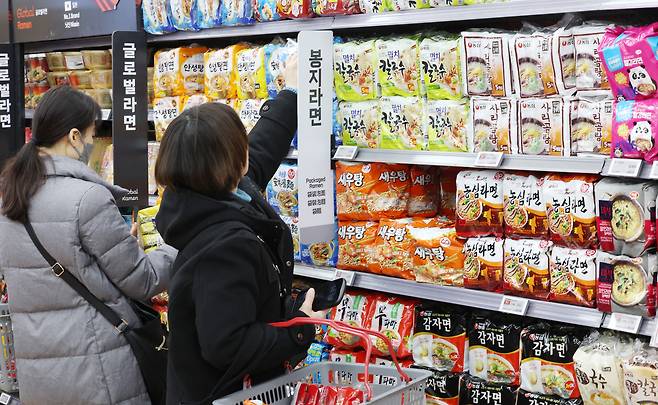
Exports of K-Food+ — the catchall label for Korean food and agricultural industries — climbed to a record $13.6 billion last year, lifted by a widening global appetite for Korean flavors and farm know-how, government data showed Monday.
According to the Ministry of Agriculture, Food and Rural Affairs, estimated K-Food+ exports in 2025 rose 5.1 percent on-year to an all-time high of $13.62 billion, of which food products accounted for $10.41 billion and agricultural industries $3.22 billion.
Food exports rose 4.3 percent from a year earlier to break past the $10 billion mark, extending their expansion for the 10th straight year.
Ramyeon led the charge, becoming the first single food item to exceed $1.5 billion in annual exports. Rising global demand, expanded production and a more stable supply chain drove the growth, the ministry noted, as sales surged not only in China and the US but also in Central Asia and the Middle East. China was the largest market at $385 million, followed by the US at $255 million.
Ramyeon has settled into its role as one of Korea’s steadiest exports, and its makers are quietly broadening their production base. Nongshim, with facilities at home and abroad, is building an export-only factory in Busan, while Samyang is constructing its first overseas plant in China. Otoki, known for its Jin Ramen product, established its US unit last year and is moving ahead with plans to build a plant in California by 2027.
Besides instant noodles, eleven other products, including sauces, ice cream and fresh produce, also reached all-time highs.
Sauces, riding on the popularity of Korean spicy flavors, reached $412 million, up 4.6 percent on-year. Ice cream crossed the $100-million line for the first time, thanks to vegan, low-fat and zero-sugar variations.
Amid export growth across major markets, the US remained the largest, with shipments rising 13.2 percent to a record $1.8 billion, followed by China at $1.59 billion. Europe posted a 13.6 percent increase to $774 million, while exports to Gulf countries jumped 22.6 percent to $412 million.
According to the ministry, ramyeon, sauces and ice cream drove much of the growth across these markets, while Europe in particular saw rising demand for health supplements, kimchi and rice-based foods.
Meanwhile, agricultural industries also posted their strongest performance in 2025, as exports climbed 8 percent to $3.22 billion on solid demand for farm machinery, pesticides, fertilizers, seeds and veterinary medicines. Leading the category was farm machinery, which rose 10.8 percent to $1.35 billion on a broader product lineup in the US and expansion into Asian and European markets.
“Even in a challenging trade environment, we delivered a record result on the back of strong global interest in K-food and the competitiveness of K-Food+ products,” said Agriculture Minister Song Mi-ryung. “The government has set a $16 billion export target for K-Food+ in 2026 and will back companies so competitive products can expand globally.”
In December, the Korean government launched a K-food export strategy focused on developing distinctive products, easing business hurdles and expanding into promising markets such as the Middle East. It plans to launch market entry projects involving multiple companies and step up support for overseas certification and compliance.
Copyright © 코리아헤럴드. 무단전재 및 재배포 금지.