How Dubai Chewy Cookies took over Korea
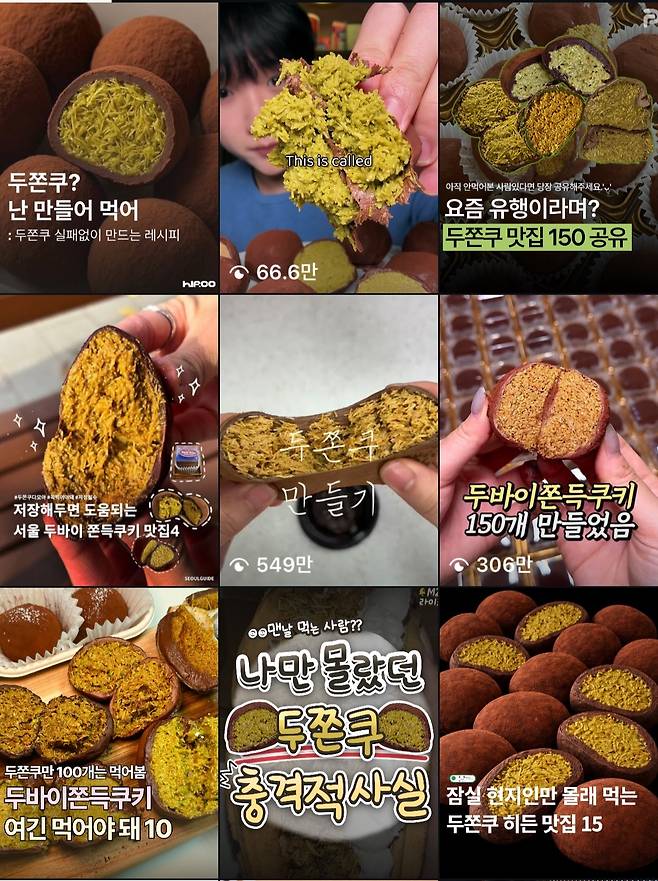
South Korea’s latest dessert craze, the Dubai chewy cookie, better known by its shorthand “dujjong-ku,” is no longer just a viral treat. It is rapidly reshaping how small businesses operate, how delivery platforms are used and even how food ingredients are priced nationwide.
Originally inspired by the Dubai chocolate trend that swept Korea in 2024, dujjong-ku is a homegrown hybrid dessert.
It is made by combining pistachio cream and kataifi, a finely shredded Middle Eastern pastry, then wrapping the filling in melted marshmallow dusted with cocoa powder. The result is a chewy, sticky texture closer to a rice cake than to a conventional cookie.
Despite its simple origins, the dessert has become one of the most sought-after food items in Korea. As shortages persist, bakeries and cafes have rushed to capitalize on the demand.
For many small dessert shops, dujjong-ku has emerged as a rare bright spot amid sluggish consumer spending. Store owners report selling hundreds of cookies a day, with some locations seeing their entire overnight batch of 200 to 300 units sell out within minutes of opening.
The frenzy intensified after Ive's Jang Won-young shared the dessert on Instagram in September. Since then, more than 30,000 Instagram posts have been tagged with the treat, and early morning open-run purchases have become routine in popular neighborhoods.
The impact has spread well beyond dessert specialists.
Restaurants with no prior connection to baked goods, including jokbal, sushi and spicy chicken feet shops, have begun selling dujjong-ku as a promotional item to boost visibility on delivery apps.
![A screenshot of a BAedal Minjok listing of a kimchijjim restaurant using "dujjonku" as a bait to appear on the search result when searching for the dessert. It has changed its menu's name to "[Instead of dujjon-ku] kimchijjim" (Captured image)](https://img4.daumcdn.net/thumb/R658x0.q70/?fname=https://t1.daumcdn.net/news/202601/12/koreaherald/20260112150203579mbeq.png)
On food delivery platforms, searches for “Dubai chewy cookie” have sharply surged over recent months.
According to the country's largest food delivery app Baedal Minjok, pickup orders for dujjon-ku during the first week of this month jumped more than 300 percent from a month earlier.
The spike has turned the dessert into a powerful search keyword, prompting some stores to insert the term into unrelated menu names purely to appear in search results.
The craze has also driven unconventional marketing tactics. A seafood restaurant recently offered a “Dubai cookie wish” menu item for 1 won, promising to start selling dujjon-ku if customers ordered it 100 times.
Online self-employed communities are filled with jokes — and not entirely joking questions — about whether hardware stores, septic cleaning companies or massage parlors should start selling the cookie.
The ripple effects extend into manufacturing and retail.
Convenience store chain CU launched a Dubai-style chewy rice cake in October and has sold more than 1.8 million units, with daily per-store supply limits imposed due to factory bottlenecks.
At the same time, the boom is straining supply chains. Pistachio, a key ingredient, has become significantly more expensive. Domestic retailers report price hikes of around 20 percent this year, driven by rising global prices and a weaker won.
International pistachio prices have climbed to about $12 per pound, up from around $8 a year earlier. Packaging costs have also doubled in some cases.
As ingredient costs rise, profit margins are shrinking. Some shops have already stopped selling dujjong-ku, while others have raised prices, with individual cookies now selling for more than 10,000 won ($7) in some locations.
Why, then, has dujjon-ku exploded so quickly?
Many experts attribute its sheer physical excess to its appeal. The dessert follows a familiar formula in Korea’s viral food culture: it is thick, heavily filled and visually overwhelming.
Korean dessert trends have repeatedly favored volume over restraint. Macarons, originally a delicate French confection with a thin layer of filling, were reinvented locally as “fat macarons” stuffed with cream several times thicker than the shell itself.
Dujjong-ku fits squarely into this lineage, offering exaggerated density and abundance that translate well on camera.
Food critic Yi Yong-jae explains that this preference reflects a deeper cultural logic. Rather than valuing subtle balance or restraint, Korean food culture tends to reward visual impact and perceived generosity.
"It is similar to preferring a table bending under ten dishes, even if some are mediocre, over a carefully prepared three-dish meal,” he said.
Social media has amplified this effect. Platforms reward foods that are immediately legible and sensational in a single image or short video, and dujjon-ku’s exaggerated thickness and overflowing fillings perform well in that environment.
According to consumer studies professor Lee Eun-hee, such runaway trends are fueled by a combination of social pressure and curiosity. “Social media is a space built on attention,” she said. “Once something becomes a talking point, people feel compelled to try it, not just to eat it, but to participate in the moment.”
Copyright © 코리아헤럴드. 무단전재 및 재배포 금지.