Industry ministry renames humanoid unit to ‘AI robots’
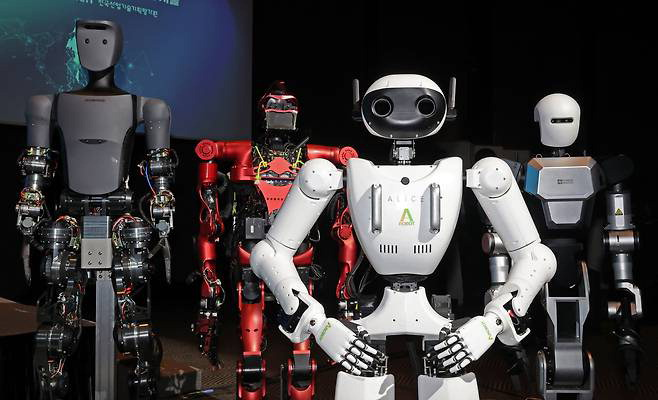
The change reflects a strategic shift away from a narrow focus on humanoids toward a wider range of robotic applications, including outdoor mobility robots and industrial robots, as the government seeks to foster an AI robot ecosystem that can be deployed across manufacturing sites.
According to the ministry on Sunday, the humanoid division of the M.AX Alliance — one of the alliance’s key project arms driving AI-led innovation in manufacturing — has been rebranded as the AI robot division and is now operating under the new name. Launched in September last year under the ministry’s leadership, the M.AX Alliance is a public-private cooperation platform aimed at accelerating an economy-wide AI transformation. It seeks to maximize productivity and build a sustainable industrial ecosystem by linking companies with rich manufacturing data to universities and research institutes developing AI models.
Humanoid robots, which resemble the human form, are widely regarded as one of the most technically demanding areas of robotics due to the complexity of achieving precise movement and balance. The ministry initially adopted the “humanoid” label based on the belief that mastering humanoid technology would enable advances across the broader robotics field.
This year, however, the ministry opted to rename the division to “AI robots” to reflect its intention to expand into all robot categories. In particular, policymakers are looking ahead to growth in markets such as outdoor mobility robots — intelligent robots capable of autonomous or remote-controlled operation for applications including delivery — as well as a variety of industrial robots. The shift is expected to support South Korea’s efforts to secure a competitive edge in the emerging field of “physical AI,” which integrates artificial intelligence with real-world robotic systems.
Copyright © 매일경제 & mk.co.kr. 무단 전재, 재배포 및 AI학습 이용 금지
- '이재용 장남' 이지호, 해군 제5전단 배치 - 매일경제
- “딸이 스스로 목숨을 끊었습니다”…가입했던 보험 있어 보험금 청구했더니 [어쩌다 세상이] -
- 삼촌은 삼전, 조카는 하이닉스 샀다…세대별 투자차이 생긴 이유는 - 매일경제
- 영하 37도까지 떨어졌다…‘항공편 모두 취소’ 관광객 수천명 발묶인 핀란드 - 매일경제
- “은행 통장에 돈 썩게두면 바보죠”…주식투자 대기자금 무려 92조원 - 매일경제
- “무알코올 맥주는 음료수죠”…아예 탕비실 쌓아두고 마신다는 이 회사 - 매일경제
- “벌어도 빚만 는다”…1인당 가계대출 9700만원 넘어 ‘역대 최대’ - 매일경제
- “월급 부칠 때마다 관두고 싶네요”...남편 퇴사 부르는 아내의 한마디는 - 매일경제
- “먼저 갑니다, 한국 욕보세요”…대만 ‘GDP 4만달러’ 먼저 찍는다 - 매일경제
- 적수가 없다!…‘세계 최강’ 안세영, 中 왕즈이 꺾고 말레이시아 오픈 3연패 달성 - MK스포츠