Korea aims for 2% growth in 2026, betting on chips, investment rebound
South Korea set out a plan to revive economic growth in 2026 while laying the groundwork for longer-term expansion, betting on strategic high-tech industries and a recovery in investment to drive the rebound.
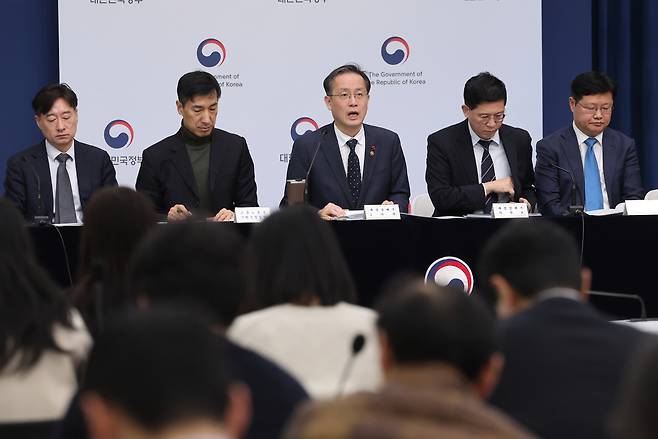
The Ministry of Economy and Finance on Friday unveiled its economic growth strategy, an annual early-year policy road map, projecting 2 percent growth this year, up from an estimated 1 percent expansion in 2025.
In rolling out the plan, the government framed 2026 as the opening chapter of a longer growth narrative running through 2045, the 100th anniversary of Korea’s liberation, positioning the strategy as more than a routine annual policy update.
“Through proactive macroeconomic management and a rebound in potential growth, we aim to achieve 2 percent growth in 2026,” First Vice Finance Minister Lee Hyoung-il said at a briefing Monday. “Building on last year’s efforts to restore growth momentum, we will pursue a bigger leap by identifying agendas toward a historic economic breakthrough in 2045 and laying out action plans that can be implemented within this administration.”
The government’s 2 percent growth forecast is slightly above the 1.8 percent outlook from the central bank and the state-run Korea Development Institute, reflecting expectations of a recovery in domestic demand and stronger-than-expected global demand for semiconductors, a cornerstone of Korea’s export-led economy.
Domestic consumption, projected to grow 1.7 percent, is expected to anchor the recovery, while exports are seen remaining resilient but expanding more slowly than last year, as imports rise with stronger domestic demand. Investment will strengthen, especially as prolonged slump in construction bottoms out, with construction investment forecast to rebound 2.4 percent in 2026, after contracting 9.5 percent last year.
Inflation is projected to remain stable at 2.1 percent, unchanged from last year, though upward pressure persists from a weak currency and higher food prices.
Building on this year’s recovery, the government set a long-term goal of reversing the slide in potential growth, which is estimated to dip below 2 percent for the first time this year and could slow to around 1 percent by 2030, before declining further in the following decade if current trends persist.
The government declared cementing Korea’s global semiconductor leadership a top priority in its growth strategy, aiming to become the world’s second-largest player by strengthening both chip manufacturing and fabless design capabilities. It plans to roll out a five-year master plan for the industry covering 2027-2031 by the fourth quarter.
To diversify growth beyond semiconductors, the governmen aims to build the world’s fourth-largest defense industry, while also cultivating biopharmaceuticals and culture as new growth engines.
The plan reiterated the government’s push for an “ultra-innovative economy,” centered on advancing and integrating artificial intelligence. Key initiatives include breaking ground on a national AI computing center, launching citywide autonomous vehicle test operations in the first half and laying out a road map to develop autonomous vessels by 2035.
Tax incentives will be expanded to accelerate the plan, including the introduction of a domestic production promotion tax scheme — dubbed Korea’s version of the Inflation Reduction Act — aimed at strengthening technology security, with detailed measures and eligible sectors to be unveiled in July.
The government will also begin test runs of digital currency in treasury management, aiming to execute up to a quarter of state funds through digital assets by 2030. Pilot use of deposit tokens in government-funded projects is planned for the first half, alongside efforts to expand applications and establish a legal framework for blockchain-based payment and settlement systems.
Beyond industrial policy, the strategy places productive finance at the center of Korea’s growth revival, with the government seeking to channel household savings, institutional money and public capital into long-term, domestic investment.
A key pillar is the National Growth Fund, a 30 trillion won ($20.6 billion) vehicle aimed at supporting strategic industries and innovative companies. The government plans to begin deployments this year, with a 600 billion won public participation fund set to launch by the third quarter, offering tax incentives to encourage long-term investment.
Separately, the government plans to establish a Korean-style sovereign wealth fund with initial capital of 20 trillion won. Funded through government-held stakes and public sector assets, the fund will prioritize investment in domestic high-tech industries such as semiconductors. Detailed operational plans will be announced in the first half.
To support the venture sector, authorities will also bolster tax incentives for startups and incorporate the secondary Kosdaq index into pension fund performance benchmarks, with the weighting to be announced this month.
The investment drive will be paired with broader reforms aimed at drawing more liquidity into local capital markets. To improve foreign investors’ access, the government unveiled a road map for inclusion in the Morgan Stanley Capital International developed-market index, including 24-hour onshore foreign-exchange trading starting in July and streamlined investor entry and trading procedures.
The government will also draw up a won internationalization road map in the first half, aimed at sharply improving foreign access to the currency and expanding demand through cross-border won-denominated payments and offshore won-based financial activities.
Copyright © 코리아헤럴드. 무단전재 및 재배포 금지.