Land Ministry admits safety lapse in Jeju Air crash, after probe finds all passengers could have survived
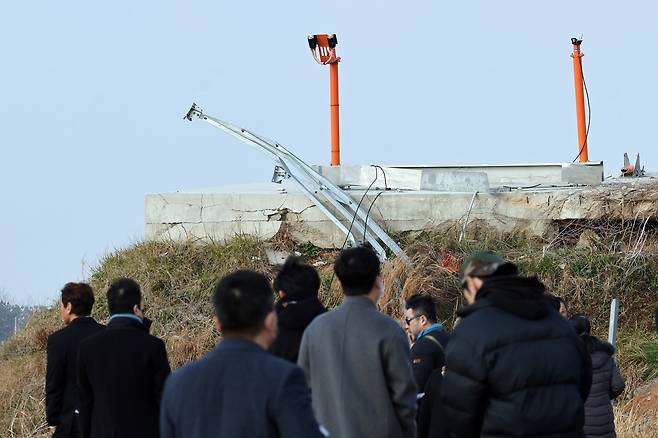
The Land Ministry has, for the first time, acknowledged that a key navigation structure involved in the fatal Jeju Air crash at Muan International Airport in December 2024 failed to meet safety standards, reversing its earlier position more than a year after the accident that killed 179 people, according to documents released Thursday by a lawmaker.
The acknowledgment was contained in a government-commissioned simulation report, obtained and disclosed by Rep. Kim Eun-hye of the People Power Party, which concluded that all passengers would likely have survived had the concrete mound supporting the airport’s localizer not existed or been designed to break upon impact.
According to the Ministry of Land, Infrastructure and Transport’s Aviation and Railway Accident Investigation Board, simulations conducted by the Computational Structural Engineering Institute of Korea showed that the aircraft would have slid along the runway and come to a stop without suffering a catastrophic impact.
The plane made a belly landing after a bird strike left its landing gear inoperable, but the outcome would likely have been different had it not collided with the concrete structure. Documents indicate that the force generated during the aircraft’s runway slide would not have led to serious injuries.
The analysis found that on flat ground without obstacles, the plane likely would have skidded some 630 meters before stopping, allowing the passengers to be rescued. Separate simulations assuming a frangible, breakaway structure for the localizer similarly projected no serious injuries and limited damage to the aircraft.
The Jeju Air vessel ultimately exploded after colliding with the concrete mound supporting the localizer — a navigation aid that guides aircraft approaching the runway.
In a significant shift, the Land Ministry told the Assembly that the localizer at Muan Airport “failed to comply with airport safety operation standards,” and that during a 2020 upgrade project, the structure should have been modified to be breakable if located within 240 meters of the runway end.
Immediately after the crash, the ministry had maintained that the installation was legal, arguing that the mound was erected 199 meters from the runway end — beyond the 150-meter minimum it cited at the time.
But airport safety standards established in 2003 require that navigation facilities installed within 240 meters of the end of a runway be designed to break upon impact and that they be installed as low as possible. While those standards formally took effect in 2010, the failure to modify the structure during a 2020 upgrade has since emerged as a central issue.
Despite including a requirement to review frangibility measures in the upgrade project’s design tender, the localizer remained on the concrete mound. Rep. Kim said meeting records show that no objections were raised when Muan Airport opted to keep the structure unchanged.
“This amounts to an acknowledgment that necessary safety improvements were not made during the 2020 upgrade,” Kim said in a statement, calling for strict accountability. She added that a parliamentary investigation would examine how the concrete mound — not included in the airport’s original 1999 design plans — came to be built.
The victims’ families welcomed the findings, issuing a statement calling the crash “a clear case of human error” and rejecting the notion that it was unavoidable. They demanded an official apology from investigators, legislative changes to ensure the independence of accident probes, full disclosure of investigation materials and a comprehensive parliamentary inquiry.
Meanwhile, the People Power Party on Friday called for a full criminal investigation into those responsible, warning that a special counsel probe should be launched if the current inquiry proves insufficient. Lawmakers from the main opposition party revealed that the simulation report had been completed in August but remained undisclosed until now.
The party also criticized existing laws, noting that airport navigation structures such as localizers are not explicitly covered under the Serious Accidents Punishment Act, urging legal revisions to hold accountable those responsible. They called for investigations to include senior officials involved in the airport’s construction and the 2020 upgrade, noting that none of the 44 individuals currently booked by police include high-ranking Transport Ministry officials.
“The hill that should have been breakable became a deadly barrier,” Kim said. “We must uncover the full truth behind how this happened.”
The Jeju Air crash occurred on Dec. 29, 2024, when a Boeing 737 operating a domestic flight attempted an emergency landing at Muan International Airport in South Jeolla Province after a bird strike disabled its landing gear.
The aircraft made a belly landing and slid along the runway before colliding with a concrete structure supporting the airport’s localizer, a navigation aid used during runway approaches.
The collision triggered an explosion and fire, killing 179 of the 181 people on board, making it one of the deadliest aviation accidents in South Korea in decades. The investigation into the precise causes of the crash remains ongoing.
Copyright © 코리아헤럴드. 무단전재 및 재배포 금지.