Korea’s current account surplus widens in Nov. on robust chip exports
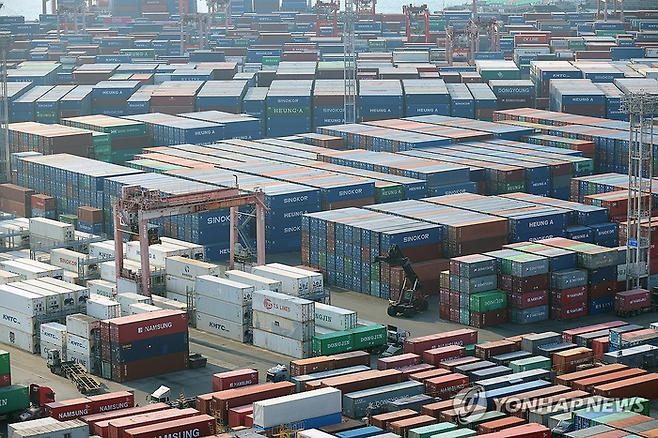
According to data released by the Bank of Korea (BOK) on Friday, the country’s current account surplus stood at $12.24 billion in November 2025.
The figure marked the 31st consecutive month of surplus, with the surplus exceeding $6.81 billion in October and $10.05 billion in November a year ago
When comparing November figures alone, it was the largest on record.
The cumulative current account surplus from January to November last year also reached a record $101.82 billion, up 17.5 percent from $86.68 billion in the same period a year earlier.
The goods account recorded a surplus of $13.31 billion in November, about 1.7 times larger than $7.82 billion in October, data showed.
It ranked fourth highest on a monthly basis and was the largest ever for November alone.
Exports stood at $60.11 billion in November, up 5.5 percent from $56.99 billion a year earlier.
The BOK noted that overall exports returned to year-on-year growth for the first time in two months, driven by a surge in information technology (IT) exports centered on semiconductors, and strong performance in the non-IT sector, including passenger cars.
Exports to Southeast Asia climbed 18.4 percent and to China 6.9 percent, while those to the United States fell 0.2 percent, the European Union slid 1.9 percent, and Japan dropped 7.7 percent.
Imports totaled $46.8 billion in November, down 0.7 percent from $47.11 billion a year earlier.
The decline was driven mainly by a 7.9 percent drop in raw material imports, reflecting falling energy prices, with imports of gas down 33.3 percent, petroleum products down 16.9 percent, and crude oil down 14.4 percent.
Capital goods imports, on the other hand, rose 4.7 percent, led by information and communications equipment (up 16.5 percent) and transport equipment (up 20.0 percent), while consumer goods imports jumped 19.9 percent.
Gold imports, in particular, surged 554.7 percent.
The services account registered a deficit of $2.73 billion in November.
Although the deficit narrowed from the previous month’s $3.75 billion, it widened from $1.95 billion a year earlier.
The travel deficit totaled 960 million, down from $1.36 billion a month earlier, as the number of outbound travelers declined after a surge during the Chuseok holiday.
The primary income account, which tracks wages of foreign workers and dividend payments overseas, recorded a surplus of $1.83 billion, down more than $1.1 billion from the previous month’s $2.94 billion.
In particular, the dividend income surplus plunged from $2.29 billion to $1.25 billion in one month as quarterly dividends were paid to overseas securities investors.
Net assets in financial account increased by $8.27 billion in November.
Direct investment of Koreans overseas rose by $4.09 billion, while that of foreigners in Korea increased by $1.76 billion.
In securities investment, Koreans’ overseas investments rose $12.26 billion while foreigners’ investments in Korea gained $5.74 billion.
Copyright © 매일경제 & mk.co.kr. 무단 전재, 재배포 및 AI학습 이용 금지
- “어려운 분들에게 전해주세요”…우체통에 성금 넣고 간 ‘기부천사’ - 매일경제
- 삼성전자 장 초반 팔아치운 초고수들…상승 전환에 후회할까[주식 초고수는 지금] - 매일경제
- 이재명표 '용산공원 아파트' 나올까…도심 최후 가용지 총동원 - 매일경제
- [속보] ‘내란 우두머리’ 윤석열 전 대통령 결심공판 시작 - 매일경제
- [단독] 이러다 재개발 또 늦어지는 거 아니야?…순항하던 성수4지구 ‘시끌’, 무슨 일이 - 매일
- 도망치려했는데 단속 요원 차로 치려했다니…총격 사망 여성 영상 ‘대반전’ - 매일경제
- 트럼프 “대만 문제는 시진핑이 결정할 일…공격 않기를 희망” - 매일경제
- [단독] 서민대출 ‘햇살론’의 배신…지원 필요한 저신용자 줄고 고신용자는 급증 - 매일경제
- 한반도 상공에 ‘영하 40도’ 찬공기…주말 대설경보급 ‘눈폭탄’ - 매일경제
- [공식발표] 베테랑 홍정호 떠나보낸 전북, ‘국대 수비수’ 박지수 영입…“헌신적인 수비로 전