Lee urges faster push on AI infrastructure, energy transition
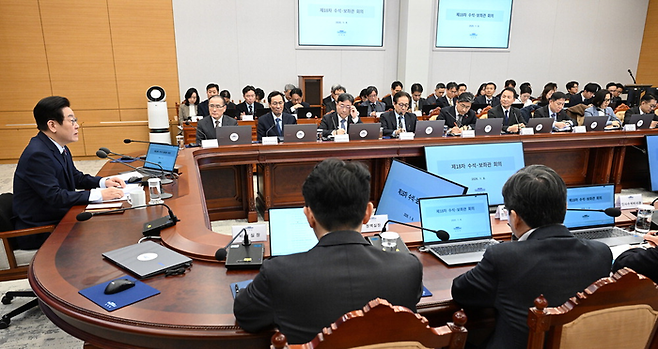
Speaking at his first senior secretaries and advisers meeting at Yeomin 1 Building of Cheong Wa Dae, Lee said the global race for an AI-driven transformation has evolved into a factor determining national destiny, not merely corporate competitiveness. He emphasized that sustainable, inclusive growth hinges on securing future-oriented advanced industrial capabilities.
Lee urged faster action in securing AI talent, expanding infrastructure and strengthening global cooperation, underscoring his vision to use AI as a foundation for a qualitative transformation across all sectors of society. The meeting addressed issues including strategies for building an AI innovation ecosystem, Korea’s economic growth strategy, the creation of a basic AI-driven society, and AI security and global leadership. He also highlighted the need for an energy transition, noting that AI data centers require massive amounts of electricity.
“How we prepare future energy sources and respond to the energy transition could determine not only economic growth but the nation’s fate,” Lee said, calling for thorough preparation. His remarks have drawn attention to the possibility that the government may increase the share of nuclear power in its energy mix.
Earlier, Kim Sung-hwan, minister of climate, energy and environment, said it was contradictory for South Korea to export nuclear power plants while refraining from building them domestically during the Moon Jae-in administration, a stance widely interpreted as signaling a policy shift under the Lee administration.
Commenting on AI infrastructure discussions, presidential spokesperson Kim Nam-joon said the government had not reviewed relocating semiconductor companies to regional areas, adding that such decisions should be left to businesses.
Lee and his senior aides are set to meet business leaders to gather views on industrial policy. On Friday, Lee will host a public briefing on economic growth strategies and invite corporate leaders, including representatives from AI unicorn Rebellions, swarm AI drone control specialist Pablo Air, and game developer Shift Up. Executives from traditional companies such as LS Cable & System, Samyang Foods, and CJ Olive Young, as well as small business owners, will also attend.
At the meeting, Lee plans to lead discussions on innovation strategies to revive potential growth and policies aimed at balanced development. Separately, Senior Presidential Scretary for Policy Kim Yong-beom will hold a closed-door meeting at the Korea Chamber of Commerce and Industry with executives from major conglomerates, including Samsung, SK, Hyundai Motor, LG, Lotte, POSCO, Hanwha, HD Hyundai, GS and Hanjin, to review investment and employment plans. Youth employment and regional investment expansion are expected to be key agenda items.
Lee earlier declared in his New Year’s address that this year would mark the starting point of a “great leap forward” for Korea. Reiterating that message at Thursday’s meeting, he said the seeds of change that emerged in the second half of last year must translate into concrete results felt in people’s daily lives this year.
Copyright © 매일경제 & mk.co.kr. 무단 전재, 재배포 및 AI학습 이용 금지
- “어려운 분들에게 전해주세요”…우체통에 성금 넣고 간 ‘기부천사’ - 매일경제
- 삼성전자 장 초반 팔아치운 초고수들…상승 전환에 후회할까[주식 초고수는 지금] - 매일경제
- 이재명표 '용산공원 아파트' 나올까…도심 최후 가용지 총동원 - 매일경제
- 도망치려했는데 단속 요원 차로 치려했다니…총격 사망 여성 영상 ‘대반전’ - 매일경제
- 한반도 상공에 ‘영하 40도’ 찬공기…주말 대설경보급 ‘눈폭탄’ - 매일경제
- 서울 부동산 규제 반사이익…부산·울산 집값 ‘쑥쑥’ 오르네 - 매일경제
- [속보] ‘내란 우두머리’ 윤석열 전 대통령 결심공판 시작 - 매일경제
- 여고생 2명 ‘조르기 기술’로 기절시킨 20대 유도사범…이유가 황당 - 매일경제
- [단독] 이러다 재개발 또 늦어지는 거 아니야?…순항하던 성수4지구 ‘시끌’, 무슨 일이 - 매일
- [공식발표] 베테랑 홍정호 떠나보낸 전북, ‘국대 수비수’ 박지수 영입…“헌신적인 수비로 전