Samsung's operating profit forecast triples to $14 billion fueled by memory supercycle
![A logo of Samsung Electronics at its Seocho office building in southern Seoul on Jan. 8 [YONHAP]](https://img2.daumcdn.net/thumb/R658x0.q70/?fname=https://t1.daumcdn.net/news/202601/08/koreajoongangdaily/20260108182947818icis.jpg)
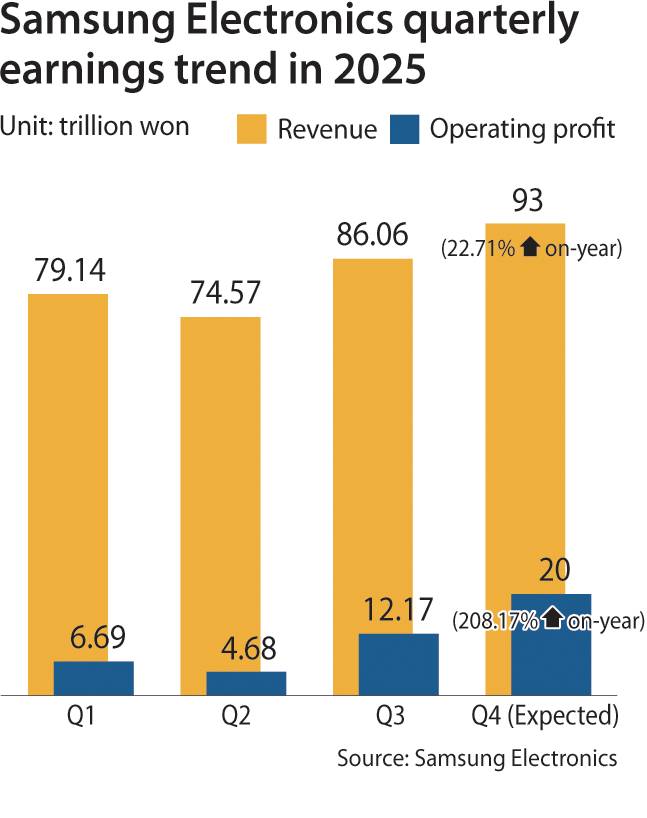
Samsung Electronics' estimated operating profit more than tripled to 20 trillion won ($14 billion) for the September-December 2025 period compared to the year before, beating even heightened market expectations amid a semiconductor supercycle driven by the AI boom.
The estimate blew past the market consensus of 18.5 trillion won provided by market tracker FnGuide, marking a whopping 208.17 percent surge from the same quarter a year earlier. Projected revenue provided by the chipmaker stood at 93 trillion won, also surpassing the market forecast of 91.47 trillion won and an increase of 22.71 percent on year.
Detailed figures per business division were not given during the preliminary guidance. The company is scheduled to release full earnings later this month.
Analysts expect the chip segment to post a record operating profit of more than 16 trillion won, the highest quarterly result in the unit's history. The previous peak was 13.65 trillion won in the third quarter of 2018 during the last chip upcycle.
A golden age for memory semiconductors... and foundries? By division, memory’s operating profit is expected to come to 17.7 trillion won, with 15.5 trillion won from dynamic random-access memory (DRAM) and 2.2 trillion won from NAND flash chips, driven by memory price increases from supply shortages, according to an SK Securities report. However, the report forecast chip manufacturing and chip design divisions, combined, to log 1.1 trillion won in operating loss.
Supply constraints are not limited to high bandwidth memory (HBM) chips used in AI accelerators. As global chipmakers prioritize HBM production, supplies of conventional DRAM and NAND chips are also tightening, benefiting Samsung across its broader memory portfolio.
“Major server customers are planning for faster server build-outs to meet surging token demand, prioritizing supply chain stability over pricing,” Daishin Securities analyst Ryu Hyung-keun said. “As a result, server DRAM prices in the first quarter of 2026 are projected to rise 40 to 50 percent quarter-on-quarter.”
Analysts note that memory manufacturers are becoming more cautious in capacity planning amid the AI boom, increasing the risk of supply shortages as demand shifts from predictable consumer electronics to hyperscale AI data centers capable of driving sudden demand spikes.
“With supply prepared cautiously and AI-driven demand rising in stepwise bursts, the industry is increasingly exposed to severe shortages in 2026 and 2027,” Meritz Securities analyst Kim Sun-woo said. “Chip price momentum is expected to persist throughout the year, reinforced by the seasonality of conventional demand, with memory makers’ share prices likely to move in tandem.”
Although Samsung’s foundry business is still projected to post losses for now, industry observers expect it to swing back to black later this year following new deals with U.S. Big Tech companies, including Qualcomm.
![Samsung Electronics Executive Chairman Lee Jae-yong inspects cleanroom facilities at NRD-K, a newly built semiconductor research and development complex, at Samsung’s Giheung semiconductor campus in Yongin on Dec. 22 [SAMSUNG ELECTRONICS]](https://img1.daumcdn.net/thumb/R658x0.q70/?fname=https://t1.daumcdn.net/news/202601/08/koreajoongangdaily/20260108182950666qfdm.jpg)
Qualcomm is reportedly in talks with Samsung over the contract manufacturing of two-nanometer chips for mobile processors, according to an exclusive report by the Korea Economic Daily. The report cited recent comments from Qualcomm CEO Cristiano Amon at CES 2026. If confirmed, the deal would mark Qualcomm’s return to Samsung as a key customer after five years, following its shift to TSMC in 2022 due to Samsung’s manufacturing challenges.
Jun Young-hyun, vice chairman of Samsung Electronics and head of its chip business, said the foundry division is “at the threshold of its next leap forward” in his New Year’s address on Jan. 2, following a major $16.5 billion deal with Tesla signed in July 2025.
![Samsung Electronics HBM4, a sixth-generation high-bandwidth memory solution for AI and HPC applications, on display during the 2025 Korea Tech Festival in Seoul on Dec. 4, 2025. [REUTERS/YONHAP]](https://img1.daumcdn.net/thumb/R658x0.q70/?fname=https://t1.daumcdn.net/news/202601/08/koreajoongangdaily/20260108182952106nzdh.jpg)
Shares skyrocket Investment firms have unanimously maintained buy ratings on the stock. Daishin Securities set the highest six-month target price at 180,000 won, matching targets from Korea Investment & Securities and KB Securities. DB Securities set a target of 174,000 won, while Eugene Investment & Securities, DS Securities and Kiwoom Securities set theirs at 170,000 won.
Samsung shares closed at 138,800 won on Thursday following the earnings guidance release, up 27 percent from Dec. 8, 2025.
On Wednesday afternoon, Samsung announced plans to repurchase 2.5 trillion won worth of its own shares for future stock-based compensation for employees. The company plans to acquire a total of 18 million shares by April 7.
BY LEE JAE-LIM [lee.jaelim@joongang.co.kr]
Copyright © 코리아중앙데일리. 무단전재 및 재배포 금지.
- 'Do you know who I am?' Hoka distributor CEO resigns after allegedly beating workers in abandoned church
- [단독] 산업부, 용인 반도체 클러스터 재확인…“이전 계획 없다”
- Kim Jong-un's relationship with daughter under scrutiny after New Year's cheek kiss
- 'When Life Gives You Tangerines,' 'Harbin' honored at Baeksang Awards — as it happened
- Hikers urged to maintain caution as wild boars become regular sight on Mount Bukhan
- Bye bye, Asiana: Hanjin to merge airline operations under Korean Air, Jin Air brands in 2026, chairman says
- Court orders release of Korean President Yoon Suk Yeol — as it happened
- Get your puffer jacket ready: Cold wave advisories to take effect in Korea from Wednesday evening
- 'Culinary Class Wars' producers to pursue legal action over malicious online comments
- Korean man allegedly killed by Indian girlfriend in Uttar Pradesh