Opposition lawmaker floats curb on foreign homebuyers
A conservative lawmaker on Thursday floated bills to address foreign buying of South Korean real estate and to tackle the malicious practice of landlords failing to return deposits to tenants under the country's "jeonse" housing lease system, in which tenants pay a large upfront deposit instead of monthly rent.
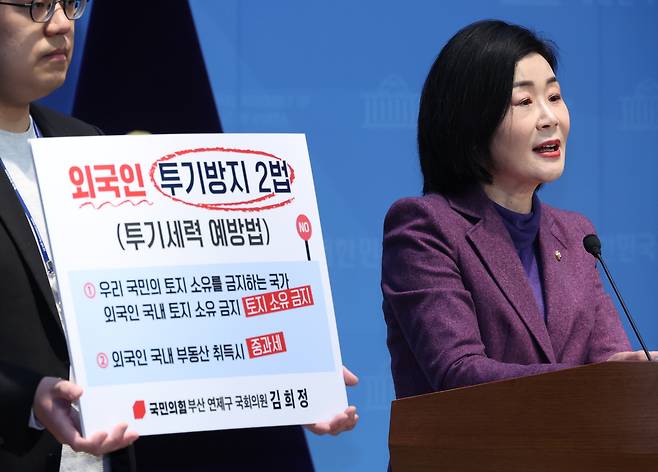
Rep. Kim Hee-jung of the main opposition People Power Party introduced a legislative package of five bills that would impose new curbs on non-Korean investors buying real estate, claiming they are not subject to the same level of oversight as Korean nationals on property purchases.
The Lee Jae Myung administration's strict regulations capping mortgage lending are "putting (South Korean) people in a dire situation" as they struggle to meet the requirements to buy a home to live in, Kim said, adding that foreign speculative capital still remains a "regulatory blind spot."
Under the new bills, foreign buyers would in principle be required to obtain permission from authorities to acquire land in South Korea. Also, buyers from countries that prohibit foreign land ownership, such as China, would be banned altogether from owning land in South Korea.
Foreign real estate buyers would also be subject to a 20 percent acquisition tax surcharge, according to Kim.
"We can no longer tolerate acts of plundering our citizens' property by foreigners who act outside South Korea's legal boundaries," Kim said.
Concerning jeonse failures involving foreign homeowners, the bills would allow travel bans for those who habitually fail to return tenants' money. Foreign landlords who fail to pay back the jeonse deposit could be subject to mandatory disclosure of their identities, including nationality, visa status, period of eligible stay and history of tax delinquencies.
Additionally, foreigners who operate private housing rental businesses in South Korea would be subject to the mandatory use of an escrow system to ensure their financial solvency.
In normal circumstances, if a foreign landlord fails to return jeonse deposits to tenants at the expiration of their contract, the state-run Korea Housing and Urban Guarantee fills in to provide guarantees for deposits.
In the past four years, the amount of money that the state-run company has paid back to tenants on behalf of foreign landlords has totaled 16 billion won ($11 million), Kim said, adding that the company had managed to recover less than 2 percent of that amount from the delinquent foreign landlords.
The Lee administration has imposed regulations on property transactions by foreigners in Seoul, as well as in select areas of Gyeonggi Province and Incheon.
Effective for a year starting last August, the rule requires foreign buyers to obtain permission from local authorities in these regions, start living in the property within four months of the transaction and live there for at least two years.
In addition, a new enforcement decree unveiled in December will come into effect in February, requiring prospective foreign homebuyers to disclose their visa status and financing plans.
Copyright © 코리아헤럴드. 무단전재 및 재배포 금지.