'Speed will decide AI humanoid race'
LAS VEGAS — Hyundai Motor Group is positioning AI-powered humanoid robots not as a long-term vision, but as practical tools that can immediately transform how manufacturing plants operate.
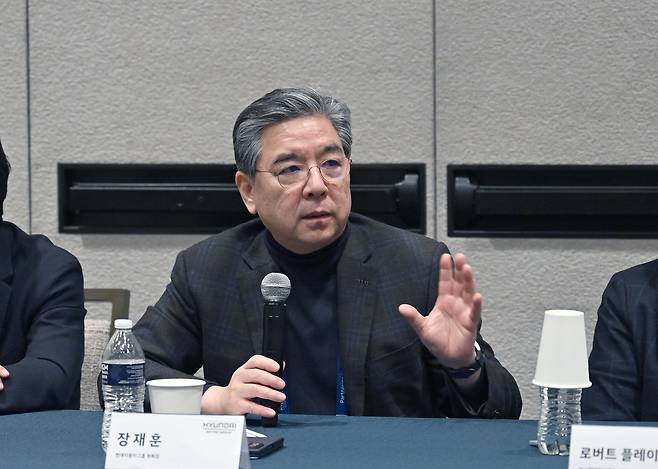
That message came through clearly in a standing interview Wednesday at the company’s CES exhibition booth, where Vice Chair Chang Jae-hoon stressed that Hyundai’s robotics and AI push is the result of years of preparation — not a response to short-term market trends or CES buzz.
“AI has been discussed for quite some time,” Chang said. “The key question was whether we could actually realize that vision with real data. That’s why we integrated the capabilities of our group companies.”
Hyundai’s CES showcase, centered on Boston Dynamics, highlighted not only its next-generation Atlas humanoid robot but also the group’s broader strategy to shift core operations toward AI-driven systems. Chang said execution speed is now the decisive factor.
“AI transformation ultimately comes down to speed,” he said. “What matters is how fast we can move, and that’s where the company will focus.”
To accelerate that process, Hyundai has actively partnered with global technology leaders such as Nvidia and Qualcomm, even as some question whether reliance on external partners could slow the internalization of core AI capabilities.
At Hyundai’s Media Day earlier this week, Chang said the key technical challenge lies in defining how much perception and decision-making a humanoid robot’s general-purpose “brain” can handle — and how effectively those decisions translate into physical action.
“When it comes to execution, partnering with industry leaders makes the most sense,” he said.
During CES, Hyundai Motor Group Executive Chair Chung Euisun met with Nvidia CEO Jensen Huang and Qualcomm Chief Operating Officer Akash Palkhiwala. Chang described the discussion with Huang as informal and forward-looking rather than tied to a specific deal. Separately, Hyundai Mobis announced a partnership to integrate Qualcomm’s AI chips into its control units for advanced driver assistance systems.
On nurturing Korea’s robotics ecosystem, Chang emphasized urgency, citing intensifying global competition — particularly from China.
“Building a domestic robotics ecosystem has to move in step with the government’s AI agenda,” he said, pointing to Hyundai’s Robotics Lab in Korea and deeper collaboration with Boston Dynamics. “Speed matters here, especially as China is pushing robotics aggressively.”
Unlike rivals targeting household humanoid robots, Hyundai is deliberately prioritizing industrial deployment, citing unresolved issues around safety, reliability and real-world validation.
“The priority is to clearly define applications — where and how robots are actually used,” Chang said. “The data generated in those environments must feed back into improving both task quality and operational performance.”
Safety remains the next major hurdle, he added, which is why Hyundai plans to validate humanoid robots first in controlled factory settings.
“It makes sense to start with business-to-business, not business-to-customer,” Chang said. “By deploying robots in our own production sites, we can refine the technology before scaling it across industries.”
Interest in Hyundai’s robotics vision was evident at CES, with 3,350 visitors lining up on the show’s opening day to view the company’s exhibition booth.
Copyright © 코리아헤럴드. 무단전재 및 재배포 금지.