U.S.-China nuclear push reshapes market as Kepco shifts export strategy
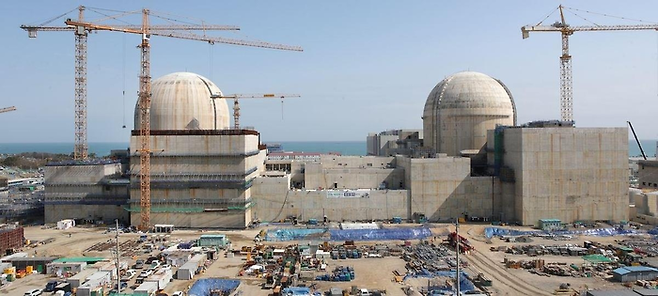
According to the Korea Nuclear Association on Tuesday, the International Energy Agency (IEA) projected in November last year that global nuclear power capacity will reach 638 gigawatts by 2040. This represents an increase of roughly 70 percent from the current 376 gigawatts tallied by the International Atomic Energy Agency (IAEA), and is 52 gigawatts higher than the IEA’s forecast issued a year earlier.
The IAEA also raised its outlook late last year, estimating global nuclear capacity in 2040 at between 519 gigawatts and 710 gigawatts, up significantly from its previous range of 491 gigawatts to 694 gigawatts.
The association noted that global nuclear capacity had been in decline following the 2011 Fukushima nuclear accident, as many countries canceled new reactor projects. “Recently, however, nuclear power expansion is being actively promoted again to strengthen energy security and reduce greenhouse gas emissions,” it said.
The resurgence is being led by the United States and China, which are locked in broader strategic competition. In May last year, Donald Trump declared a “nuclear renaissance” after signing four executive orders aimed at revitalizing the sector. The U.S. plans to quadruple its nuclear generation capacity from around 100 gigawatts to 400 gigawatts by 2050.
Support for nuclear power also continued under the Joe Biden administration through the Inflation Reduction Act, which provides tax credits covering 30 percent of new nuclear construction costs. Electricity generated by next-generation nuclear plants is eligible for tax credits of at least $27.5 per megawatt-hour for 10 years, while power produced by existing reactors qualifies for credits of $15 per megawatt-hour.
China’s push has been equally aggressive. The Chinese government plans to increase nuclear power generation from the current 451 terawatt-hours to 1,408 terawatt-hours by 2050. The Oxford Institute for Energy Studies projects that China will overtake the United States as the world’s largest holder of nuclear generation capacity by 2030. From 2014 to 2023, China accounted for 33 of the 61 nuclear reactors that broke ground worldwide, according to the association.
Analysts say the U.S. nuclear expansion presents a major opportunity for South Korea. Shim Sang-min, a senior research fellow at the Asan Institute for Policy Studies, said in a recent report that “South Korea is capable of providing the new nuclear construction capacity that the United States needs.”
He also pointed to growing room for cooperation in nuclear fuel supply chains, citing a memorandum of understanding signed by Korea Hydro & Nuclear Power and POSCO International with Centrus Energy to expand uranium enrichment facilities in the United States.
Korea’s nuclear export agencies, including Kepco, are also stepping up efforts to develop strategies for new reactor projects. Kepco said it recently commissioned a policy consulting project focused on nuclear power exports, aimed at defining participation strategies for overseas projects.
Beyond exporting its APR1400 reactor, Kepco plans to explore ways to enter nuclear projects using other reactor models. The strategy includes enabling South Korea’s nuclear value chain — spanning design firms, equipment suppliers and construction companies — to participate in projects based on foreign reactor technologies.
The utility is also considering diversification through participation in small modular reactor projects and plans to craft customized marketing strategies tailored to country-specific policies in markets such as the United States, Canada and Saudi Arabia.
Through the consulting project, Kepco also intends to outline concrete measures to advance bilateral nuclear cooperation with the United States, identifying nuclear-related business opportunities that can be carried out domestically through government-led U.S. investment initiatives.
Kepco’s move is also seen as a strategic response to ongoing discussions at the Ministry of Trade, Industry and Resources over streamlining South Korea’s fragmented nuclear export system. The ministry is reviewing options to either establish a new dedicated body or consolidate export authority under Kepco or Korea Hydro & Nuclear Power, amid criticism that the current dual-track structure has undermined efficiency.
Copyright © 매일경제 & mk.co.kr. 무단 전재, 재배포 및 AI학습 이용 금지
- “솔직히 중국 따라갈 자신없다”…CES 정복한 ‘중국산’에 탄식만 - 매일경제
- 삼성전자 24만원·하이닉스 112만원...믿기 힘든 목표가 나왔다 - 매일경제
- “한달 18만원, 나만 이렇게 비싸게 내나”…실손보험, 갈아타야 하나 고민이라면 - 매일경제
- 75명 사망자 낸 베네수 마두로 체포작전, 미군 피해 이정도라니 - 매일경제
- 삼성전자 작년 4분기 영업익 20조원…대한민국 기업 사상 최대 - 매일경제
- “가격 안 보고 삽니다”…만성 ‘공급부족’에 폭등, 젠슨 황도 찜한 이 업종 - 매일경제
- “억대 연봉인데, 월급 31개월치 한번에 준다”…연초 희망퇴직 받는 ‘이 회사’ - 매일경제
- 40대 한국인 인도서 흉기 찔려 숨져…20대 현지인 여성 구속 - 매일경제
- “자녀 결혼에 1억3000만원 실화냐”…은퇴 닥칠 아빠 노후 ‘무방비’ - 매일경제
- SON 없어도 든든하네! ‘韓 최고 재능’ 양민혁 향한 ‘코번트리 출신’ 매디슨의 애정 미쳤다…