Hyundai Motor surges on Jensen Huang boost
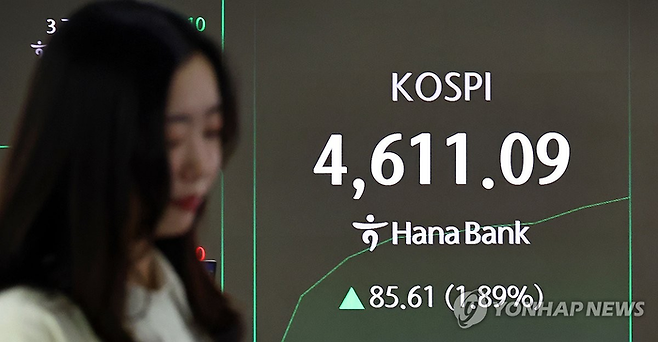
The Kospi finished the session up 0.57 percent, or 25.58 points, at 4,551.06, after briefly topping the 4,600 level intraday. Shares of Samsung Electronics and SK hynix rose around 4 percent and 5 percent, respectively, while Hyundai Motor surged as much as 17.53 percent.
Despite the headline gains, market breadth remained weak. Investor attention stayed concentrated on large-cap semiconductor stocks, which account for roughly 30 percent of the Kospi’s total market capitalization, leaving most mid- and small-cap shares under pressure. Even as the index ended higher, a majority of Kospi-listed stocks and the tech-heavy Kosdaq market closed in negative territory.
The Kospi held above the 4,550 level into the close, although gains narrowed late in the session. Optimism was fueled by comments from Jensen Huang, chief executive of Nvidia, who on Tuesday (local time) delivered a bullish assessment of the global memory chip market. Investor sentiment was further lifted by reports that Huang is set to meet Hyundai Motor Group Chairman Chung Eui-sun.
While the index advanced, internal market dynamics told a different story. Excluding LG Energy Solution, all of the top five stocks by market capitalization posted gains, yet 73.68 percent of Kospi-listed shares declined. Of 931 stocks, 686 fell, while only 202 advanced.
This pattern has persisted throughout the index’s record-setting run. According to Koscom, when the Kospi first reached the 4,300 level on Jan. 2, only 341 stocks gained while 456 declined. On Jan. 4, decliners outnumbered advancers by 10, and even on the previous day, when the index broke above 4,500, falling stocks exceeded rising ones by 74.
Performance gaps between large caps and smaller shares have also widened. From Dec. 5 through Jan. 7, the Kospi rose 12.97 percent, while the Kosdaq gained just 1.89 percent. Over the same period, Samsung Electronics, SK hynix and SK Square each jumped more than 30 percent, with half of the Kospi’s top 10 stocks outperforming the index. In contrast, the Kospi mid-cap and small-cap indices fell 2.31 percent and 0.96 percent, respectively.
Upward revisions to earnings forecasts for Samsung Electronics and SK hynix continue to gather momentum. On Tuesday (local time), global investment bank Macquarie raised its target price for Samsung Electronics to 240,000 won ($166) from 175,000 won, and for SK hynix to 1.12 million won from 800,000 won — the highest targets among domestic and overseas brokerages.
Macquarie lifted its 2026 operating profit forecast for Samsung Electronics to 151.2 trillion won, roughly 50 percent above its previous estimate. For SK hynix, the investment bank raised its 2026 earnings-per-share outlook by 72 percent and projected operating profit of 136.5 trillion won. “The global memory chip supply shortage is unlikely to find a clear resolution before 2028,” Macquarie said, adding that “excessive concerns over the memory cycle should be avoided and premature selling is not advisable.”
Market watchers expect the semiconductor-led rally to further deepen polarization in the equity market ahead of the earnings season for fourth-quarter results. Unlike the period of September and October last year, when the so-called “memory supercycle” fueled broader risk appetite, conditions remain unfavorable for a sustained rotation into mid- and small-cap stocks.
Lee Kyung-min, a researcher at Daishin Securities, said sentiment could gradually improve for selected stocks that deliver upbeat guidance when companies report fourth-quarter results later this year. “Until then, the rally is likely to remain driven by large-cap semiconductor stocks, with investment appetite for mid- and small-cap shares staying limited,” he said.
Copyright © 매일경제 & mk.co.kr. 무단 전재, 재배포 및 AI학습 이용 금지
- “솔직히 중국 따라갈 자신없다”…CES 정복한 ‘중국산’에 탄식만 - 매일경제
- 삼성전자 24만원·하이닉스 112만원...믿기 힘든 목표가 나왔다 - 매일경제
- “한달 18만원, 나만 이렇게 비싸게 내나”…실손보험, 갈아타야 하나 고민이라면 - 매일경제
- 75명 사망자 낸 베네수 마두로 체포작전, 미군 피해 이정도라니 - 매일경제
- 삼성전자 작년 4분기 영업익 20조원…대한민국 기업 사상 최대 - 매일경제
- “가격 안 보고 삽니다”…만성 ‘공급부족’에 폭등, 젠슨 황도 찜한 이 업종 - 매일경제
- “억대 연봉인데, 월급 31개월치 한번에 준다”…연초 희망퇴직 받는 ‘이 회사’ - 매일경제
- 40대 한국인 인도서 흉기 찔려 숨져…20대 현지인 여성 구속 - 매일경제
- “자녀 결혼에 1억3000만원 실화냐”…은퇴 닥칠 아빠 노후 ‘무방비’ - 매일경제
- SON 없어도 든든하네! ‘韓 최고 재능’ 양민혁 향한 ‘코번트리 출신’ 매디슨의 애정 미쳤다…