More than a demo: Hyundai robots clock in at CES
LAS VEGAS — Hyundai Motor Group on Tuesday laid out its vision for AI-driven robotics at CES 2026, offering a detailed look at how robots — from humanoids to mobile platforms — are moving from experimental tools to core assets on factory floors.
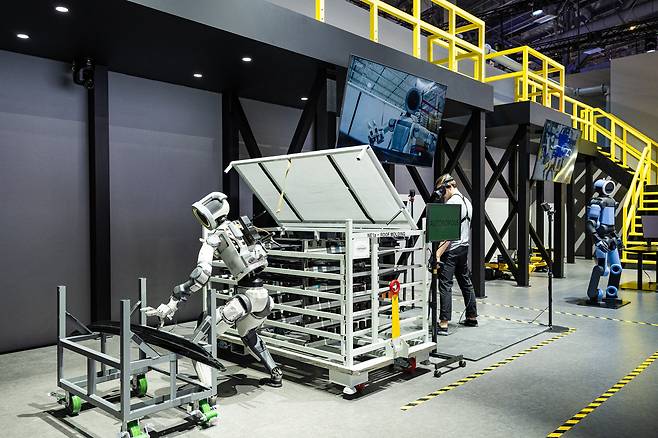
At the center of the showcase was Boston Dynamics’ next-generation Electric Atlas humanoid, which performed a live autonomous production task in public for the first time. Unlike the tightly choreographed demonstrations typical of trade shows, Atlas operated under an “autonomous AI policy,” trained over several days by Boston Dynamics engineers using newly collected task data.
“This is not just a demo — it’s a live experiment,” said Aya Durbin, head of humanoid application strategy at Boston Dynamics. Engineers stood nearby wearing teleoperation equipment, ready to intervene if the robot made an error. Any corrections, Durbin explained, are fed back into the system, allowing Atlas to improve its performance through repetition and learning.
Atlas demonstrated parts sequencing, a real manufacturing process used at Hyundai plants that involves sorting and arranging vehicle components before assembly. The task is widely regarded as repetitive and physically demanding for human workers. During the demonstration, the humanoid robot lifted car roof molding pieces one by one and carefully placed them into designated slots on a multitier rack, highlighting its precision and stability.
Hyundai said Atlas is expected to take on similar low-risk but labor-intensive tasks initially, with plans to expand its role into broader manufacturing and fulfillment operations as the technology matures.
Alongside Atlas, Boston Dynamics’ four-legged robot Spot showcased its growing role in industrial environments. Using Orbit AI, Spot demonstrated remote facility inspection, real-time monitoring and AI-based problem detection. Responding to an engineer’s command, the robot used its gripper to open a door, illustrating how it can access confined or hazardous areas that may pose risks to human workers.
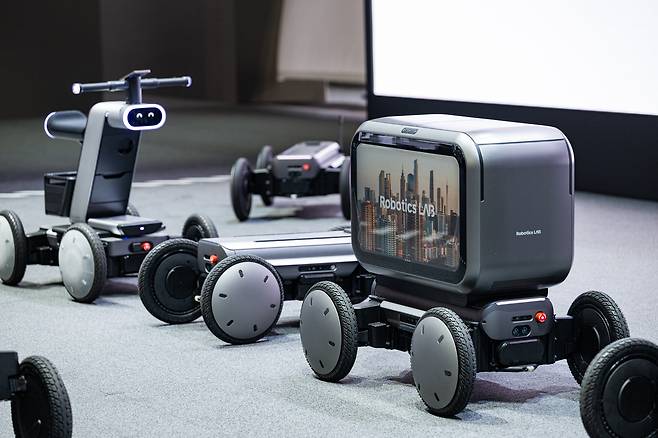
Hyundai also highlighted its Mobile Eccentric Droid, or MobED -- four-wheeled autonomous robotic platform designed for mobility across uneven terrain. MobED demonstrated its ability to maintain balance while moving over artificial slopes, automatically adjusting its posture using an eccentric-wheel Drive-and-Lift system. Named a best of innovation winner in the robotics category at the CES Innovation Awards, MobED supports modular attachments for logistics, delivery, filming and other applications. Commercialization is scheduled to begin in the first quarter of 2026.
Additional exhibits included X-ble Shoulder, an industrial wearable robot designed to reduce shoulder strain during overhead work, Boston Dynamics’ Stretch unloading robot, and collaborative and autonomous mobile robots developed by Hyundai Wia.
Hyundai framed the lineup as part of a unified physical AI ecosystem, emphasizing that real-world deployment, data generation and continuous learning — rather than lab experiments — will define the next phase of industrial robotics.
Copyright © 코리아헤럴드. 무단전재 및 재배포 금지.