Inside AI server bottleneck: Why Samsung Electro-Mechanics matters — but can’t celebrate yet
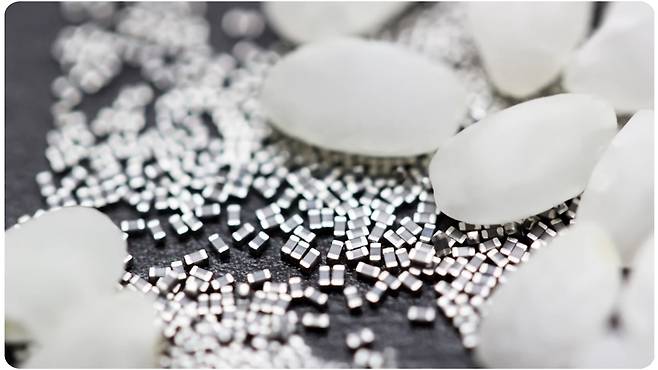
In the AI hardware boom, chips get the headlines. But inside every AI server, a quieter part is now driving supply risk and shaping who can scale production: the multilayer ceramic capacitor, or MLCC.
As AI data center servers grow hotter and more power-dense, MLCCs have become harder to produce and more central to performance. These tiny, layered parts regulate and stabilize voltage near chips, absorbing power fluctuations that could otherwise disrupt performance. That’s why Samsung Electro-Mechanics, the world’s No. 2 MLCC maker, is suddenly being treated as a strategic AI supplier.
AI-related MLCCs accounted for just 3 percent of the company's revenue in 2023, but that share grew to 9 percent in 2024 and is expected to exceed 10 percent in 2025. These high-end parts reportedly command an average selling price premium of two to three times that of standard IT MLCCs.
Local analysts are bullish. With demand from AI servers and autonomous vehicles rising, Samsung Electro-Mechanics is forecast to re-enter the “1 trillion won operating profit club” this year. But according to analysts and MLCC manufacturing experts, beneath the market optimism lies a more complicated truth. Samsung’s relevance is real, but the physics of manufacturability may limit how much it can profit from this moment.
“AI servers don’t just use more MLCCs,” said Phillip Yoon, a former chief research engineer at Samsung Electro-Mechanics. “They need capacitance densities that push right up against process limits.”
“Making them at scale is what separates companies like Murata and Samsung from the rest. But it also makes margin growth much harder than people assume,” he added.
A general-purpose server typically uses around 2,200 MLCCs. AI servers may need 28,000, and nearly 27 times more total capacitance. But adding more parts isn’t enough. There’s less space near power-hungry GPUs, so each capacitor must deliver more performance in the same or smaller footprint.
That drives up complexity. The capacitors now require hundreds of ultrathin internal layers, sometimes below one micrometer. These parts are not only harder to make, but also slower to produce and more prone to defects.
“You’re asking for far more electrical stability under harsher conditions,” said Ko Eui-young, analyst at iM Securities. “That sharply raises the technical bar.”
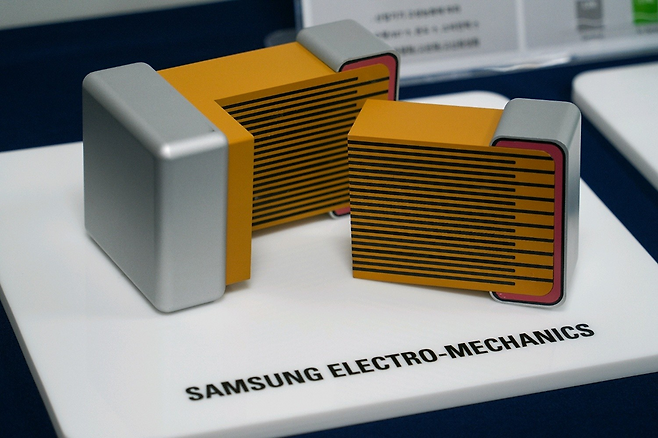
Even top manufacturers struggle to maintain yields. According to Kim So-won at Kiwoom Securities, production efficiency for these high-end MLCCs can fall to just 40 to 60 percent of standard levels, even when machines run at full tilt.
That explains why the market is narrowing. Murata, which holds about 40 percent of global share, remains the dominant player. But Samsung at around 20 to 25 percent is increasingly seen as the only viable second source for AI-grade MLCCs.
“Second-source qualification becomes a strategic requirement,” Ko said. “Even if Murata leads, hyperscalers want a backup they can trust.”
Samsung’s edge comes partly from vertical integration. According to Yoon, it produces its own fine-grain barium titanate powder — a key ingredient in high-capacitance MLCCs — while many competitors still rely on external suppliers. Yoon calls it “the upstream choke point,” explaining that few firms can source this powder at both the quality and scale AI MLCCs demand. Murata secures it through a close partnership with Japan’s Fuji‑Titan.
“AI servers and advanced vehicles require compact, high-reliability MLCCs, which means thinning dielectrics without sacrificing stability,” said Lee Min-gon, vice president of MLCC product development at Samsung Electro-Mechanics, during a technical briefing earlier this year in July. “That’s why we’ve internalized fine-powder production. It’s essential for both performance and long-term competitiveness.”
But the same materials and process complexity that narrow the field also limit profitability.
“Yields can start below 10 (percent). Even stabilized lines may struggle to exceed 60 to 70 percent," Yoon said. “That’s a huge amount of expensive scrap.”
High-end MLCCs use costly powders, ultra-flat films, and precise co-firing processes. And unlike semiconductors, where automation drives down cost over time, MLCC yield improvements lag behind rising performance requirements. “There’s no simple way to automate away those losses. And because specs keep tightening, the learning curve is often being outpaced by the spec curve,” Yoon warned.
That means margins won’t follow a typical supply-constrained boom. ASPs for AI-grade MLCCs may be much higher, but rising costs and process losses eat into those gains.
Another key question is how long Samsung’s lead will last. Yoon notes that Chinese firms are making rapid progress in fine-particle barium titanate powder and MLCC process technology, backed by “money power” and aggressive talent recruitment. If they solve powder quality and defect control, he estimates they could close the gap within five to eight years.
But until then, Samsung's position as a second pillar in the AI server MLCC market is real and strategically significant.
“Margins may not explode,” Yoon said. “But relevance already has.”
Copyright © 코리아헤럴드. 무단전재 및 재배포 금지.