People Power Party chair caves, apologizes for Yoon’s martial law declaration
전체 맥락을 이해하기 위해서는 본문 보기를 권장합니다.
"On the night of Dec. 3, 2024, 18 People Power Party lawmakers, including myself, attended the vote to lift martial law. After the vote, all lawmakers from our party urged the president to swiftly lift the measure."
He went on to say that the declaration of martial law was the "wrong means that did not fit the situation."
이 글자크기로 변경됩니다.
(예시) 가장 빠른 뉴스가 있고 다양한 정보, 쌍방향 소통이 숨쉬는 다음뉴스를 만나보세요. 다음뉴스는 국내외 주요이슈와 실시간 속보, 문화생활 및 다양한 분야의 뉴스를 입체적으로 전달하고 있습니다.
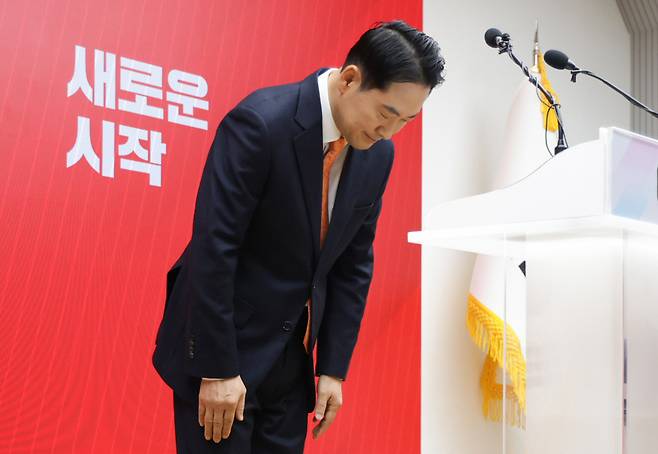
Rep. Jang Dong-hyeok, chair of the main opposition People Power Party, on Wednesday apologized for the first time for then-President Yoon Suk Yeol's martial law declaration on Dec. 3, 2024, after mounting pressure to do so.
Jang made the remarks during a speech prepared to outline what he described as a “new future” for the party, which lost last year's presidential election and has suffered internal splits in the wake of the martial law episode.
Speaking to reporters at the party's headquarters in Yeouido, Seoul, Jang said the People Power Party must pursue what he called “winning change,” adding that clarifying the party’s stance on the martial law incident was a necessary step.
“First, I would like to clearly state our position on the declaration of martial law,” Jang said.
“On the night of Dec. 3, 2024, 18 People Power Party lawmakers, including myself, attended the vote to lift martial law. After the vote, all lawmakers from our party urged the president to swiftly lift the measure.”
He went on to say that the declaration of martial law was the “wrong means that did not fit the situation.”
“As the ruling party at the time and one pillar of state governance, we failed to fulfill our role,” Jang said. “We feel grave responsibility for that failure, and I sincerely apologize to the people.”
However, Jang did not explicitly address calls — raised both inside and outside the party — to clearly sever ties with Yoon, a point that critics say undermines the sincerity of his apology. Yoon has left the party, but still has outspoken supporters among its membership and lawmakers.
Jang’s remarks come as the People Power Party faces declining support ahead of local elections scheduled for June, widely viewed as a key test of the party’s political standing.
According to a recent poll conducted from Dec. 31 to Jan. 2, support for the ruling Democratic Party of Korea stood at 45.7 percent, compared to 35.5 percent for the People Power Party, marking a second straight weekly drop for the opposition party.
As part of his vision for “winning change,” Jang said a range of measures, including renaming the party, are under consideration. Other proposed measures include recruiting more young members and experts, as well as strengthening transparency in candidate screening ahead of the local elections.
Regarding calls to form a united conservative front for the local election — widely understood as potential cooperation with the minor opposition New Reform Party, led by former People Power Party chief Rep. Lee Jun-seok — Jang said the party would remain open.
“If they share the values of liberal democracy and the goal of stopping what we see as authoritarian rule under the Lee Jae Myung administration, we are willing to join forces with anyone,” he said.
Observers, however, have questioned the substance of Jang’s apology.
“There was no mention of severing ties with former President Yoon, who was at the center of the martial law declaration, having been elected president as the People Power Party’s candidate,” Choi Chang-ryul, a professor of political science at Yongin University, told The Korea Herald.
“In particular, Jang rose to leadership with the backing of Yoon supporters and far-right forces even after Yoon was suspended from office, and he opposed Yoon’s impeachment.”
Choi added that expressions of regret over the violence associated with martial law were not new.
“Both the ruling and opposition parties have taken a critical view of the coercive nature of the martial law episode, and Jang himself has previously said he ‘deeply regrets’ it,” he said. “What matters now is specificity — including a clear break from Yoon and the far-right forces that supported the declaration.”
Choi also dismissed the proposal to change the party’s name as insufficient.
“Conservative parties preceding the People Power Party changed their names multiple times,” he said. “A name change alone, more than a year after the martial law incident, is unlikely to be taken seriously by the public.”
Korean political parties have a long tradition of rebranding, and conservative factions have been particularly active in this realm over the past decade. Following major defeats linked to the impeachment of President Park Geun-hye, the party changed its name from the Saenuri Party to the Liberty Korea Party in 2017. It changed again to the United Future Party early in 2020 before adopting its current name later that same year after disastrous legislative elections.
As yet, however, no specific alternative name has been floated, with Jang saying any decision would be made after carefully considering party members.
Choi warned that a poorly framed apology could backfire politically.
“While it can be interpreted as an attempt to clear the slate and go on the offensive against the Democratic Party amid its own corruption and personnel scandals, an apology full of gaps instead gives the ruling party ammunition,” he said. “It may even end up shielding the Democratic Party from scrutiny.”
Another political commentator, Lee Jong-hoon, said Jang’s remarks should be read less as a turning point than as a response to mounting pressure on the party leadership.
“It appears to be a message issued under considerable pressure, and the political calculations behind it must be examined,” Lee said. “Given Jang’s past actions, it will take time to judge (his) sincerity. What matters is how the leadership acts going forward.”
Regarding the impact of Jang’s apology on the upcoming local elections, Lee added, “Rather than dramatically shifting the political landscape in the short term, its effect is likely to be assessed in conjunction with external variables.”
Copyright © 코리아헤럴드. 무단전재 및 재배포 금지.