Hyundai deepens US chip ties to power AI-driven mobility
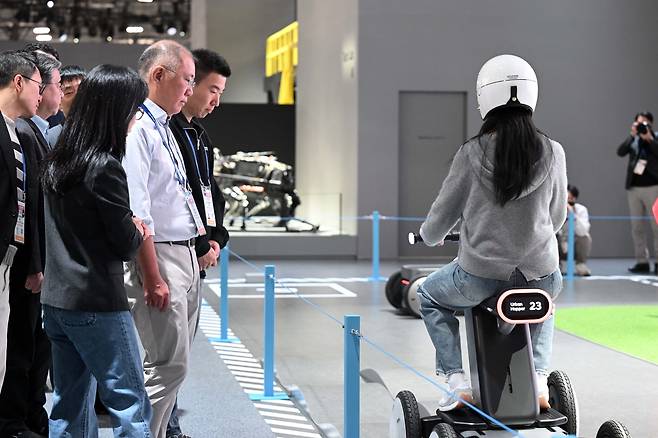
LAS VEGAS — Hyundai Motor Group Executive Chair Chung Euisun visited Qualcomm Technologies’ booth at CES 2026 on Tuesday, signaling the automaker’s intent to deepen ties with the US chipmaker as Hyundai accelerates its shift toward software-defined vehicles.
The visit came shortly after Chung returned from a three-day trip to China as part of an economic delegation accompanying President Lee Jae Myung. At tech-focused trade show, Chung toured Qualcomm’s exhibition space and held a private meeting with Akash Palkhiwala, Qualcomm’s chief operating officer. Details of the discussion were not disclosed.
Hyundai Motor Co. CEO Jose Munoz also underscored the importance of the partnership, stressing the central role of semiconductors in modern vehicles.
“There are no cars without chips,” Munoz said during a brief standing interview with reporters outside the Qualcomm booth. He added that Qualcomm has long worked closely with Hyundai and that a senior Qualcomm executive overseeing original equipment manufacturer relations was expected to meet with him soon.
The executive Munoz referred to is believed to be Nakul Duggal, Qualcomm Technologies’ executive vice president and general manager of automotive, industrial and embedded internet of things as well as robotics. Industry insiders view Duggal as a key architect of Qualcomm’s expansion beyond mobile system-on-chip businesses into automotive semiconductors and software platforms.
Hyundai’s outreach to Qualcomm coincided with a concrete partnership announcement. Earlier Tuesday, Hyundai Motor’s parts affiliate Hyundai Mobis said it would collaborate with Qualcomm to integrate the chipmaker’s Snapdragon Ride Flex system on a chip and Snapdragon Ride Automated Driving Stack with Mobis’ proprietary software and sensing technologies. The joint effort targets next-generation infotainment systems and advanced driver assistance systems.
Qualcomm chips are also expected to power the infotainment system of the upcoming Genesis GV90, Hyundai’s flagship electric SUV. Last month, Hyundai was reported to have selected Qualcomm’s solution over Samsung Electronics’ Exynos Auto V920 for the model — a move widely interpreted as a pivot away from hardware-centric platforms toward software-driven ecosystems led by Qualcomm and Nvidia, particularly in advanced driver assistance system-focused vehicle computing.
Later in the day, Chung held a roughly 30-minute meeting with Nvidia CEO Jensen Huang. He was greeted by Madison Huang, Nvidia’s senior director of product marketing and the daughter of Jensen Huang, as well as Nvidia Vice President Norman Marks.
While specifics of the meeting were not disclosed, the talks were widely seen as building on Hyundai’s expanding artificial intelligence collaboration with Nvidia. In October last year, Hyundai made the decision to procure 50,000 Nvidia Blackwell GPUs to strengthen its physical AI capabilities in robotics and autonomous driving.
Expectations of deeper cooperation have been fueled by Nvidia’s recent launch of Alphamayo, its autonomous driving platform based on a Vision-Language-Action model. The system enables AI to logically explain driving decisions — a capability considered more advanced than Tesla’s Full Self-Driving. Nvidia announced Monday that Alphamayo would first be deployed in Mercedes-Benz vehicles, with plans to expand partnerships with other automakers.
“All possibilities remain open,” Hyundai Motor Group Vice Chair Chang Jae-hoon said Monday, when asked about potential collaboration with Nvidia on self-driving technologies.
Earlier on Tuesday, Chung also visited the booths of leading Korean technology firms. He met with Eun Seok-hyun, president of vehicle solutions at LG Electronics, and Roh Tae-moon, president and co-CEO of Samsung Electronics.
After watching a demonstration of Samsung’s Bespoke AI Steam robot vacuum lifting a 10-kilogram dumbbell using suction, Chung floated an idea on the spot: combining the technology with Hyundai’s MobED, its next-generation autonomous mobility robot platform.
“If we attach four of these to MobED, it could move anywhere without tipping over, with better control and suction,” Chung said.
Copyright © 코리아헤럴드. 무단전재 및 재배포 금지.