Ramyeon, ajumma enter Oxford English Dictionary
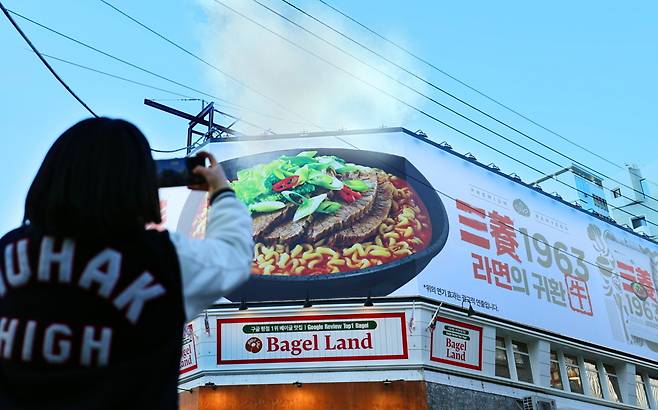
Several Korean terms rooted in daily life and social relationships have been formally entered into the Oxford English Dictionary, the latest sign of Korea’s widening cultural reach.
New entries include ramyeon (Korean-style instant noodles), haenyeo (Jeju’s female free divers) and sunbae (or seonbae — a senior in a hierarchical relationship), alongside bingsu (a shaved-ice dessert), jjimjilbang (a public bathhouse), ajumma (a middle-aged woman), Korean barbecue (tabletop grilled meat) and officetel (a combined office-residential building), according to Jieun Kiaer, a University of Oxford professor who serves as the publisher’s Korean language consultant on Wednesday.
The additions mark the second consecutive year that Korean-derived terms have been incorporated into the dictionary.
First published in 1884, the OED now operates as a digital platform that is regularly updated to reflect contemporary usage.
While Korean words were once rarely included, their presence has expanded sharply since the early 2000s in tandem with the global spread of Korean pop culture.
In 2021 alone, 26 Korean terms such as daebak (an exclamation of excitement) and oppa (a woman’s elder brother) were added in a single update.
The latest entries reflect words whose frequency in English has risen alongside the popularity of Korean television dramas, food and social customs. Ramyeon and haenyeo are among the most prominent examples.
Their Japanese counterparts ramen and ama had been listed earlier, but English-language usage tied specifically to Korean contexts has grown sufficiently to warrant separate entries.
Kiaer said haenyeo had previously fallen short of the OED’s threshold because of limited English-language research and citations. That changed as dramas and documentaries featuring the female divers of Jeju Island increased international exposure and academic references.
Terms such as jjimjilbang and bingsu also saw wider adoption as Korean culture introduced English-speaking audiences to distinctly Korean leisure spaces and desserts.
The dictionary also added sunbae, a hierarchical social title that differs from the English term “senior.” Other Korean relational terms such as nuna, maknae and hyung have been added in recent years for similar reasons.
While the OED already includes Korean food terms like galbi, samgyeopsal and bulgogi, this update marks the first time the English phrase Korean barbecue has been formally entered. One of the earliest cited uses dates to a 1938 article in Hawaii’s Honolulu Star-Bulletin that referred to a Korean barbecue dinner.
The OED contains roughly 500,000 words and phrases drawn from past and present English usage, each supported by real-world citations from books, academic papers, news reports and social media. Once admitted, entries are not removed even if their usage later declines.
Kiaer said the permanence of inclusion carries long-term significance, adding that for Korean culture to maintain its global influence, English-language publishing and academic research will be increasingly important.
Copyright © 코리아헤럴드. 무단전재 및 재배포 금지.