Homeplus plans sale of 5 stores by next year to raise restructuring funds
Under the plan, Homeplus intends to sell two stores already in the process of signing sales contracts—the Yuseong and Donggwangju locations—followed by three additional stores next year: Seosu-won, Yatap and Jinhae. The sales will proceed with the consent of Meritz Financial Group, which holds beneficiary rights under collateral trusts on the properties. The five stores are expected to generate a combined 407.5 billion won ($283 million).
A creditor-side official cautioned that not all sold stores would necessarily close, noting that whether they continue operating under a lease-back arrangement will depend on negotiations with buyers. “Homeplus is in urgent need of liquidity, so it plans to sell five stores that can be converted into cash quickly,” the official said.
The restructuring plan reflects Homeplus’s intention to pursue business normalization after its sale attempt fell through. Rather than liquidation, the company has made clear that it is aiming to preserve operations while restructuring under court protection.
According to the plan, proceeds from real estate sales will, in principle, be used to repay rehabilitation claims. With creditor approval, however, some of the funds may be allocated as operating capital to help the company overcome its liquidity crunch and stabilize day-to-day operations.
In addition to store sales, Homeplus plans to divest its Express supermarket business unit within this year to further secure repayment resources and operating funds. The company also said it is considering additional store disposals on the premise of selling properties and then re-entering them as tenants.
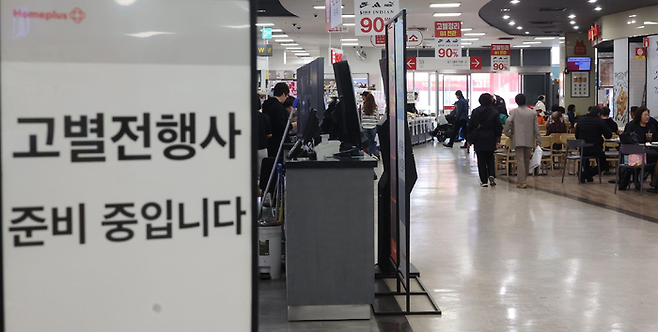
On workforce restructuring, the company plans to rely primarily on natural attrition. With a large number of long-tenured employees, Homeplus expects annual retirements to continue, while additional voluntary departures are likely as some workers opt not to relocate following store closures. Management believes that suspending new hiring alone could result in a substantial reduction in headcount. Workforce cuts at headquarters are also planned as part of a broader burden-sharing effort.
The restructuring plan outlines three main funding sources for debt repayment: store sales, the divestment of the Express supermarket unit, and debtor-in-possession, or DIP, financing. Among these, the most immediate challenge is securing 300 billion won in DIP financing to fund urgent operations. Without execution of the DIP facility within this month, the rehabilitation process itself could be jeopardized, as the company is already facing a severe cash shortage.
Homeplus is currently seeking financial investors to provide the DIP financing. Industry sources said the company is leaning toward negotiating terms with a small number of designated investors rather than raising funds from a broad investor pool.
The court has asked creditors to submit their views on the restructuring plan by Tuesday. After reviewing creditor feedback, the court will decide whether to approve the plan. If approved, Homeplus plans to gather stakeholder opinions and finalize the proposal as early as March, after which the court will convene a creditors’ meeting to determine final authorization.
Copyright © 매일경제 & mk.co.kr. 무단 전재, 재배포 및 AI학습 이용 금지
- “베네수엘라 다음은 바로”…트럼프 측근이 ‘우리땅’이라며 언급한 나라 - 매일경제
- “노인들 까먹고 날리는 돈 수두룩”…매년 수십억씩 불어나는 ‘이 돈’ 어쩌나 - 매일경제
- “너무 오르길래 겁나서 팔았어요”…반도체 바통 이을 다음 주자는 - 매일경제
- “이달 2만병 추가 공급한다”…난리난 1만원대 위스키 ‘품절대란’ - 매일경제
- 미·중이 앞장서는 원전 르네상스…한전, 수출 새판 짠다 - 매일경제
- “결심했다 받아가라”…‘윤 어게인’ 133만 유튜버 고성국, 국민의힘 입당 - 매일경제
- [속보] 장동혁 “12·3 비상계엄, 잘못된 수단…책임 통감·국민께 사과” - 매일경제
- 하룻밤 외박한 남편, 치매 진단서 들고왔네요…대체 어디서 잤길래 - 매일경제
- 안젤리나 졸리, 355억 저택 매각…미국 떠나 캄보디아 간다 - 매일경제
- ‘천군만마!’ 김혜성-고우석, 사이판 WBC 1차 캠프 합류한다 - MK스포츠