Student rights and teachers' authority at odds
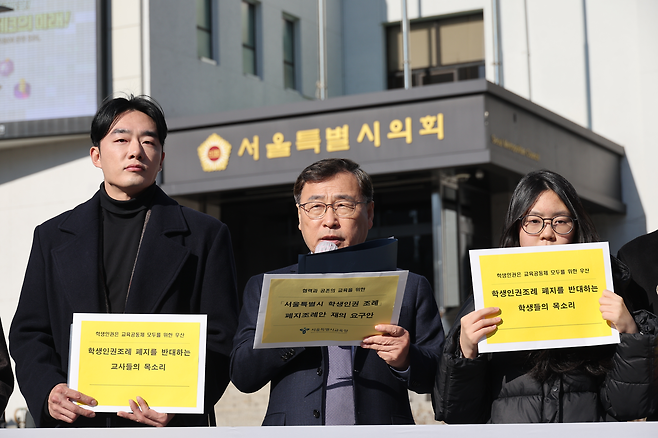
Seoul’s education chief has moved to block the abolition of the city’s student human rights ordinance, setting up another round in a long-running legal and political fight over how schools should balance protecting students’ and teachers' rights.
Jung Geun-sik, superintendent of education for Seoul, said Monday that he has formally requested the Seoul Metropolitan Council to reconsider its decision to repeal the Seoul Student Human Rights Ordinance, warning that the move violates the Constitution and higher-level laws.
The ordinance repeal was passed by the council on Dec. 16, 2025. First enacted in 2012, the ordinance has served as a legal framework to protect students from discrimination and rights violations in schools, including safeguards related to dignity, freedom of expression and protection from abuse.
“A rollback of students’ rights is a rollback of the human rights of the entire education community,” Jung said in front of the Seoul Metropolitan Council, pledging to “respond firmly to protect the core values of our education.”
Under South Korean law, a superintendent of education can demand reconsideration of a local education-related ordinance if it is deemed unconstitutional or against the public interest. If the council passes the repeal with a two-thirds majority, the ordinance will take effect despite the objection.
So while Jung’s request pauses the process and forces another vote, but it does not end the dispute. Instead, it revives a conflict that has already spanned more than a decade, multiple court rulings and shifting political majorities.
The Seoul Student Human Rights Ordinance was introduced in 2012 to guarantee basic rights for students, including protection from discrimination based on sex, religion, family background, gender identity and sexual orientation.
Conservative critics have long opposed the ordinance, arguing that it tilts schools too heavily in favor of students, that its limitations on classroom punishment weakens teachers’ authority and that it injects sexual minority issues into classrooms.
Despite repeated challenges, the ordinance has survived challenges in court. In 2018 and 2019, both the Seoul Administrative Court and the Constitutional Court ruled that the ordinance was legally valid.
The conflict intensified in 2024, when the Seoul Metropolitan Council passed a bill to abolish the ordinance amid protests calling for more protection for teachers after one died in a high-profile classroom suicide the year before.
Then-Superintendent Jo Hee-yeon sought a temporary injunction, and the Supreme Court suspended enforcement of the repeal. The court has yet to issue a final ruling on the legality of that vote.
While that case remains pending, the repeal effort resurfaced in November 2025 through a resident-initiated ordinance, a legal mechanism that requires councils to deliberate on proposals backed by citizen petitions. The council passed the repeal again in December.
In his reconsideration request, Jung argued that abolishing the ordinance violates the constitutional obligation of the state and local governments to protect fundamental rights, as well as duties imposed under higher-level laws and international treaties.
He also said the repeal unlawfully infringes on the superintendent’s authority by dismantling key institutional bodies, including the Student Human Rights Education Center and the Student Rights Advocate system.
By removing those mechanisms, Jung said, the repeal would eliminate public functions responsible for prevention and remedy of rights violations, amounting to a serious infringement of the public interest.
He dismissed the stated grounds for repeal as legally and factually unfounded, noting that courts have already rejected claims that the ordinance violates freedom of expression, religious freedom or parents’ educational rights.
He added that there was a lack of evidence to support claims that the ordinance has led to declining academic performance, weakened teachers’ authority or fueled gender identity controversies.
The Seoul Metropolitan Office of Education also criticized the council for pushing ahead with another repeal vote while Supreme Court proceedings on the earlier repeal are still under way.
“Repeated efforts to abolish the same ordinance have resulted in overlapping lawsuits and administrative procedures, wasting public resources and causing serious confusion and harm in schools,” Jung said.
He said he has asked the Education Ministry and the National Assembly to work together to protect students’ rights and has submitted a letter to the Supreme Court raising concerns about the council’s voting procedure.
“This repeal erases the human rights of students and the broader education community, and deepens divisions within schools,” Jung said. “Human rights are a shared value that cannot be abolished or applied selectively.”
Copyright © 코리아헤럴드. 무단전재 및 재배포 금지.