Hyundai Motor Group chief highlights vision of expanding physical AI ecosystem
전체 맥락을 이해하기 위해서는 본문 보기를 권장합니다.
"In this wave of change, companies that fail to internalize AI capabilities will find it difficult to ensure their survival," he said. "The only way for us to sustain our position as a global leader in the years ahead is to embed AI into our organizational DNA, not borrowing it from the outside."
"Above all, what matters most is fast and clear communication, and agile decision-making that is free from formality," he said. "Leaders must step out into the field, engage directly with people, and understand the essence of situations firsthand."
이 글자크기로 변경됩니다.
(예시) 가장 빠른 뉴스가 있고 다양한 정보, 쌍방향 소통이 숨쉬는 다음뉴스를 만나보세요. 다음뉴스는 국내외 주요이슈와 실시간 속보, 문화생활 및 다양한 분야의 뉴스를 입체적으로 전달하고 있습니다.
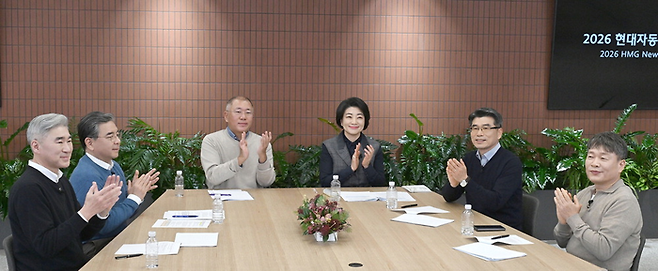
The South Korean auto giant held a New Year’s meeting in a roundtable format on Monday, where senior executives exchanged views on future business strategies.
Participants included Chung, Group Vice Chair Chang Jae-hoon, Hyundai Motor Co. President José Muñoz, Kia Corp. President Song Ho-sung, and Hyundai Mobis Co. President Lee Gyu-suk.
Considering Chung’s schedule of visiting China as part of a business delegation, the discussion was pre-recorded and shared with employees.
During the meeting, Chung elaborated on AI‘s strategic importance. He noted that AI is fundamentally changing how companies and industries operate and rendering past formulas for success obsolete.
“In this wave of change, companies that fail to internalize AI capabilities will find it difficult to ensure their survival,” he said. “The only way for us to sustain our position as a global leader in the years ahead is to embed AI into our organizational DNA, not borrowing it from the outside.”
He also highlighted that as momentum shifts toward physical AI, Hyundai Motor Group‘s data from vehicles, robots, and manufacturing processes becomes increasingly differentiated.
“This is our powerful, unique weapon that big tech companies cannot easily replicate,” Chung said.
The chairman also stressed that the conglomerate’s “future hinges on whether we treat AI as a tool or adopt it as the engine of organizational evolution.”
“For Hyundai Motor Group, which possesses data, capital, and manufacturing capabilities, AI is a game we have a strong chance of winning,” he said.
Chung further called for a complete transformation in the way the group works by adopting an “agile” strategy focused on speed and flexibility.
“Above all, what matters most is fast and clear communication, and agile decision-making that is free from formality,” he said. “Leaders must step out into the field, engage directly with people, and understand the essence of situations firsthand.”
Regarding the conglomerate’s domestic mid- to long-term investment allocating 125.2 trillion won ($86.55 billion) through 2030, Chung said, “This will not simply be about expanding our scale, but about using it as an opportunity for our qualitative growth.”
“The most certain thing is the uncertainty of the future, and the most uncertain thing is certainty itself. Because we know the future is uncertain, we must ultimately build it together as one team,” he added.
Following Chung’s remarks, senior executives presented their individual business plans.
Vice Chair Chang outlined the group’s robotics vision centered on physical AI.
“We plan to build robot data-collection and performance-verification facilities with conditions almost identical to Hyundai Motor Group’s factories,” he said. “Through our collaboration with robotics subsidiary Boston Dynamics Inc., we are jointly advancing hardware and physical AI, combining world-class robotics R&D with manufacturing expertise.”
He also unveiled plans to accelerate efforts to secure software-defined vehicle (SDV) technologies, an area where it is viewed as lagging behind the United States and China.
Manfred Harrer, who was appointed president and head of Hyundai Motor Group’s R&D division this year, provided updates on technology development.
Harrer noted that through the SDV Pace Car (test vehicle), the conglomerate is proceeding with the establishment of a mass-production system and verification as originally planned.
He added that the tech capabilities secured through this process will be applied to next-generation models.
Copyright © 매일경제 & mk.co.kr. 무단 전재, 재배포 및 AI학습 이용 금지
- “방구석폐인 백수아들, 생활비 내놓네요”…월300도 번다는 ‘쌀먹’ 뭐길래 - 매일경제
- 오늘의 운세 2026년 1월 6일 火(음력 11월 18일) - 매일경제
- “물가 뛰니 연금도 늘어야지”…국민연금 2.1% 인상, 최고 월 325만1925원 - 매일경제
- “급한 불 끄느라 달러 곳간 헐었다 ”…외환보유액 7개월만에 감소 - 매일경제
- 서학개미 몰렸던 종목 ‘시들’…테슬라·애플 내다팔고, 어디로? - 매일경제
- 안성기 별세로 다시 주목받는 혈액암…‘감기인줄 알았다’가 가장 위험 - 매일경제
- ‘고수익’ 찾아 캄보디아 간 女 인플루언서, 길거리서 정신이상자로 발견 - 매일경제
- “돈 문제 엮이면 다 망해”…‘박나래 절친’ 개그우먼 소신 발언 - 매일경제
- 227명 피눈물 값으로 징역 10년…전세사기 빌라왕, 감옥 간다 - 매일경제
- [공식발표] ‘정신적 지주와 2026시즌도 함께’ 안양, KBK 김보경과 재계약…“팬들의 열정적인 응