Corporate R&D sentiment rebounds, fueled by AI, new businesses
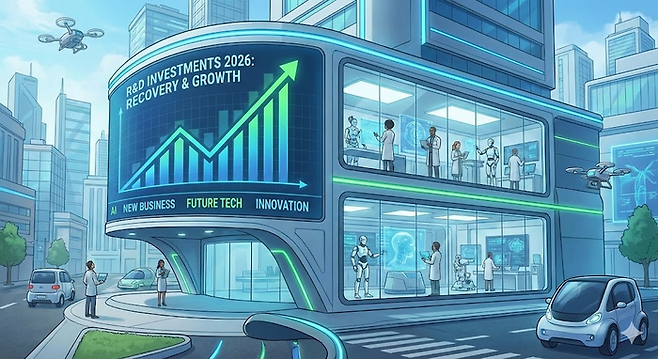
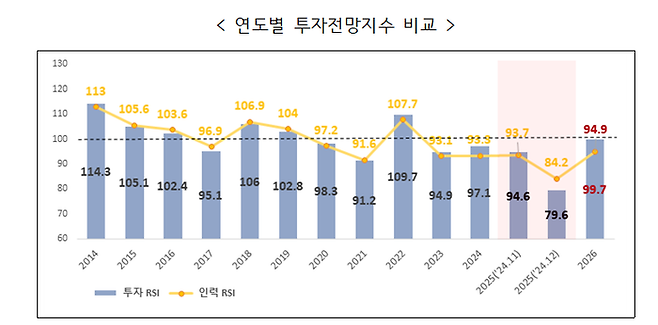
According to a survey released Monday by the Korea Industrial Technology Association (KOITA), the R&D investment outlook index for next year came in at 99.7, based on responses from 500 companies operating in-house research institutes. The reading marks a sharp rebound from the 2025 outlook of 79.6, when corporate uncertainty was at its peak, signaling that the steep downturn in R&D spending has eased and conditions are stabilizing.
The index—known as the Research Survey Index (RSI)—measures whether companies expect to increase or reduce R&D investment and hiring. A reading above 100 indicates more firms plan to raise spending than cut it, while a figure below 100 points to contraction. While the investment index remained just below the threshold, the hiring index, which tracks researcher recruitment, rose to 94.9, up sharply from 84.2 a year earlier.
Sectoral differences were pronounced. The electrical and electronics industry, which includes semiconductors, stood out as the only sector projecting expansion in both investment and hiring, posting an investment RSI of 110.7 and a workforce RSI of 104.2. Machinery, information and communications, and chemicals also showed positive momentum with investment indices above 100. In contrast, construction (90.0), materials (89.6) and automotive (90.6) industries were expected to remain subdued, with both investment and hiring indices below the benchmark.
“The data capture a clear signal that R&D sentiment, which had sharply contracted amid uncertainty, is moving into a phase of stabilization and easing,” said Kim Jong-hoon, head of the Industrial Technology Innovation Institute (KITI) under KOITA.
Ko Seo-gon, executive deputy chairman of KOITA, noted that companies are likely to continue a strategy of selective and focused investment rather than broad-based expansion. “Creating a business-friendly policy environment will be crucial to sustaining the recovery trend,” he said.
Copyright © 매일경제 & mk.co.kr. 무단 전재, 재배포 및 AI학습 이용 금지
- “방구석폐인 백수아들, 생활비 내놓네요”…월300도 번다는 ‘쌀먹’ 뭐길래 - 매일경제
- 오늘의 운세 2026년 1월 6일 火(음력 11월 18일) - 매일경제
- “물가 뛰니 연금도 늘어야지”…국민연금 2.1% 인상, 최고 월 325만1925원 - 매일경제
- “급한 불 끄느라 달러 곳간 헐었다 ”…외환보유액 7개월만에 감소 - 매일경제
- 서학개미 몰렸던 종목 ‘시들’…테슬라·애플 내다팔고, 어디로? - 매일경제
- 안성기 별세로 다시 주목받는 혈액암…‘감기인줄 알았다’가 가장 위험 - 매일경제
- ‘고수익’ 찾아 캄보디아 간 女 인플루언서, 길거리서 정신이상자로 발견 - 매일경제
- “돈 문제 엮이면 다 망해”…‘박나래 절친’ 개그우먼 소신 발언 - 매일경제
- 227명 피눈물 값으로 징역 10년…전세사기 빌라왕, 감옥 간다 - 매일경제
- [공식발표] ‘정신적 지주와 2026시즌도 함께’ 안양, KBK 김보경과 재계약…“팬들의 열정적인 응