Korean stock market rally draws liquidity from banks into stocks

According to the Korea Financial Investment Association on Monday, investor deposits excluding on-exchange derivatives margins totaled 87.8 trillion won ($60.7 billion) as of the end of December, up nearly 10 trillion won from 77.9 trillion won about a month earlier.
Investor deposits refer to funds held in brokerage accounts for stock purchases or proceeds from stock sales that have not been withdrawn, and are widely viewed as liquidity that can flow into the stock market at any time.
After reaching a record 88.27 trillion won in early November, investor deposits declined as the market stalled, but have since rebounded to near their peak.
The buildup of standby funds is also reflected in cash management account (CMA) balances at securities firms.
CMA balances surpassed 100 trillion won for the first time in December, reaching 100.3 trillion won as of December 31, up more than 2 trillion won from a month earlier.
Investor deposits and CMA balances suggest that more than 12 trillion won moved into stock market-related assets in December alone.
According to data from the country’s five major commercial banks, time deposits totaled 939.3 trillion won at the end of last year, down 32.7 trillion won from the previous month. The five lenders are KB Kookmin, Shinhan, Hana, Woori and NH NongHyup.
The decline came despite banks raising deposit rates toward year-end to shore up funding.
The Korea Federation of Banks said the highest one-year time deposit rates at major lenders recently rose to between 2.55 and 3 percent.
Although deposit balances typically fall around year-end due to settlement effects, last year’s drop was steeper than usual.
In December 2024, deposits declined by about 21 trillion won, largely due to corporate fund movements, but last year’s contraction far exceeded that level.
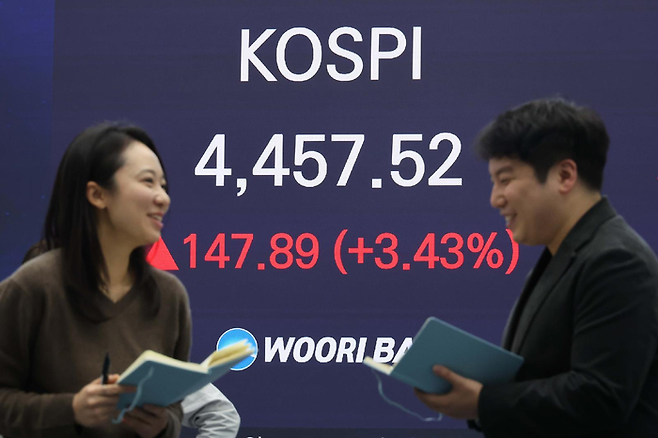
Market participants point to the sharp rise in the Kospi as a major factor pulling liquidity away from banks.
“Concerns are mounting internally as funds continue to move toward capital markets,” said an industry insider.
The government’s push to boost shareholder value under its Kospi 5,000 initiative is also reinforcing the trend.
The Ministry of Economy and Finance is expected to include tax incentives aimed at drawing domestic liquidity into capital markets in its forthcoming 2026 economic growth strategy.
“Bank deposits alone are insufficient to keep pace with rising inflation in a super-aged society,” said Huh Jae-hwan, a researcher at Eugene Investment and Securities Co. “Domestic retail investors’ stock buying is likely to persist as investment in risk assets becomes increasingly unavoidable.”
The launch of integrated management accounts (IMAs) at securities firms is also cited as a contributing factor.
IMAs offer principal protection while targeting annual returns in the 4 percent range, higher than bank deposit rates. Korea Investment and Securities’ IMA No. 1 reached its 1 trillion won subscription limit just four days after its debut.
Copyright © 매일경제 & mk.co.kr. 무단 전재, 재배포 및 AI학습 이용 금지
- “방구석폐인 백수아들, 생활비 내놓네요”…월300도 번다는 ‘쌀먹’ 뭐길래 - 매일경제
- 오늘의 운세 2026년 1월 6일 火(음력 11월 18일) - 매일경제
- “물가 뛰니 연금도 늘어야지”…국민연금 2.1% 인상, 최고 월 325만1925원 - 매일경제
- “급한 불 끄느라 달러 곳간 헐었다 ”…외환보유액 7개월만에 감소 - 매일경제
- 서학개미 몰렸던 종목 ‘시들’…테슬라·애플 내다팔고, 어디로? - 매일경제
- 안성기 별세로 다시 주목받는 혈액암…‘감기인줄 알았다’가 가장 위험 - 매일경제
- ‘고수익’ 찾아 캄보디아 간 女 인플루언서, 길거리서 정신이상자로 발견 - 매일경제
- “돈 문제 엮이면 다 망해”…‘박나래 절친’ 개그우먼 소신 발언 - 매일경제
- 227명 피눈물 값으로 징역 10년…전세사기 빌라왕, 감옥 간다 - 매일경제
- [공식발표] ‘정신적 지주와 2026시즌도 함께’ 안양, KBK 김보경과 재계약…“팬들의 열정적인 응