Seoul, Beijing agree to annual summits, high-level West Sea boundary talks
전체 맥락을 이해하기 위해서는 본문 보기를 권장합니다.
Lee and Xi also agreed to "restore strategic dialogue channels across a range of fields, including between their foreign and security authorities, in order to solidify political trust between the two countries."
The two leaders further committed to "expanding communication and exchanges between their defense authorities to enhance mutual trust and explore ways to contribute to regional peace and stability."
이 글자크기로 변경됩니다.
(예시) 가장 빠른 뉴스가 있고 다양한 정보, 쌍방향 소통이 숨쉬는 다음뉴스를 만나보세요. 다음뉴스는 국내외 주요이슈와 실시간 속보, 문화생활 및 다양한 분야의 뉴스를 입체적으로 전달하고 있습니다.
BEIJING — South Korea and China agreed on Monday to hold leaders’ meetings annually and seek strategic communication on sensitive issues – including long-unresolved maritime boundaries in the West Sea.
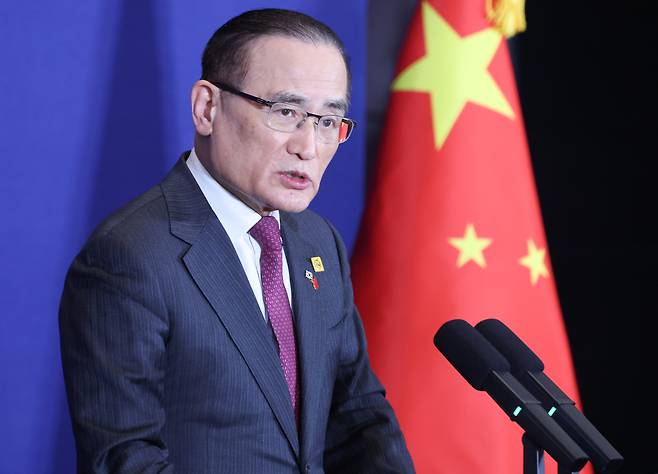
The second summit between President Lee Jae Myung and Chinese President Xi Jinping on Monday in Beijing “consolidated the momentum toward a full restoration of South Korea–China relations,” national security adviser Wi Sung-lac said during a press briefing following the summit.
“In line with a full restoration of Korea–China relations, the two leaders shared the view that they should continue to meet on an annual basis,” Wi told reporters.
Lee and Xi also agreed to “restore strategic dialogue channels across a range of fields, including between their foreign and security authorities, in order to solidify political trust between the two countries.”
The two leaders further committed to “expanding communication and exchanges between their defense authorities to enhance mutual trust and explore ways to contribute to regional peace and stability.”
The 90-minute summit also covered sensitive issues, including China’s unilateral installation of structures in the Provisional Measures Zone – a jointly managed area in the West Sea established under the 2000 Korea–China Fisheries Agreement.
“Both sides shared the view that it is important to turn the West Sea into a sea of peace and shared prosperity for the stable, long-term development of South Korea–China relations,” Wi said.
Seoul and Beijing agreed to continue constructive consultations on issues related to China’s structures in the West Sea. “On this matter as well, I have come to hold cautious expectations that progress can be made,” Wi added.
The two sides also agreed to work toward holding “vice minister-level talks on the delimitation of maritime economic zones in the West Sea” this year.
Wi said Seoul and Beijing also shared the view that “restraint and responsible conduct are essential” in the West Sea, where the maritime boundary remains undefined.
During the summit, Korea and China “reached a consensus on gradually, step by step, expanding cultural-content exchanges in areas acceptable to both sides, and agreed to advance consultations on the specific details.”
Seoul and Beijing agreed to move forward with exchanges in areas such as the game of Go and football, while seeking progress in other fields – including television dramas and films – through working-level consultations.
Whether China will lift its unofficial “Hallyu ban” on Korean content – imposed after South Korea’s 2016 deployment of the US THAAD missile defense system, and whose existence Beijing has consistently denied – drew close attention during the summit.
Wi suggested, however, that Seoul and Beijing still differ on the pace and scope of any expansion in cultural exchanges.
“On cultural exchanges more broadly, China has maintained its position that cultural exchanges should be ‘healthy and beneficial,’” Wi said. “In response, we proposed pursuing working-level negotiations and gradually expanding cooperation, beginning with areas that are currently feasible.”
Wi added that “it is realistic to start with areas where mutual understanding can be reached and build from there in a phased manner,” noting that cultural content, and public attitudes toward culture, vary across countries.
During the Lee–Xi summit, Seoul and Beijing also “reaffirmed the shared understanding that peace and stability on the Korean Peninsula constitute a common interest of both countries,” Wi said.
Wi further explained that both sides “confirmed China’s willingness to play a constructive role toward that end.”
“We also shared the view on the importance of resuming dialogue with North Korea, and agreed to continue exploring creative approaches to easing tensions and building peace on the Korean Peninsula,” he said.
Asked whether the Lee–Xi summit addressed the US capture of Venezuelan President Nicolas Maduro through a military operation as well as the Taiwan issue and rising tensions between Beijing and Tokyo, Wi said the leaders held wide-ranging talks on regional developments.
“There were extensive discussions on developments on the Korean Peninsula and in the surrounding region. China presented its views, and we clearly explained our own position,” Wi said. “The discussions were neither misaligned nor confrontational; rather, they took place in a cordial and constructive atmosphere.”
On the economic front, Seoul and Beijing “agreed to step up efforts to achieve meaningful progress within the year” in negotiations on services and investment under the Korea–China free trade agreement — part of the second phase of the pact, Wi said.
Copyright © 코리아헤럴드. 무단전재 및 재배포 금지.