Chung Euisun puts physical AI at heart of Hyundai’s future
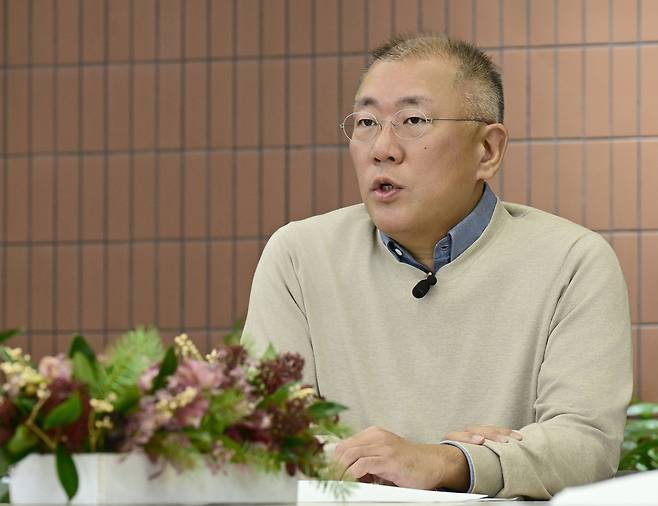
Hyundai Motor Group Executive Chair Chung Euisun said Monday that the automaker must place artificial intelligence at the core of its strategy to secure its future, betting on physical AI as a key strength amid a rapidly changing business environment.
“Looking at the automotive market alone, we’ve entered an era where AI capabilities determine core competitiveness of products like autonomous driving, software-based vehicle control and personalized UX,” Chung said in a pre-recorded New Year’s roundtable with senior executives shared online with employees worldwide.
Chung noted that global industry leaders have already poured hundreds of trillions of won into AI to take upper hand, while acknowledging that Hyundai still lags in some capabilities.
“But rather than thinking it’s too late, our group will work with various partners this year to navigate the industrial transformation spurred by AI,” said Chung, expressing confidence in Hyundai’s strengths in physical AI, manufacturing and data.
“As the center of gravity in AI shifts toward physical AI, the value of ‘moving physical assets’ like automobiles and robots, along with data generated from manufacturing plants will become more scarce,” said Chung. “These are powerful advantages that big tech companies cannot easily replicate. For Hyundai Motor, which possesses data, capital and manufacturing capabilities, AI is a game in which we have a strong chance of winning.”
Looking ahead, Chung warned that growing global tade tensions and competitors’ accelerated expansion into global markets would continue to squeeze profit margins in 2026. He added that Hyundai's business may be disrupted or impacted in certain regions due to geopolitical conflicts.
"This will be the year when the crisis factors we have worried about become a reality," he said.
In response to such challenges, Chung called for an organizational transformation rooted in deep reflection, agile decision making and fast and transparent communication.
During the roundtable discussion, Vice Chair Jang Jae-hoon and other senior executives outlined progress in key areas including software-defined vehicles, autonomous driving, robotics and hydrogen.
Jang said the group’s transition to a software-centric mobility company was a “matter of survival.”
“This is a non-negotiable and unchanging direction,” said Jang when asked about Hyundai’s SDV strategy. “The SDV transition is a task that the entire group must think together and prepare for the next phase of SDV development.”
Jang said Hyundai would maintain its collaboration with the group’s autonomous driving subsidiary 42dot and proceed with major SDV-related development projects as scheduled. Jang’s remark came amid questions following a recent leadership change at the unit.
He also added that Motional, its Boston-based autonomous driving joint venture with Aptiv, plans to commercialize fully driverless Ioniq 5 robotaxis in Las Vegas by end of this year.
Copyright © 코리아헤럴드. 무단전재 및 재배포 금지.