Coupang hearing highlights limits of Assembly scrutiny
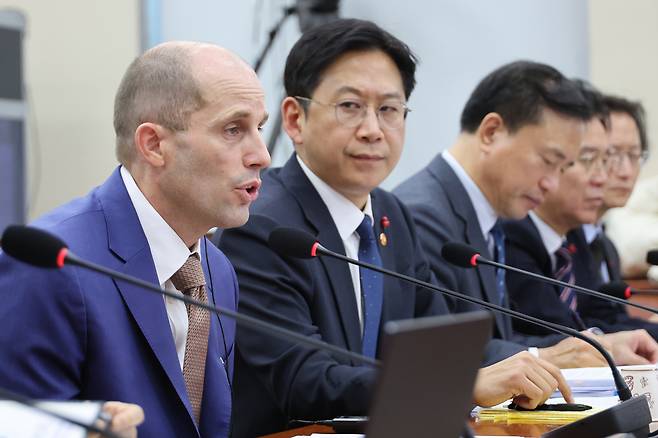
Controversy surrounding e-commerce giant Coupang has raised questions not only about the company, but also about how effective scrutiny in the National Assembly is concerning such corporations.
While lawmakers summoned Coupang executives and raised a wide range of allegations — from personal data protection failures to labor conditions and market dominance — critics say the proceedings have so far generated more confrontation than meaningful results.
The National Assembly last week held a two-day hearing on Coupang, initially convened to address a data leak that may have affected more than 33 million users here, roughly two-thirds of South Korea's population. A request for a full parliamentary investigation into the company was later submitted, further escalating political pressure.
Despite the formal process, the hearings exposed the limits of how well they can be enforced. Although the Assembly can summon witnesses, measures such as penalties or companion orders are rarely exercised in practice — particularly when key figures reside overseas or lead global corporations like Coupang. As a result, lawmakers may be left questioning lower-ranking executives with limited authority.
The hearings proceeded without Coupang founder and Chair Kim Bom-suk — more commonly known as Bom Kim — despite repeated summons. His younger brother, Kim Yoo-seok, a vice president at the company, and former CEO Kang Han-seung were also absent, citing scheduling conflicts in written explanations.
Instead, Coupang was represented by senior executives from its local operations, including Harold Rogers, chief executive of the company’s Korea unit, and Park Dae-joon, a former CEO.
The sessions at times shifted away from substantive discussion of data security measures or regulatory remedies and toward disputes over accountability and responsibility.
At times, lawmakers strayed off topic entirely, raising broader concerns, including Coupang’s dominant position in the domestic market, alleged abuses of power over sellers and harsh working conditions at logistics facilities.
These issues were largely aired as accusations, without meaningful follow-up.
At one point Rep. Chung Il-young took issue with Rogers' attitude and accused Coupang of insulting the parliament and the Korean people, saying that the company should leave the Korean market, considering its attitude toward Korea.
Rogers, for his part, refused to state simple facts such as his visa status. Faced with emotionally charged accusations, he did little to hide his frustration when his remarks were interrupted. He visibly bristled and cut himself off, saying, “Enough.”
Some lawmakers argued that Coupang’s reliance on a US-based leadership structure has insulated its top decision-maker from direct domestic accountability, highlighting what they see as a gap in the Assembly's ability to assert its authority.
Experts, however, cautioned that the fractious hearings risked obscuring the original purpose of parliamentary oversight.
Kim Dae-jong, a professor of business administration at Sejong University, said the political response has focused less on institutional remedies than on symbolic demands for top executives to appear.
“Time is being spent on confrontations,” Kim said. “But key issues — such as effective data protection measures and improvements to labor conditions — remain largely unaddressed.”
He added that while companies may weigh global business considerations, domestic accountability cannot be deferred indefinitely.
“When decisions made by a company affect Korean consumers and workers so directly, the public naturally expects accountability to function here,” Kim said.
Consumer advocates echoed concerns that political theater does little to protect users.
Jung Ji-yeon, secretary-general of the Korea Consumer Federation, said that while public apologies can temporarily ease anger, they do not substitute for concrete remedies.
“What ultimately matters is whether compensation for affected users and measures to prevent a recurrence are actually effective,” Jung said. “Without that, even repeated hearings risk becoming symbolic exercises rather than solutions.”
Copyright © 코리아헤럴드. 무단전재 및 재배포 금지.