Korea’s 2026 holiday calendar: Fewer days off, longer breaks
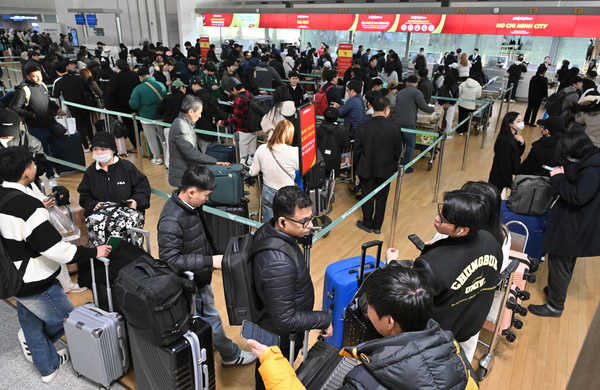
The total number of holidays in 2026 for the standard five-day-a-week worker will be one day fewer than last year, but there will be longer consecutive breaks with the combination of weekends and state-designated holidays.
A total of 118 days off will be available for South Korean workers throughout the year, including Saturdays and 70 so-called “red days” -- public holidays and Sundays -- marked in red ink on standard Korean calendars, according to the Korea Aerospace Administration's official calendary.
Although the total is lower than the 119 days available in 2025, retailers and travel agencies are already branding 2026 as a “year of blessing for employees.”
"The quantity of rest days appears similar, but the quality of those days is different,” said WeGive, a Korean online donation and crowdfunding platform.
This is because there are eight holidays lasting more than three consecutive days when weekends are included, up from six in 2025. The most preferred length of vacations for South Koreans is three or four days, as chosen by 54.2 percent of respondents in a July survey by local pollster Now & Survey.
Below is a list of the possibilities for a long holiday in 2026.
Lunar New Year: Potential nine-day holiday
The first long break comes in February with Seollal, Korea’s Lunar New Year holiday.
In 2026, Seollal falls on Tuesday, Feb. 17, but the holiday period runs from Monday, Feb. 16 to Wednesday, Feb. 18. If the preceding weekend is included, employees can take five consecutive days off.
The break can be extended to nine days, from Feb. 14 to 22, if employees use annual leave on the Thursday and Friday following the official holiday.
March and May: Independence Movement Day and Buddha's Birthday
At the beginning of March, employees can take three days off from Feb. 28 to March 2 in commemoration of the March 1 Independence Movement of 1919.
As March 1 falls on a Sunday in 2026, Monday, March 2, is designated as a substitute holiday, combining with the preceding weekend for a total of three days off.
Children’s Day, celebrated on May 5, falls on a Tuesday. Taking off Monday, May 4, would create a four-day holiday.
Buddha’s Birthday also creates a three-day holiday from May 23 to 25. This year’s Buddhist holiday falls on a Sunday, meaning the next workday (Monday, May 25) has been designated a substitute holiday.
Summer lull and Constitution Day proposal
There are no additional holidays in June or July. The only holiday during this period is Memorial Day on June 6, which falls on a Saturday in 2026. Under current law, Memorial Day is a commemoration, not a statutory holiday, and therefore does not qualify for a substitute holiday if it falls on a weekend.
In November 2025, however, a bill designating July 17, Constitution Day, as a national holiday passed the Legislation and Judiciary Subcommittee under the National Assembly’s Public Administration and Security Committee. If approved in a plenary vote, the change would add a three-day holiday in July.
Autumn and winter: Liberation Day to Chuseok and Christmas
Liberation Day, marking Korea’s independence from Japanese colonial rule, is observed Aug. 15 -- this year, a Saturday.
Unlike Memorial Day, Liberation Day is a "national holiday," so if it falls on a Saturday, a substitute holiday is designated on the next working day -- Aug. 17. This extends the break to three days.
Chuseok follows with a four-day holiday from Sept. 24 to 27.
October features two extended holiday periods. Employees will have three days off from Oct. 3 to 5 for National Foundation Day, followed by another three-day break from Oct. 9 to 11 for Hangeul Day.
Together, the two holidays effectively turn the second week of October into a three-day workweek.
The final holiday of the year is Christmas, which falls on a Friday in 2026, allowing employees to enjoy a three-day break, including the weekend.
Copyright © 코리아헤럴드. 무단전재 및 재배포 금지.