Overseas wildfires added to November fine dust pollution spike
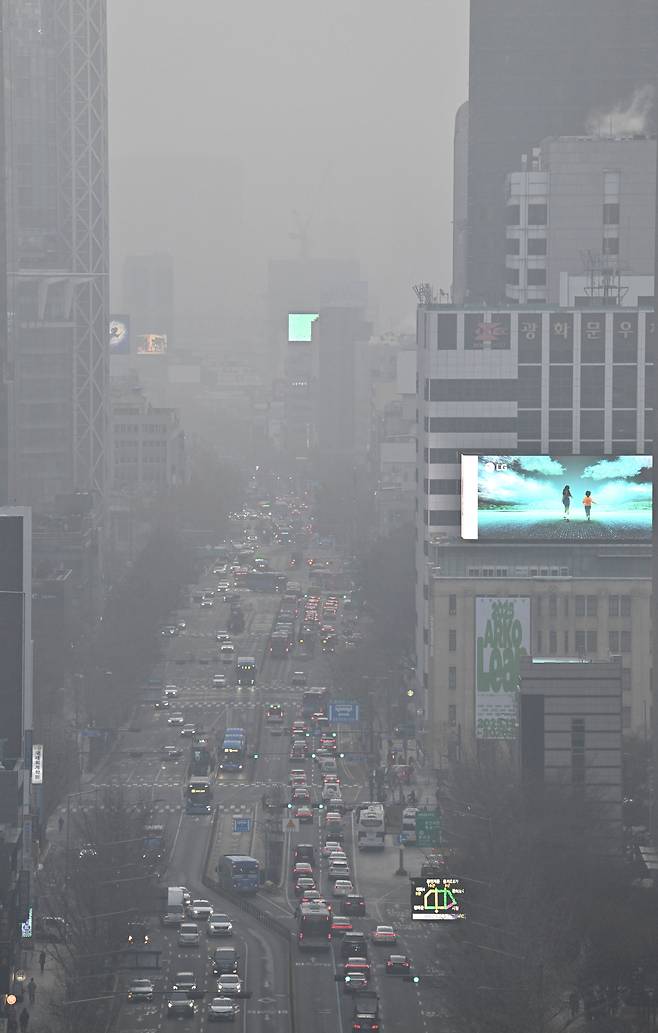
One of the causes behind the nationwide fine particulate matter alert in November was overseas wildfires, a report by the Seoul Metropolitan Government’s Institute of Health and Environment suggested Friday.
Researchers at the city-run institute conducted a detailed chemical analysis of air pollutants on Nov. 24, when a nationwide advisory was in effect for PM2.5 — particles measuring below 2.5 micrometers across — and detected clear signatures linked to biomass burning outside Korea.
According to the institute, elevated concentrations of biomass burning organic aerosols, or BBOA, were found in air samples collected that day in Seoul, Incheon, Gyeonggi Province, South Chungcheong Province and Sejong.
The presence of BBOA — carbon-based particles emitted by forest fires and when burning wood and agricultural waste — suggests that smoke from abroad contributed to the spike in ultrafine dust. The study did not mention specific wildfires in connection with the pollution spike.
Using mass spectrometry to identify different pollutants, the institute classified organic aerosols affecting Seoul into several categories, including emissions from cooking, vehicle exhaust, biomass burning such as wildfires, and aerosols formed through long-range transport and atmospheric oxidation.
BBOA, while only one of several contributors to fine dust, is known to pose risks to human health and influence climate patterns. Its detection highlights the role of transboundary air pollution, particularly during periods of heightened wildfire activity in neighboring regions.
Seoul has stepped up efforts to curb fine dust levels through its seasonal air quality management program, which has been in place since 2019. Under the program, stricter pollution controls are enforced each year from December through March, a period when ultrafine dust levels typically peak.
City officials said the initiative has yielded tangible results, with average PM2.5 concentrations falling by about 30 percent compared with levels recorded before the seasonal controls were introduced.
The city said it planned to continue refining its monitoring and analysis to better inform policy responses and public advisories during high-pollution episodes.
Copyright © 코리아헤럴드. 무단전재 및 재배포 금지.