Kim Jong-un’s daughter takes center stage at New Year ceremony, fanning speculation about NK hierarchy
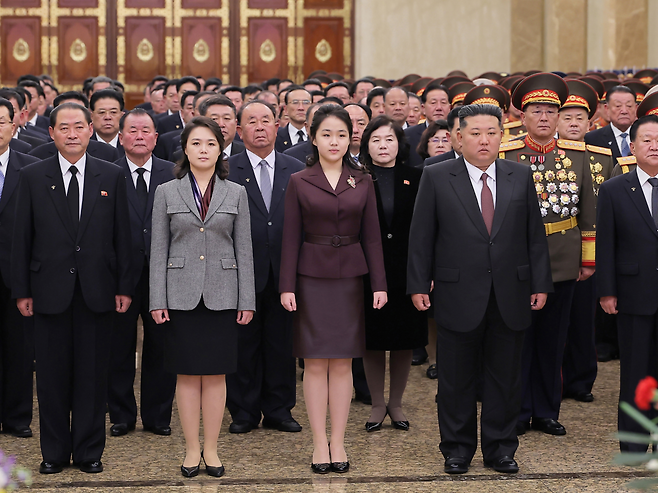
Kim Ju-ae, the daughter of North Korean leader Kim Jong-un, made her first known public visit to the Kim family mausoleum on New Year’s Day, a move experts say could strengthen the narrative of her as a potential successor.
North Korea’s state media, Korean Central News Agency, reported Friday that Kim visited the Kumsusan Palace of the Sun in Pyongyang the previous day to mark the New Year, accompanied by his wife, Ri Sol-ju.
Senior officials from the ruling Workers’ Party, the government and the military were also in attendance, including top figures from the Cabinet, the Presidium of the Supreme People’s Assembly and the Defense Ministry, according to the report.
While KCNA did not mention Kim Ju-ae by name in its report, photographs released by state media showed her standing at the center of the group, positioned between Kim Jong-un and his wife.
The Kumsusan Palace of the Sun, where the preserved bodies of state founder Kim Il-sung and former leader Kim Jong-il are enshrined, is regarded as one of the most powerful symbols of regime legitimacy in North Korea.
Kim Jong-un’s visit marked his first New Year’s Day tribute at the site since 2023. Although he observed the tradition almost every year after taking power in 2012, he skipped the visit in 2018 and again in 2024 and 2025.
Cheong Seong-chang, vice president of the Sejong Institute, said Kim Ju-ae’s presence was highly symbolic and suggested a deliberate political signal ahead of the ruling party’s upcoming congress, which is widely expected to be held in early 2026.
“Resuming the New Year’s visit to the Kumsusan Palace together with Kim Ju-ae appears to be a carefully orchestrated political move ahead of the ninth Workers’ Party Congress,” Cheong said. “It can be interpreted as an indication that Kim Jong-un intends to formalize her status domestically and internationally as his successor.”
Kim Ju-ae, who has appeared in North Korean state media since 2022, had never before been publicly shown paying tribute at the mausoleum.
Cheong noted that the front row at such ceremonies is typically reserved for the most senior party elites, including members of the Politburo Standing Committee and full Politburo members. He said placing Kim Ju-ae not only in the front row but at the central position — traditionally occupied by Kim Jong-un himself — carries particular weight.
“This can be seen as Kim Jong-un symbolically reporting to his predecessors, Kim Il-sung and Kim Jong-il, that he intends to present Kim Ju-ae as his successor at the upcoming party congress,” Cheong said.
Historically, North Korea’s leadership succession has unfolded in three stages: internal designation and grooming, in which a successor is quietly prepared and elevated; domestic formalization, often marked by party appointments or official recognition at key political events; and international formalization, when the successor’s status is acknowledged beyond North Korea.
Against this backdrop, Cheong said Kim Ju-ae appears to be in the first stage, with the ninth party congress likely to serve as a turning point for the latter two stages.
Cheong added that Kim Ju-ae could be assigned a significant role during the upcoming congress as part of the hereditary succession process, but cautioned that such a move carries risks.
“Granting such powerful positions to a figure of such a young age would require careful calculation, given how it could be received both domestically and internationally,” he said.
Kim Jong-il, the country’s second leader and the father of Kim Jong-un, had his successor status formally recognized at the sixth Workers’ Party Congress in 1980, while Kim Jong-un’s own position was internationally formalized at the third Workers’ Party Conference in 2010.
Copyright © 코리아헤럴드. 무단전재 및 재배포 금지.