Foreign graduate hiring rises despite overall slowdown
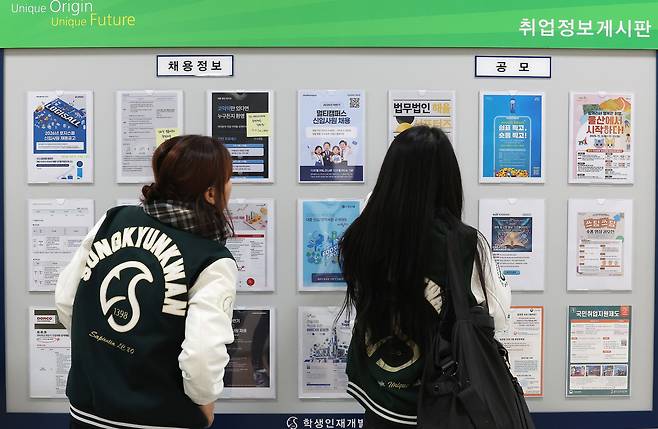
The hiring rate for international students who graduated from South Korean universities rose over 50 percent last year, according to government data, despite a slight fall in overall graduate hiring.
About 1 in 3 job-seeking foreign graduates found work in Korea, data released by the Ministry of Education Monday showed, up from 21.7 percent the year before.
Officials cautioned that the increase partly reflects changes in survey methodology, including the use of resident registration numbers starting in 2024. The revision followed a legal overhaul of the employment-tracking system and provides the first statistically reliable snapshot of foreign graduate employment, they said.
“After the enforcement decree of the Higher Education Law was amended, we were able to use alien registration numbers in the survey, significantly improving accuracy,” an Education Ministry official said. “This marks the first time that state, public and big data have been jointly used to calculate the employment rate for international students.”
The report counted almost 15,000 of the roughly 36,300 international students who graduated last year as job seekers in 2024, with another 5,600 going on to graduate school.
About 7,000 left the country, with the remainder not counted as job seekers for other reasons. When asked by The Korea Herald, the ministry declined to give further details, such as how they categorized those who already had jobs or were working illegally.
The increase in the hiring rate reflects a rise in recruitment to 5,000 from 3,600 the previous year, but also reflects a decline in those seeking work here, which was 16,600 in 2023.
The proportion of all international student graduates who were hired rose to 13.8 percent in 2024, up from 11 percent in 2023 and 7.5 percent in 2022, and the highest level since the statistics were first compiled in 2007.
Average starting pay for international graduates also edged higher. The share earning a monthly salary of more than 3 million won ($2,100) rose by 1 percentage point to 33.3 percent in 2024, from 32.3 percent a year earlier.
“This time we did not take any qualitative assessment, like job category, of international graduates because we were primarily focused on improving the (survey) system itself,” the official said.
The data was compiled on Dec. 31, 2024, by the Education Ministry in cooperation with the Ministry of Data and Statistics, and the Korea Educational Development Institute. The survey covered 635,000 graduates, both Korean and international, and tracked their post-graduation status.
International student hiring still lags far behind that of Korean graduates, which is 69.5 percent, though the latter has fallen slightly. Some 377,00 out of 543,000 job-seeking graduates secured jobs, a 0.8 percentage-point drop from 2023, when the rate had surpassed 70 percent for the first time.
Those with postgraduate degrees had the highest employment rate, at 82.1 percent, followed by community college graduates at 72.1 percent and four-year university graduates at 62.8 percent. Employment fell across all categories, with four-year universities experiencing the sharpest decline at 1.8 percentage points.
“This decrease is largely attributable to the overall economic slowdown,” the Education Ministry official said.
By academic field, graduates from medical and pharmaceutical programs posted the highest employment rate at 79.4 percent, followed by education (71.1 percent) and engineering (70.4 percent). Employment rates for social sciences (69.0 percent), arts and physical education (66.7 percent), natural sciences (65.4 percent) and humanities (61.1 percent) all fell below the average.
Regionally, universities located in the Seoul metropolitan area reported a higher employment rate of 71.3 percent, compared with 67.7 percent for institutions outside the capital region.
A gender gap remained, with 71.2 percent of male graduates and 67.9 percent of female graduates finding work, though the gap narrowed to 3.3 percentage points, down from 3.9 percentage points a year earlier.
National health insurance data shows that average monthly wages rose. Four-year university graduates earned an average of 3.15 million won, while community college graduates earned 2.69 million won. Master’s degree holders earned 4.96 million won, and doctoral graduates earned 6.53 million won.
Small and medium-sized enterprises accounted for the largest share of employment at 44.9 percent, followed by nonprofit organizations, large corporations and government bodies. The share of graduate hires made by large companies rose 2.3 percentage points from the previous year.
Copyright © 코리아헤럴드. 무단전재 및 재배포 금지.