Park Hae-soo rides another wave of global fame
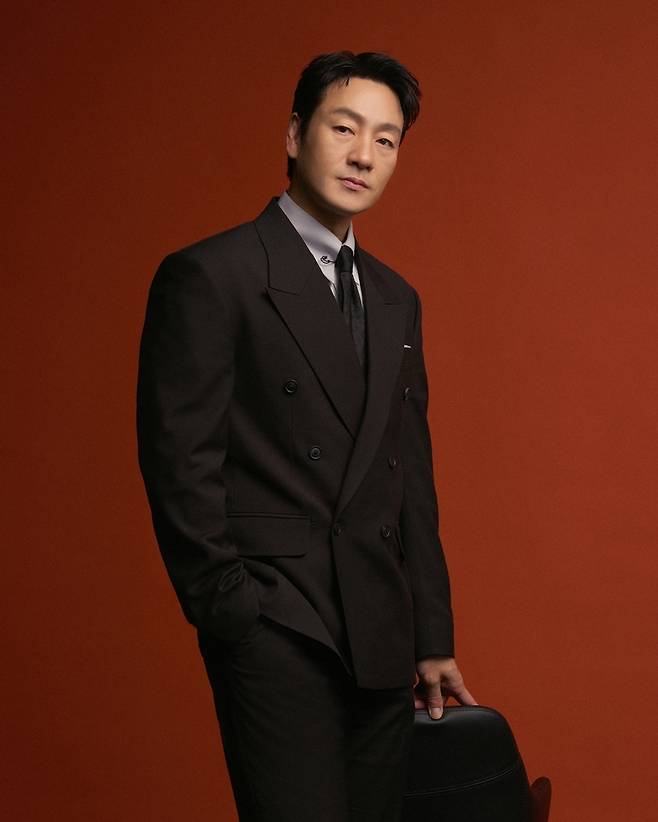
"I only heard about it this morning," Park Hae-soo says. "They briefed me right before this interview. It still hasn't quite sunk in."
Seated in a Samcheong-dong cafe on a Tuesday afternoon, Park is processing the news that his latest film, "The Great Flood," has rocketed to the top of Netflix's global charts — No. 1 in over 50 countries — within days of its Dec. 19 release.
The news landed just hours ago, relayed by a staffer during a pre-interview meeting.
Park pauses, almost bashful.
"I'm just grateful. Grateful that this kind of experiment actually exists out there," he said.
For most actors, this would be a novel sensation. For Park, it's closer to deja vu. The 44-year-old has become a face viewers overseas would surely recognize from Netflix's ever-expanding Korean roster.
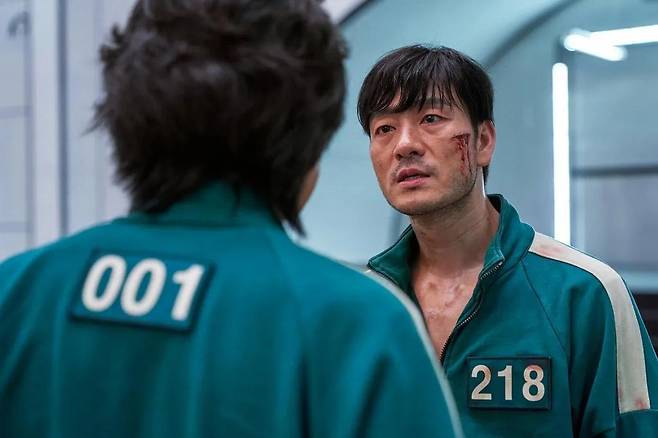
You don't forget his Sang-woo in "Squid Game" — the sharp-jawed finance bro who had it all before finding himself neck-deep in the rot. His exasperated outburst at Lee Jung-jae's Gi-hun — "Ha, come on! Gi-hun!" — was memed to death.
That 2021 breakout practically handed him a golden ticket to the streaming giant's pipeline. Since then, he's starred in "Narco-Saints" and "Money Heist: Korea," among others, and most recently played a dogged prosecutor in the drama "The Price of Confession."
Park, in short, is an unprecedented product of an unprecedented era, when a Korean actor can beam directly into living rooms from Sao Paulo to Stockholm without setting a foot outside Korea. Speaking in a measured, quiet voice, he downplays the Netflix poster boy label.
"Actors are in a position to be chosen," he says. "It's not up to me. I just show up when they call."
But even for Park, "The Great Flood" is a curious case, one that's topping charts despite, or perhaps because of, the sheer bewilderment it has provoked.
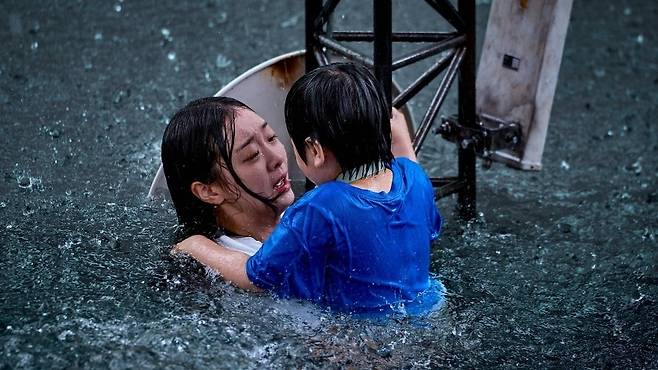
Director Kim Byung-woo's Netflix original opens as garden-variety disaster spectacle: Seoul drowning under biblical floods, young mother An-na (Kim Da-mi) clawing her way up a sinking high-rise with her adorable but often-times maddening son Ja-in (Kwon Eun-seong) in tow. The first 40 minutes of waterlogged mayhem are sufficiently watchable, if not totally gripping, checking the boxes in a perfunctory, almost algorithmic sort of way.
It would have been just another forgettable streaming disaster flick had the narrative not veered, midway through, into something stranger altogether — a dizzying sci-fi puzzle involving time loops, recursive simulations and some high-concept business about the fate of humanity.
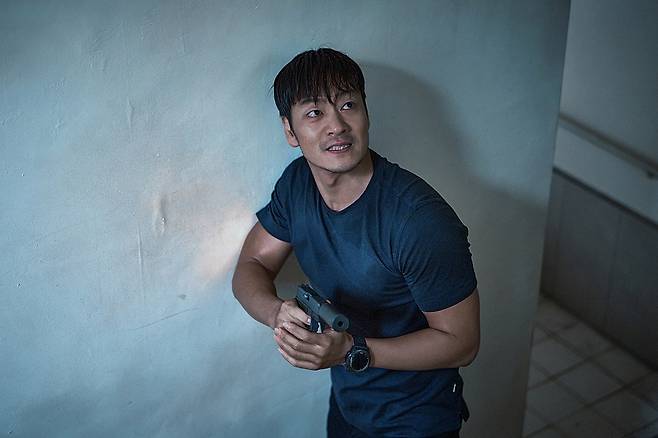
Stolid and steely as usual, Park plays a security operative dispatched to save An-na from the flooded building. He's a purely functional presence at most — delivering flat exposition, providing a counterweight to An-na's maternal desperation — before more or less fading from view.
Asked if he's aware of the mixed reception, Park takes it in stride.
"I expected the response would vary," he says. "But I didn't expect it to be this divided. It stings a bit, honestly. But people are just different. They bring different things to it."
The screenplay, he recalls, read like nothing he'd encountered before. No scene headings, just numbers and cryptic sequences that left him unsure whether he'd moved on to a new scene or was still in the same one. It took a couple of reads before the structure clicked, but that initial disorientation, he says, mirrored what audiences would eventually feel.
For Park, the film's merit lies precisely in that audacity — the willingness to confound expectations rather than cater to them.
"I keep coming back to this word: challenge," he says. "It matters that films like this exist, even if they split the room. Because if creators are too scared to take risks, the next generation learns to play it safe. And then we all lose.
"Korea has so many talented actors, people who can shift between tragedy and comedy, who have these expressive, versatile faces. If we pair that with bolder genre experiments, we've got something to put on the world stage. That's the kind of opportunity global streaming opens up."
Park has seen up close what that star-making apparatus can do. If fame is something that finds you while you're grinding on the margins, then Park has paid his fair share of dues.
He started out in musical theater in the mid-2000s, collecting stage credits and bit parts for nearly a decade before television gave him traction — most notably 2017's "Prison Playbook," one of the highest-rated Korean cable dramas ever.
Two years later, having branched out to film in earnest, he won best new actor at the Blue Dragon Film Awards.
But "Squid Game" was what blew the doors open, catapulting him from working actor to streaming-era star.
The wave that got him here isn't exactly celebrated across the industry. As streaming platforms muscle in, producers complain they can't get back-end profits; exhibitors blame streamers for killing box office takings, a particularly sore point in Korea, where theater attendance still lags far behind pre-pandemic levels. There's a quiet wariness, rarely voiced publicly, that the company has upended a decades-old ecosystem.
Park chooses his words carefully here.
"Netflix is a tremendous window for Korean content to reach the world. You can't deny that," he says. "But I also think it doesn't have to be zero-sum. There's room for collaboration — for the industry and the platform to build something together, sustainably."
When it comes to his own choices, though, he doesn't equivocate: "I don't pick projects based on where they'll land or what kind of reach they'll get. I'm not that shallow, and I'm not trying to game anything. I just follow what moves my heart."
So what is it that moves Park Hae-soo's heart? One thing, for certain, is theater.
The stage is where he started out, and live performance remains his abiding passion. Even amid a packed schedule of TV and film engagements, he's managed to keep one foot on the boards. Last year, he starred alongside Jeon Do-yeon in Simon Stone's acclaimed adaptation of Chekhov's "The Cherry Orchard," reimagined as a story of a crumbling chaebol family in contemporary Seoul.
Now the production is going global. Park performed the show in Hong Kong and Singapore this fall; runs in Australia and New York are slated for 2026. He visibly lights up discussing the experience of performing in Korean before audiences who don't speak the language.
"What surprised me was that a lot of them stopped reading the subtitles partway through," he says. "They'd glance at the screen once, get the gist, and then just watch us. Watch how we lived in those moments. Because at some point, it stops being about the words."
In a way, it echoes what streaming has done for Korean stories in recent years — carrying them to corners of the world that once seemed impossibly distant. But theater, for Park, seems to offer something the algorithm-fueled machinery can't quite replicate. The kind of intimacy and immediacy no screen can hold, yet somehow crosses borders all the same.
"When I go abroad and watch a play in a language I don't understand, I already know the rough shape of the story," he says. "That's the magic of theater — it doesn't need translation.
"You just watch the actors, and you feel it. And then the story reveals itself."
"The Great Flood" is available on Netflix.
Copyright © 코리아헤럴드. 무단전재 및 재배포 금지.