Ruling party pushes through another controversial bill after filibuster
전체 맥락을 이해하기 위해서는 본문 보기를 권장합니다.
"To keep rewriting and revising (a bill) again and again, even as it is being debated on the floor, raises the fundamental question of why the Legislation and Judiciary Committee exists in the first place."
In its final revision, the Democratic Party restored an intent requirement by adding the phrase "with the intent to cause harm or for the purpose of obtaining unjust gains."
이 글자크기로 변경됩니다.
(예시) 가장 빠른 뉴스가 있고 다양한 정보, 쌍방향 소통이 숨쉬는 다음뉴스를 만나보세요. 다음뉴스는 국내외 주요이슈와 실시간 속보, 문화생활 및 다양한 분야의 뉴스를 입체적으로 전달하고 있습니다.
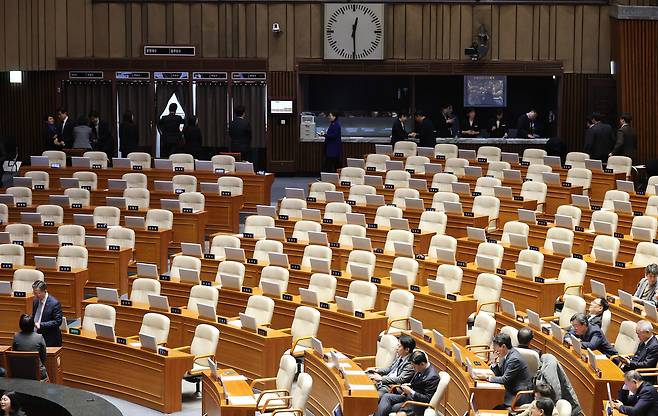
The ruling Democratic Party of Korea on Wednesday unilaterally pushed through another controversial bill, despite criticism that it was rushing potentially unconstitutional legislation without due consultation.
The vote for the bill targeting false and manipulated information came after the end of a filibuster launched Monday by the main opposition People Power Party to block the passage of two bills pushed by the Democratic Party.
The National Assembly passed the bill to revise the Information and Communications Network Act by a vote of 170-3, with four abstentions. Only 177 of the 298 lawmakers participated.
The People Power Party boycotted both this vote and another on Tuesday, for a bill to establish special tribunals to handle insurrection charges linked to ousted President Yoon Suk Yeol's martial law declaration on Dec. 3, 2024.
The bill targeting false and manipulated information aims to clarify the definition of illegal content and the criteria for identifying false or manipulated information, and to prohibit the online distribution of such material.
Under the bill, media outlets and online content creators — including YouTubers — who deliberately spread illegal, false or manipulated information for unjust gain and cause harm to others could be held liable for punitive damages of up to five times the actual damages.
The two bills drew fire from the People Power Party over what it called last-minute, patchwork changes made ahead of the plenary session.
According to the party, such a process undercuts the normal legislative track. A bill is typically finalized in a standing committee and then vetted by the Legislation and Judiciary Committee for legal structure and wording before coming to a floor vote at the Assembly.
The anti-fake information bill, originally planned to be tabled on Monday, was revised at the last minute and introduced to the Assembly floor on Tuesday after the Democratic Party unilaterally changed the legislation amid growing concerns that it could violate constitutional protections for freedom of expression.
“The submission of last-minute, revised versions ahead of the plenary session underscores the lack of proper deliberation on these bills,” People Power Party floor leader Rep. Song Eon-seog said Wednesday, referring to the two measures passed by the ruling party.
“To keep rewriting and revising (a bill) again and again, even as it is being debated on the floor, raises the fundamental question of why the Legislation and Judiciary Committee exists in the first place."
The original draft for the bill, approved by the Science, ICT, Broadcasting and Communications Committee, would have limited civil damages to cases involving “intentional” false information.
But the bill was broadened during review by the Legislation and Judiciary Committee to also cover “false or manipulated information” stemming from simple mistakes, misperceptions or errors.
In its final revision, the Democratic Party restored an intent requirement by adding the phrase “with the intent to cause harm or for the purpose of obtaining unjust gains.”
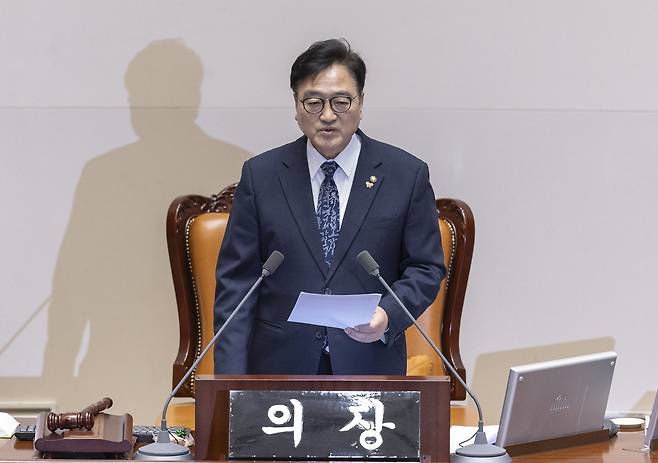
Assembly Speaker Rep. Woo Won-shik, an independent lawmaker, also raised concerns about the practice of repeatedly revising bills just before they are introduced on the Assembly floor.
“It sets a very bad precedent for a bill that has been referred to the plenary after approval by the Legislation and Judiciary Committee to be amended on the floor due to controversy over its (legal) instability," Woo said before adjourning the plenary session on Wednesday.
“It not only runs counter to the purpose of the Legislation and Judiciary Committee, but also undermines public trust in the National Assembly as a legislative institution."
Woo went on to say "As the person representing the National Assembly, I cannot help but voice serious concern and point out this issue, which goes directly to public trust in the Assembly.”
Amid the ongoing filibuster, Woo and the Democratic Party criticized Deputy National Assembly Speaker Rep. Joo Ho-young of the People Power Party for refusing to preside over the proceedings.
Since the 22nd National Assembly opened on May 30, 2024, lawmakers have staged 10 filibusters totaling 535 hours. Woo disclosed that Joo only presided for 33 hours, while Woo and Deputy Speaker Rep. Lee Hack-young of the Democratic Party chaired the remaining 502 hours.
Woo underscored the importance of the filibuster as a procedural tool for narrowing gaps between rival parties, calling on Joo to fulfill his duty.
“If there are differences in views, I believe this is a time when we must carry on — even through unlimited debate — for the sake of the Republic of Korea and the lives of its people,” Woo told lawmakers, referring to South Korea by its official name.
“Unlimited debate is not sustainable when it depends entirely on the speaker and a single deputy speaker.”
Copyright © 코리아헤럴드. 무단전재 및 재배포 금지.