Ruling party passes Dec. 3 tribunal bill, new filibuster begins over ‘fake info’
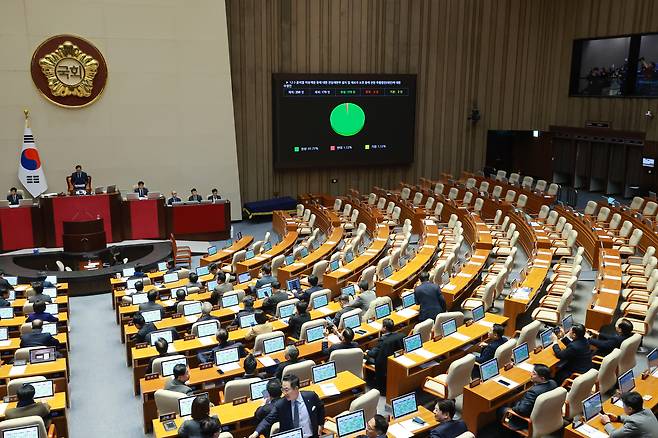
The ruling Democratic Party of Korea on Tuesday unilaterally passed a bill to establish special tribunals for insurrection and treason charges linked to former President Yoon Suk Yeol's martial law declaration, ending a day-long filibuster by the main opposition People Power Party.
It was the second consecutive day of brinkmanship for the National Assembly, with the Democratic Party tabling contentious bills without consulting the opposition, and the People Power Party trying to block them through filibusters.
After 24 hours of debate, the Assembly first approved a motion to end the filibuster that began around 11:38 a.m. Monday, which passed 185-1, with 186 votes cast.
The chamber then moved immediately to pass the special-tribunal bill targeting cases tied to Yoon’s imposition of martial law on Dec. 3, 2024. The bill passed 175–2, with two abstentions and 179 of 298 lawmakers participating, as the People Power Party boycotted the vote.
The revised bill mandates the establishment of at least two specialized tribunals each at the Seoul Central District Court and the Seoul High Court to handle insurrection, treason and rebellion charges tied to the martial law decree.
The bill also leaves the selection of judges largely to the judiciary’s internal procedures, after an earlier version drew criticism for proposing a separate nomination committee that could have involved outside influence, including the justice minister.
Rep. Jang Dong-hyeok, leader of the People Power Party, called on President Lee Jae Myung to veto the bill after concluding a 24-hour filibuster, during which he served as the sole speaker until 11:40 a.m. Tuesday.
“If the president truly has the will to defend the Constitution, he must exercise his veto even if this bill has been passed,” Jang said. “I strongly urge him to do so.”
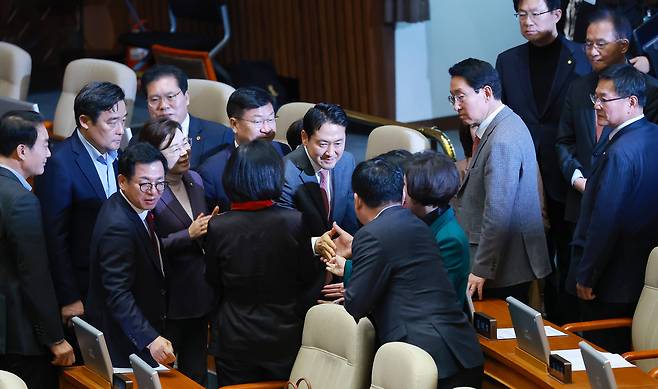
Amid the intensifying standoff between the ruling and opposition parties, Jang — the first leader of a main opposition party in South Korea’s constitutional history to take the floor in a filibuster — also set the longest filibuster record ever in the National Assembly.
However, the Democratic Party dismissed Jang's claims that the special tribunal for insurrection cases would undermine judicial independence as "an amount to a distortion of the facts."
"Rather than weakening judicial independence, it is designed as an institutional safeguard to protect trials from external pressure and political influence," party spokesperson Rep. Moon Dae-lim said in a statement.
After the two votes, the Democratic Party immediately moved on to another contentious measure — dubbed the anti-fake and manipulated information bill — that would revise the Information and Communications Network Act, despite objections from the People Power Party.
The move prompted the People Power Party to launch a new filibuster, and the Democratic Party again immediately filed a motion to terminate the debate after 24 hours — repeating Monday’s cycle.
Rep. Choi Soo-jin of the People Power Party began her speech at around 12:21 p.m. on Tuesday as the first speaker of the filibuster, criticizing the bill as “legislation that seeks to silence the public under the name of law and institutions.”
"What exactly does the Democratic Party mean by 'false information'? Is the concept clearly defined? Is there an objective standard? There is none. The definition is excessively abstract, overly broad and inherently arbitrary," Choi said, warning of excessive penalties. “The bigger problem is that it combines punitive damages and fines."
Rep. Han Jeoung-ae, head of the Democratic Party’s policy committee, explained that “the revised bill clearly defines the conditions under which the distribution of information would be prohibited — limited to cases where there is intent to infringe on others’ rights or the public interest, or to cause harm or seek unjust gain.”
“In doing so, the revised bill eliminates concerns over unconstitutionality.”
The bill seeks to clarify the definition of illegal content and the criteria for identifying false or manipulated information, and to prohibit the online distribution of such material.
Under the bill, media outlets and online content creators — including YouTubers — who deliberately spread illegal, false or manipulated information for unjust gain and cause harm to others could be held liable for punitive damages of up to five times the actual damages.
Floor leader of the People Power Party Rep. Song Eon-seog said the bill amounted to “a declaration of a censorship state.”
“The government seeks to arbitrarily define what constitutes false or manipulated information, censor the media and YouTube, impose punitive damages of up to five times the actual damages, suppress freedom of expression and press freedom, and steer the country toward authoritarianism,” Song told reporters. “This is a law that can never be accepted in South Korea.”
Copyright © 코리아헤럴드. 무단전재 및 재배포 금지.