Cheap child care? Korea’s Filipina caregiver program found it wasn't
전체 맥락을 이해하기 위해서는 본문 보기를 권장합니다.
"Although there will be no further expansion of the foreign nanny project, the Ministry of Employment and Labor will support the stable employment of those already participating," a ministry official said. "The nannies will be eligible to extend their work permits, in line with rules applied to other E-9 visa holders."
"If wages are already lower than what the labor intensity warrants, would foreign workers remain if they were paid even less than Koreans? Such a system would not be sustainable."
이 글자크기로 변경됩니다.
(예시) 가장 빠른 뉴스가 있고 다양한 정보, 쌍방향 소통이 숨쉬는 다음뉴스를 만나보세요. 다음뉴스는 국내외 주요이슈와 실시간 속보, 문화생활 및 다양한 분야의 뉴스를 입체적으로 전달하고 있습니다.
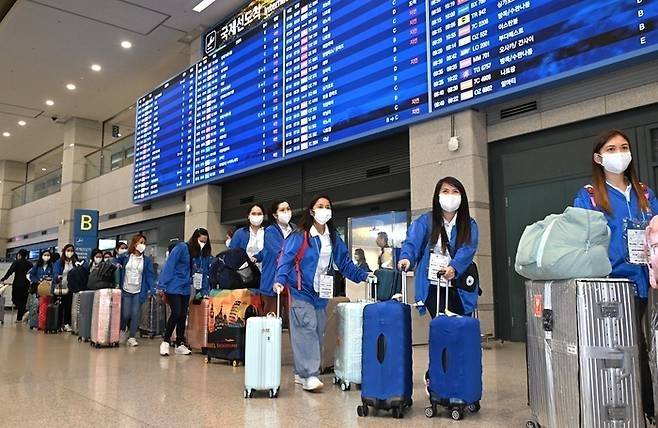
Seoul’s attempt to address the country’s low birth rate through an influx of foreign caregivers is set to wind down, as the Korean government said Monday it would not issue any additional visas tied to the city’s domestic worker program.
The project began in August 2024, when 100 Filipina caregivers entered Korea on E-9 non-professional work visas, aiming to reduce high child care costs, widely cited as a major factor behind Korea’s low birth rate.
Seoul had planned to expand the program to 1,200 caregivers with full implementation from March. The program, however, failed to gain traction. Higher-than-expected wages fueled public doubts about its effectiveness, leaving the project’s future uncertain.
The cost of the child care service has reached levels comparable to those provided by Korean nationals in Seoul, as the city failed to implement a lower wage system. Between September 2024 and February, the hourly rate was set at 13,940 won ($9.40), translating into a monthly cost of about 2.42 million won for a 40-hour workweek.
From March, monthly fees rose by an additional 497,000 won, as the workers became eligible for severance pay under Korea’s Labor Standards Act once their contracts exceeded one year.
The high prices skewed demand toward relatively affluent households, prompting criticism that the policy primarily benefited families already able to afford child care services.
A February survey by the labor ministry showed that 73 percent of subscribers were households with combined monthly incomes exceeding 9 million won. Residents of higher-income districts, including Gangnam-gu, Seocho-gu and Songpa-gu, accounted for 40 percent of users.
“Although there will be no further expansion of the foreign nanny project, the Ministry of Employment and Labor will support the stable employment of those already participating,” a ministry official said. “The nannies will be eligible to extend their work permits, in line with rules applied to other E-9 visa holders.”
Of the 100 Filipina caregivers who entered Korea, 17 have returned home, and one reportedly changed jobs to work as a hotel cleaner. Under the E-9 visa for service sector workers, job changes are permitted up to three times within the sector. The remaining 82, currently employed as household child care workers in Seoul, will be allowed to continue in service jobs nationwide for up to 58 months.
Seoul Mayor Oh Se-hoon repeatedly suggested exempting the foreign domestic workers from parts of Korea’s labor standards, including the minimum wage. He cited examples from Hong Kong and Singapore, where foreign domestic helpers are employed at lower monthly costs.
The Labor Ministry and labor rights groups, however, strongly opposed the idea, arguing that Korea, as a member of the International Labor Organization, is obliged to apply labor laws equally to Korean and foreign workers.
In June, Oh acknowledged that the initial concept behind the project had limitations. “The idea of introducing very low-cost foreign labor is, in reality, difficult to justify when considering Korea’s international standing and labor environment,” he said during a city council meeting.
Experts say Korea’s high child care costs stem from deeper structural problems and cannot be resolved simply by introducing cheaper labor.
“The sector has long been characterized by entrenched low wages, rooted in the perception that child care is low-skilled work that anyone can do,” said Cho Hyuk-jin, a research fellow at the Korea Labor Institute.
“If wages are already lower than what the labor intensity warrants, would foreign workers remain if they were paid even less than Koreans? Such a system would not be sustainable.”
Activists for child care workers’ rights also said the approach was short-sighted, arguing that the attempt sidestepped the more fundamental task of expanding high-quality public child care.
“The government should move toward policies that both elevate the value of care work and ease the burden of child care,” said an official from the Federation of Korean Trade Unions.
Copyright © 코리아헤럴드. 무단전재 및 재배포 금지.