Korea-India partnership not desirable but essential: foreign minister
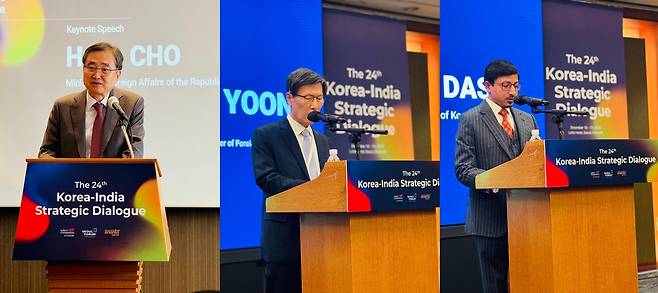
South Korean Foreign Minister Cho Hyun said India was an indispensable global partner in era of turbulence and strategic competition at the 24th Korea-India Strategic Dialogue held Dec. 18-19.
Delivering a keynote speech at the annual gathering, Cho highlighted India’s rising strategic value due to its agenda-setting influence on regional stability and global supply chains.
“Cooperation between Korea and India is not simply desirable — it is essential,” Cho stressed.
“President Lee Jae Myung will, in fact, visit India sometime next year,” he added.
Lee and Indian Prime Minister Narendra Modi have met twice within six months, first on the sidelines of the G7 Summit in Canada and later in November at the G20 Summit in Johannesburg.
Cho cited complementary strengths in manufacturing and technology, India’s growing market, and shared democratic values alongside deepening people-to-people and cultural exchanges.
“Imagine how wonderful it would be if Bollywood met K-pop,” said Cho, who served as the Korean Ambassador to India from 2015 to 2017.
The minister underscored growing Korea-India defense cooperation, noting the K9 Vajra program and first-ever bilateral naval exercise, and reaffirmed Korea’s commitment to peace and denuclearization on the Korean Peninsula with India’s support.
“Korea is committed to contributing not only to Make in India but also to Viksit Bharat 2047,” the minister added.
Diplomats, experts and industry stakeholders from the two countries recommended diversification and expansion of cooperation in AI, technology and culture during the two-day dialogue.
Held each year since 1996, the dialogue has served as a forum for Korea-India strategic engagement across politics, diplomacy, security, economy and people-to-people connections.
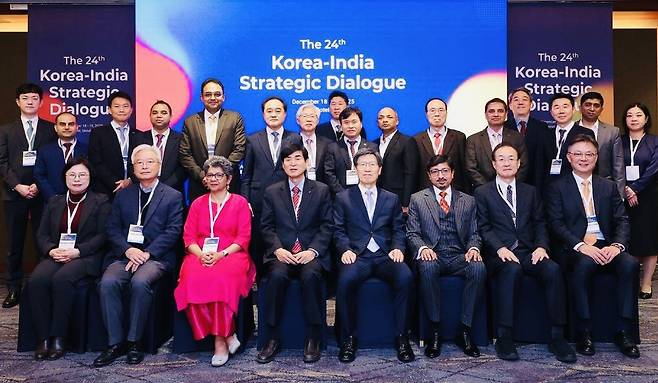
Organizers told The Korea Herald that the forum strengthens South Korean ties with India, helping Seoul diversify its regional diplomacy and engage with the Global South.
Outlining strategies in his remarks, Indian Ambassador to Korea Gourangalal Das highlighted diversification as essential to resilience, shared prosperity, democratic technology, and human unity.
“Countries like India and Korea … need to think together and come up with their own strategies for not only survival in a very uncertain world but also thriving together,” he said,.
C. Rajamohan, a fellow at the Council on Strategic and Defense Research in New Delhi, warned that growing US unpredictability and pressure on allies mean middle powers like Korea and India must build greater strategic autonomy and strengthen bilateral cooperation.
"Today Korea might be called a model ally, but next time they might say something else,” he said.
There were notes of strategic caution in the dialogue, which touched on ethical, societal and democratic dimensions of the evolving partnership between the two countries.
Indrani Bagchi, CEO of the Ananta Centre, a non-partisan think tank based in New Delhi, said India, Korea, and other middle powers can find "a greater common space … in terms of our strategic outlook."
She stressed that technology must align with foreign policy and called for "minilaterals or, frankly, greater bilateral coverage" to strengthen cooperation.
Yoon Young-kwan, chairman of the Asan Institute for Policy Studies, warned that a second Trump administration could reshape the Asia-Pacific order, with major implications for Korea and India.
The former Korean foreign minister also stressed that "Korea can no longer rely unconditionally on US security (guarantees" and "must strengthen itself while deepening cooperation with like-minded, democratic partners.”
Meanwhile, Song Kyung-jin, a fellow at the Asiatic Research Institute at Korea University who moderated sessions of the dialogue, urged India and Korea to jointly develop technologies for critical materials, artificial intelligence and emerging sectors.
Experts underscored shipbuilding, digital technology and finance as key pillars of Korea–India cooperation, calling for Korea to partner with India’s naval ambitions and for both countries to combine AI talent and semiconductor strengths to emerge as a “third force” in the global digital order.
However, they underlined that the vision needed solid financial backing, improved tax treaties, regulatory alignments, joint investment vehicles and mechanisms to manage currency risks and boost investor confidence.
The dialogue covered practical policy recommendations on economic resilience, technological sovereignty and cultural diplomacy, with outcomes to be shared with both governments through a joint statement.
Copyright © 코리아헤럴드. 무단전재 및 재배포 금지.