JCS confirms 'farther south' MDL rule
전체 맥락을 이해하기 위해서는 본문 보기를 권장합니다.
"Our military has prioritized MDL markers identified on the ground since last year," Lee said. "In areas where markers are not clearly identifiable, we are taking action based on a comprehensive judgment that considers both the MDL on military maps and the line connecting UNC MDL marker coordinates."
Lee added that the guideline was introduced "to ensure decisive responses by frontline units while preventing accidental clashes between the two Koreas in the event of armistice violations by North Korean forces inside the DMZ."
이 글자크기로 변경됩니다.
(예시) 가장 빠른 뉴스가 있고 다양한 정보, 쌍방향 소통이 숨쉬는 다음뉴스를 만나보세요. 다음뉴스는 국내외 주요이슈와 실시간 속보, 문화생활 및 다양한 분야의 뉴스를 입체적으로 전달하고 있습니다.
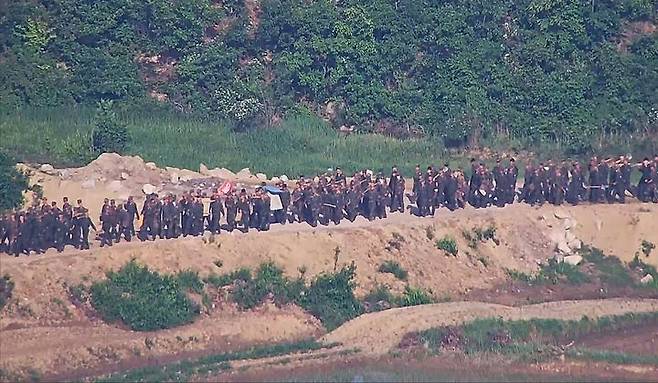
South Korea’s Joint Chiefs of Staff confirmed Monday that frontline units received a revised internal guideline on how to determine Military Demarcation Line violations, amid a recent rise in North Korean troop incursions inside the Demilitarized Zone.
The guideline circulated in September allows the military to apply a line drawn farther south in cases where South Korean military maps and United Nations Command standards do not align.
At a regular Defense Ministry briefing, JCS spokesperson Col. Lee Sung-jun said the measure has been in effect since last year.
“Our military has prioritized MDL markers identified on the ground since last year,” Lee said. “In areas where markers are not clearly identifiable, we are taking action based on a comprehensive judgment that considers both the MDL on military maps and the line connecting UNC MDL marker coordinates.”
Under the guidance, when the two standards diverge, frontline units may effectively apply the line drawn farther south in determining a violation.
However, the updated instructions tell units to prioritize on-site MDL markers when they are clearly identifiable.
Lee added that the guideline was introduced “to ensure decisive responses by frontline units while preventing accidental clashes between the two Koreas in the event of armistice violations by North Korean forces inside the DMZ.”
The JCS belatedly confirmed the revised guideline after Chosun Ilbo reported it, as a long-standing mismatch between South Korean military maps and the UNC’s MDL standard came into sharper focus.
A military official, requesting anonymity, provided background on why the two standards have diverged during a closed-door briefing later in the day.
The South Korean military’s map was initially aligned with actual terrain based on data produced by the US National Geospatial-Intelligence Agency in 2004, and was updated once around 2014 and 2015.
The MDL reference line used by the UNC, meanwhile, was created around 2016, with differences emerging in the interim due to advances in scientific and surveying technologies.
As a result, points where the two MDL standards do not align now outnumber those where they do, with discrepancies estimated at around 60 percent, the official explained. The Defense Ministry said it plans to consult with the UNC next year to address these mismatches.
The official said the issue has been brought to light by North Korea’s intensifying efforts since last year to physically transform the inter-Korean boundary. After North Korean leader Kim Jong-un declared in December 2023 that the two Koreas were in a hostile “two-state” relationship, North Korean forces began sustained work from April last year in areas near the MDL, including land clearing, construction of tactical roads, and the installation of barbed-wire fences and land-mine obstacles.
As a result of these activities, tactical road fencing has increased by about 10 kilometers compared with the previous year, reaching an estimated total of 50 to 60 kilometers, while parts of new minefields are believed to have been established, according to the official.
During these activities, North Korean troops have crossed the MDL 16 times since March, with 10 cases reported in November alone, according to South Korean officials.
In response to the increase, Seoul’s Defense Ministry last month proposed holding military talks with Pyongyang to discuss ways to clarify the MDL and reduce the risk of accidental clashes. North Korea has yet to respond to the proposal.
The military's revised guideline has sparked criticism from the main opposition People Power Party, which denounced the revised MDL guideline on Monday, calling it an act of “self-sabotage of national security” by the Lee Jae Myung administration.
In a statement, senior party spokesperson Rep. Park Sung-hoon said the revised guidelines amounted to “ceding territory” and could create confusion and security gaps along the front line.
Park also claimed that MDL crossings by North Korean troops increased following the September circulation of the guideline, arguing that the policy sends “the wrong signal” to Pyongyang.
People Power Party Rep. Na Kyung-won echoed the criticism in a Facebook post, questioning the logic of defaulting southward in cases of ambiguity and accusing the government of making the change without public disclosure or parliamentary consent.
Na urged the administration to withdraw the guideline, warning it would weaken deterrence on the Korean Peninsula.
United States Forces Korea Commander Xavier Brunson, who also heads the UNC, recently cautioned against politicizing the DMZ.
Speaking on a security-focused podcast on Friday, Brunson said the armistice agreement must remain the governing framework for all activities in the buffer zone, emphasizing that changes to access or operational rules should not undermine the legal authority of the armistice.
Brunson noted South Korea’s proposal for military talks on MDL clarification but stressed that all actions must adhere strictly to armistice provisions.
The MDL was established under the 1953 armistice agreement that halted the Korean War, with 1,292 boundary markers originally installed along the line. Due to decades of weathering and erosion, only about 200 markers are believed to remain identifiable today.
Copyright © 코리아헤럴드. 무단전재 및 재배포 금지.