Wi meets US energy chief amid talks on nuclear-powered submarines
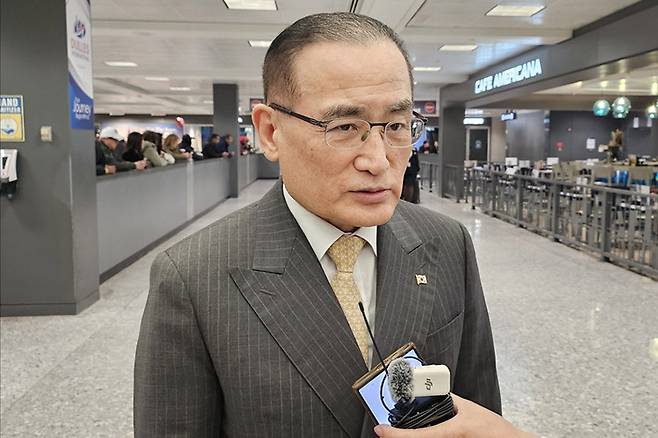
South Korean director of national security Wi Sung-lac met US Energy Secretary Chris Wright on Wednesday amid ongoing discussions between Seoul and Washington over plans for South Korea to build nuclear-powered submarines using fuel supplied by the United States.
Sources familiar with the issue said that Wi’s meeting with Wright — whose role involves civilian nuclear energy policy — may have involved preliminary discussions on the next steps regarding civilian uranium enrichment and the reprocessing of spent nuclear fuel. Both were referenced in the fact sheet from October's South Korea-US summit.
On the same day, Jacob Helberg, US undersecretary of state for economic growth, energy and the environment, told reporters that multiple US officials are in contact with their South Korean counterparts, and energy issues are among the topics being discussed.
Earlier, South Korean First Vice Foreign Minister Park Yoon-joo also met US Under Secretary of State for Political Affairs Alison Hooker in Washington, where the two sides agreed to move quickly to launch a working-level consultative body to implement the summit agreements.
To advance the submarine plan, the two sides may need to navigate existing constraints under the bilateral nuclear cooperation agreement, which could limit Seoul’s development of nuclear-powered submarines.
First signed in 1956 and entering into force in 1957, the South Korea–US nuclear cooperation agreement places strict controls on Seoul’s enrichment of uranium and reprocessing of spent nuclear fuel, requiring US consent. While the agreement was revised in 2015 to allow limited activities under conditional frameworks, its core restrictions remain in place.
Wi previously stressed the need to explore legal pathways to work around the agreement, citing Australia as a precedent.
Australia was able to pursue the development of nuclear-powered submarines through an agreement with Washington. Under Section 91 of the US Atomic Energy Act, the US president is authorized to approve the transfer of nuclear materials for military use.
Arriving at Dulles International Airport on Tuesday, Wi said he would discuss “the possibility” of an arrangement with Washington that could address fuel reprocessing–related issues tied to South Korea’s nuclear-powered submarine program, citing the Australian case.
Wi is expected to return to Seoul after a stop in New York on Thursday, where he would likely visit the United Nations headquarters.
Ahead of his trip, Wi also said he would first consult with US officials on the prospects for dialogue involving North Korea and inter-Korean relations, adding that he also plans to discuss the matter at the UN.
During a bilateral summit held Oct. 30 between President Lee Jae Myung and US President Donald Trump, the two leaders agreed to allow South Korea to pursue the construction of nuclear-powered submarines.
Since then, the allies have held follow-up discussions on the issue, culminating in the release of a joint fact sheet on Nov. 14 that confirmed Washington’s “approval for Seoul to build nuclear-powered attack submarines.”
Copyright © 코리아헤럴드. 무단전재 및 재배포 금지.