President calls for tougher penalties for technology theft
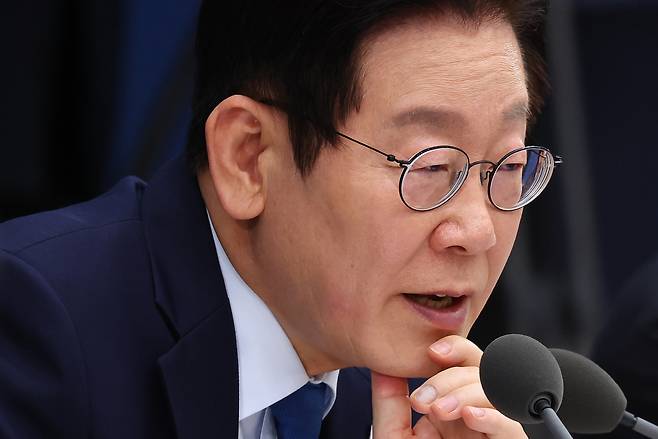
President Lee Jae Myung on Wednesday called for stricter civil penalties for technology theft, saying tougher sanctions are needed to dissuade companies from engaging in unfair practices.
During a livestreamed policy briefing to the president by the Ministry of SMEs and Startups, Lee asked the government to review his proposal to impose fines equivalent to a certain percentage of a perpetrator’s earnings from stealing technology from small and medium-sized enterprises, which often struggle to respond to threats involving leaks of core technologies.
“If I were to end up paying 2 billion won ($1.35 million) in penalty surcharges after earning 100 billion won from technology theft, I would probably just steal it,” Lee said, as he was briefed on the ministry’s 2026 policy goals by SMEs Minister Han Seong-sook, in Sejong.
Lee’s remarks referred to the SME Ministry’s announcement in September that the maximum penalty surcharge for a company that steals technologies from its subcontractor would be capped at 2 billion won per violation. At the time, the ministry also unveiled plans to raise the maximum fine for critical technology leaks to foreign countries from 1.5 billion won to 6.5 billion won.
An estimated 300 cases of technology theft have been reported annually, with average damages from antitrust violations estimated at 1.8 billion won, according to the government. Moreover, victims were awarded an average of 140 million won, which is less than 20 percent of the damage filed against those who stole the technology. The victims often found themselves wrestling to secure proof of who was responsible for each technology theft as it happened.
“Criminal punishment isn’t really effective,” Lee said. “Even if offenders are punished, they often receive suspended sentences, which hardly serve as a deterrent.”
Lee made the remarks as he emphasized that addressing economic polarization between conglomerates and small vendors is essential to improving South Korea’s competitive edge.
Highlighting entrenched power imbalances in South Korea’s industrial structure, which relies heavily on large business groups, Lee said small vendors have long been left vulnerable and that the time has come for stronger state protection.
One way to empower small vendors, he said, is to lift regulations that prohibit their representatives from unionizing against large business groups.
“The government should work to allow small and medium-sized enterprises, franchisees and vendors to form alliances and engage in solidarity actions,” Lee said, calling for a fundamental shift in policies that have effectively banned collective action by company owners.
Unionization of small store owners, according to Lee, is effectively considered a violation of antitrust rules.
The ruling party-controlled National Assembly passed a revision the previous week to the Fair Transactions in Franchise Business Act to grant franchisees the collective bargaining right to deal with franchisors. It will take 12 more months to come into effect after its promulgation.
“Maintaining balance is a crucial task, as it empowers small enterprises that have long been subjugated by large business entities or multinational corporations,” Lee said. He added that such a power balance between unionized workers and their management has allowed fair market conditions and capitalism to function properly.
Lee argued that practices by large companies that squeeze contractors’ profits, leaving them with only minimal margins for survival, have undermined the nation’s competitive edge.
“Since small vendors are being squeezed, they cannot attract talented individuals, making growth and development difficult,” Lee said.
On Tuesday, Lee called for shared economic growth among all stakeholders as a way to address inequality across political, social and economic sectors.
Lee’s livestreamed policy briefings with government bodies entered their fourth day Wednesday.
Copyright © 코리아헤럴드. 무단전재 및 재배포 금지.