Korea, UK seal upgraded free trade deal easing auto export rules
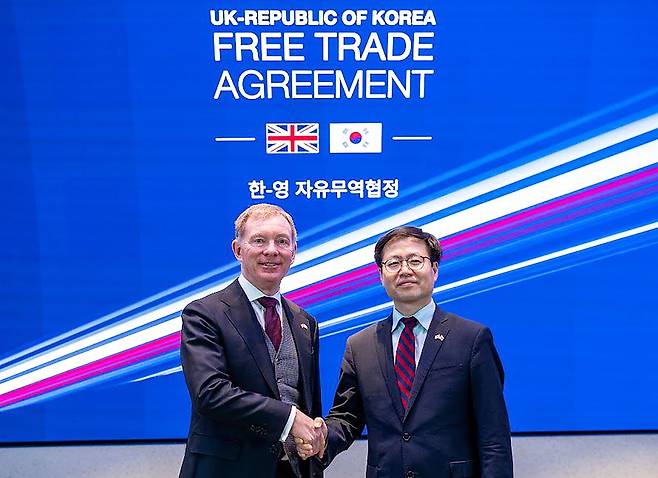
South Korea and the United Kingdom have concluded negotiations on an upgraded free trade agreement, easing rules of origin for Korean automobiles and consumer goods exports to the UK, while expanding market access for Korean firms in Britain’s high-speed rail and services sectors.
Korea’s Ministry of Trade, Industry and Resources said Tuesday that Minister Yeo Han-koo and his UK counterpart, Chris Bryant, met in London a day earlier and jointly signed the deal, concluding two years of negotiations.
The agreement builds on the bilateral free trade pact in effect since 2021, following Britain’s exit from the bloc, largely modeled on the European Union-South Korea free trade agreement signed in 2011. Since then, the two sides have held six rounds of negotiations and five ministerial meetings to upgrade the deal.
The most significant change is a lower threshold for Korean automobiles, which account for about 36 percent of Korea’s shipments to the UK. Under the previous rules, vehicles qualified for exemption from the 10 percent tariff only if at least 55 percent of their value was created in Korea. The upgraded agreement lowers that requirement to 25 percent.
The revision is particularly significant as Korean automakers ramp up production of electric vehicles, where value calculations can fluctuate sharply depending on the prices of imported raw materials such as lithium and graphite used in battery manufacturing.
Consumer goods are also set to benefit from eased rules of origin. Tariffs of up to 8 percent on beauty and other chemical products will be waived if key processing steps, including chemical reactions, refining and mixing, are carried out in Korea. Processed foods such as gimbap and kimchi will also qualify for tariff-free treatment even when key ingredients are sourced from third countries and imported for final production in Korea.
Beauty and food have emerged as fast-growing export categories. Korean cosmetics exports to the UK surged nearly 240 percent between 2019 and 2024, according to the ministry, while the number of Korean restaurants listed on the UK food-delivery platform Just Eat rose 76 percent on-year in 2024.
The agreement also expands access for Korean firms to the UK’s high-speed rail procurement market, addressing what Seoul described as a long-standing imbalance in market openness. In services, Britain agreed to further open sectors such as online gaming, where Korean firms have a strong global presence, and to provide greater legal certainty for new services based on emerging technologies including artificial intelligence.
The two sides also agreed to streamline visa procedures to facilitate the entry of Korean engineers and specialized workers involved in building manufacturing facilities in the UK, the ministry said.
In addition, the agreement updates the digital trade framework, covering cross-border data transfers and online consumer protection, while promoting joint development and investment in AI.
Amid ongoing shifts in global supply chains, the two countries agreed to institutionalize supply chain cooperation by establishing a dedicated chapter in the agreement. In the event of supply disruptions, they will operate a designated hotline and convene an emergency meeting within 10 days to coordinate a joint response.
The two sides also agreed to establish a Korea-UK Innovation Committee to hold regular discussions on cooperation in advanced technology fields such as artificial intelligence, autonomous vehicles and biotechnology.
“We expect the upgraded agreement to reinforce the free trade order amid growing global uncertainty driven by rising protectionism, while strengthening ties with a key trade partner in Europe,” Yeo said.
Copyright © 코리아헤럴드. 무단전재 및 재배포 금지.