It's okay to 'speak like a river'
전체 맥락을 이해하기 위해서는 본문 보기를 권장합니다.
"There is a child who read 'I Talk Like a River,'" Kim said, turning toward the book's author, Canadian poet and children's book writer Jordan Scott. "He spoke very little for a long time, and his parents were worried. Eventually, they realized that he stutters."
Well-meaning adults urged intervention, suggesting therapy and correction. But the parents noticed something else first. The boy loved books. When he encountered "I Talk Like a River," he told them, "I talk like a river, too."
이 글자크기로 변경됩니다.
(예시) 가장 빠른 뉴스가 있고 다양한 정보, 쌍방향 소통이 숨쉬는 다음뉴스를 만나보세요. 다음뉴스는 국내외 주요이슈와 실시간 속보, 문화생활 및 다양한 분야의 뉴스를 입체적으로 전달하고 있습니다.
BUSAN — At a book talk held Saturday during the Busan International Children’s Book Fair, children’s literature critic and translator Kim Ji-eun told a story that drew a warm round of applause, reminding the audience how a single picture book can reach a child who has not yet found his voice.
“There is a child who read ‘I Talk Like a River,’” Kim said, turning toward the book's author, Canadian poet and children’s book writer Jordan Scott. “He spoke very little for a long time, and his parents were worried. Eventually, they realized that he stutters.”
Well-meaning adults urged intervention, suggesting therapy and correction. But the parents noticed something else first. The boy loved books. When he encountered “I Talk Like a River,” he told them, “I talk like a river, too.”
Kim relayed the story to Scott the day before, and Scott responded by writing a letter just for the boy, closing with the line, “From your fellow member of the club who talks like a river.”
“For me, growing up, there were no books that portrayed stuttering in a positive way,” Scott said. “It’s important for children to be able to see themselves in literature.”
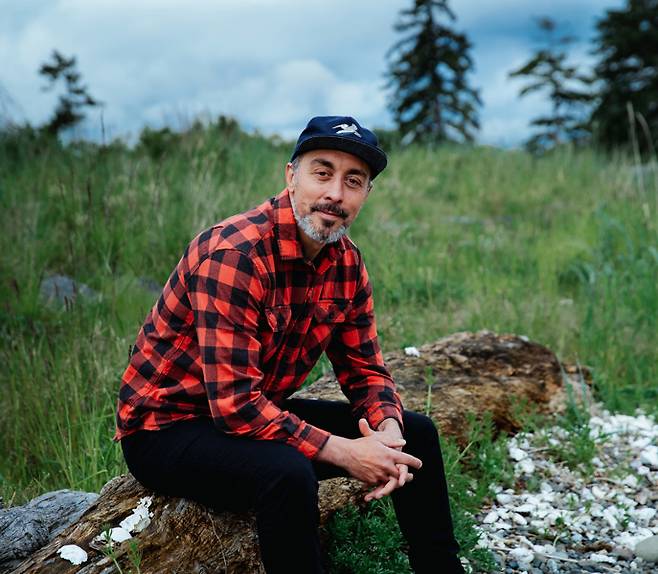
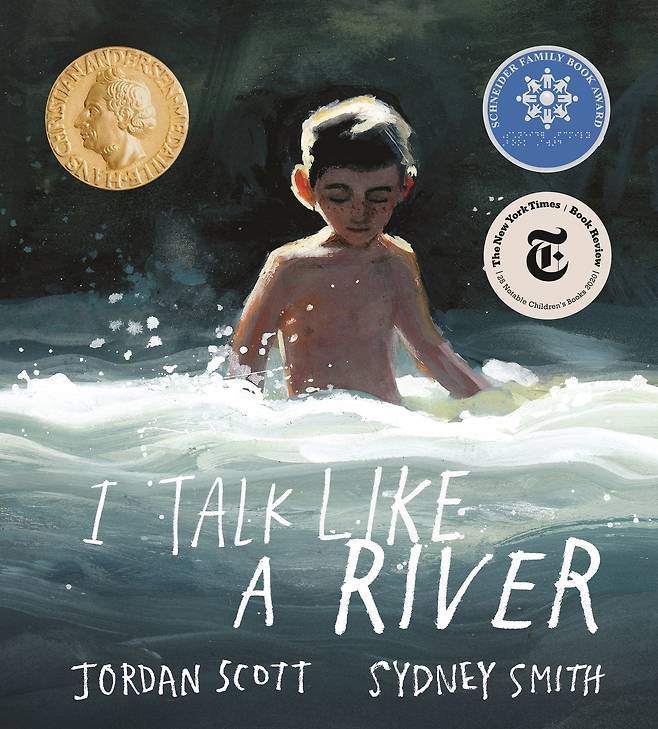
Scott was in Busan for the second edition of the BICBF, held from Dec. 11-14 under the theme “The Young Ones and the Sea.” Known for drawing deeply from autobiographical memory and the natural world, Scott was visiting Korea for the fourth time, though it was his first visit to the country's second-largest city. On Friday, he led a workshop on his creative process and on Saturday took part in a dialogue with Kim, who translated two of his award-winning books into Korean: “I Talk Like a River” (2021) and “My Baba’s Garden” (2023).
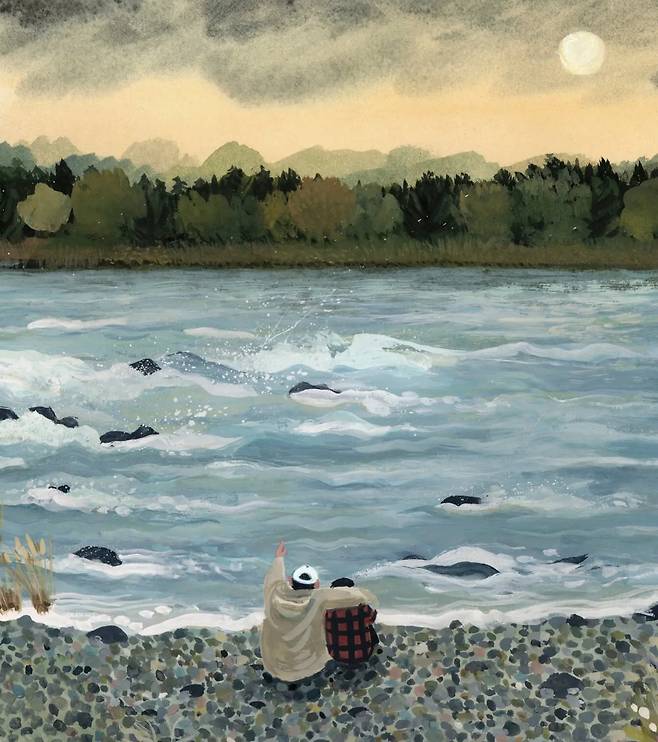
In “I Talk Like a River,” the protagonist, like Scott himself, is a child who stutters. Overwhelmed after a difficult day at school, the boy feels isolated, alone and incapable of communicating in the way he wishes. His compassionate father takes him for a walk by the river, helping him reconnect with the world around him. "My dad sees I am sad and pulls me close," the boy narrates. "He points me to the river and says: See how that water moves? That’s how you speak.”
Scott has said the scene mirrors his own childhood. “We lived pretty high up on a mountain,” he recalled. “Behind our house, there was a steep ravine, and there was a river that ran down the mountain and connected to a much larger river that flowed out to the sea.”
As a boy, Scott would sneak out, climb down the ravine, and walk along or swim in the water in silence. “It was so beautiful and so quiet. I didn’t talk. I didn’t have to worry about speech or stuttering.”
The small river eventually met a larger one, carrying him onward.
“I remember feeling a sense of freedom, but also of belonging to something greater than myself. There are currents in the rivers and the ocean, and I like the feeling of just letting go. Sometimes I don’t try to swim against them; I allow myself to be carried wherever they lead.”
Nature remains central to Scott’s writing and life. He lives on Vancouver Island, where forests, mountains and ocean dominate the landscape, and says nearly all of his creative inspiration comes from being outdoors.
“The beach is very close to my house,” he said. “I try to swim in the ocean every day, even in winter. It’s a ritual for me. It feels like a cleansing, physically and spiritually.”
When he’s in nature, Scott said, he returns to a childlike state: touching bark, smelling trees, getting dirty. “It’s not really a secret,” he said of his creative process. “It’s about giving yourself over to nature. We’re collaborating.”
That collaboration will soon take literary form again. Scott is writing a new book, “Whale Heart," about a boy and his grandfather who collect objects washed ashore until one day they encounter something extraordinary: the heart of a whale.
Copyright © 코리아헤럴드. 무단전재 및 재배포 금지.